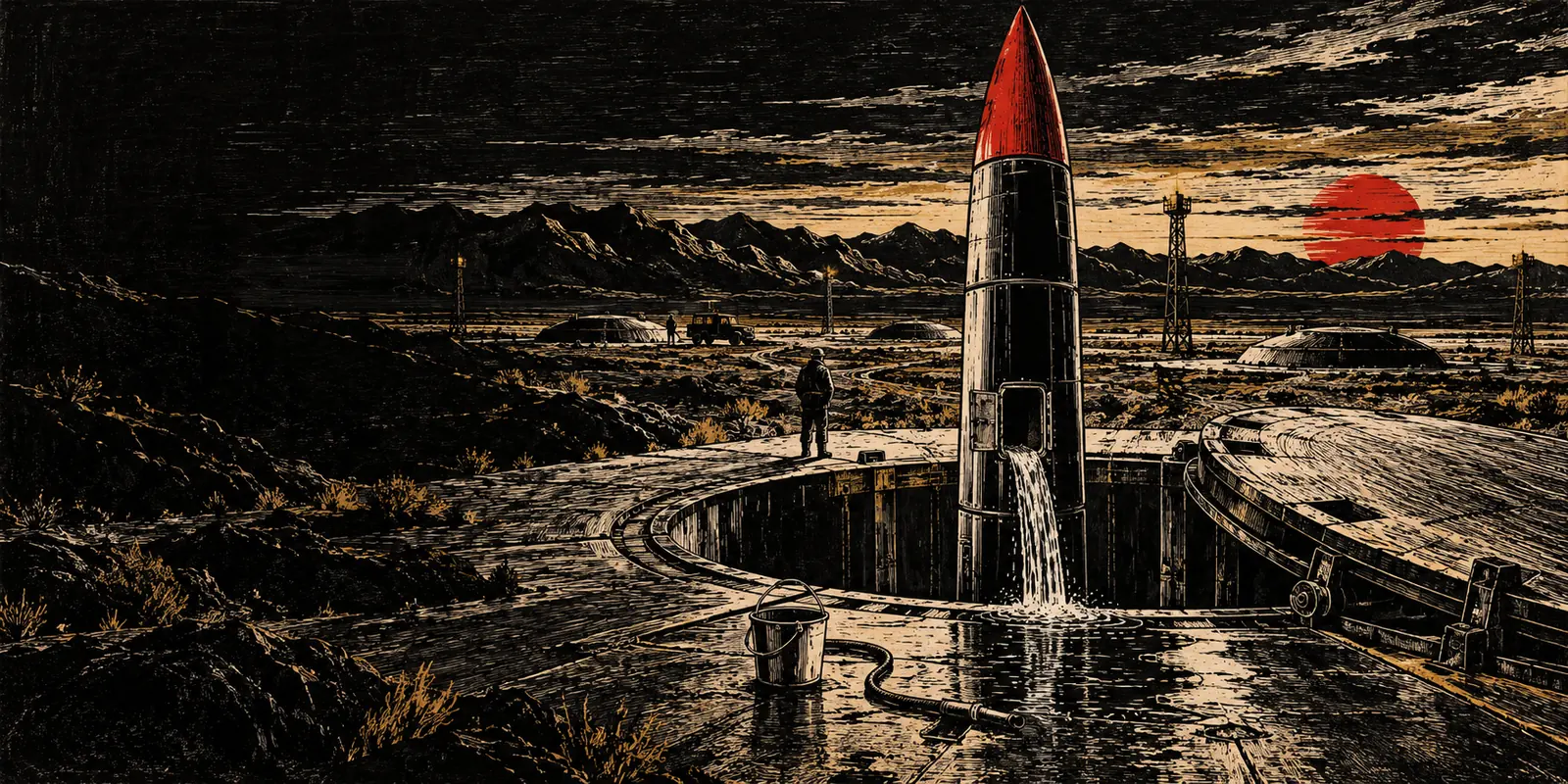
In the summer of 2023 the People's Liberation Army Rocket Force lost its leadership. Commander Li Yuchao was removed, and so were his deputies Zhang Zhenzhong and Liu Guangbin. No detailed explanation came with the announcements. No successors were named at once. The service that holds China's nuclear arsenal, about 600 warheads, and the DF-26 missiles that Chinese media had nicknamed the Guam Killer, and the intercontinental ballistic missiles sitting in new silo fields in western China, was running without confirmed senior commanders. An intercontinental ballistic missile is a rocket built to throw a warhead from one continent to another. A silo is the underground tube it launches from.
The removals did not stop. By December 2023, nine more senior military officials were under investigation. In June 2024 the Politburo announced the expulsion of two defense ministers in a row, Li Shangfu and Wei Fenghe. The charges included enormous bribes and abuse of authority. Official commentary went further. It said their faith had collapsed and loyalty had shifted. In October 2025 the purge reached the top of the command. He Weidong, a vice chairman of the Central Military Commission and one of the most senior officers in uniform, was expelled from the Communist Party, and so was Miao Hua, head of the Political Work Department. In January 2026 authorities announced an investigation of Zhang Youxia, the other vice chairman, China's highest-ranking active-duty general, a man long regarded as one of Xi Jinping's most trusted military advisors. By February 2026 the seven-member Central Military Commission had two publicly confirmed members left: Xi Jinping and Zhang Shengmin, the anti-corruption chief.
Intelligence reports out of Washington made the hardware look as damaged as the roster. U.S. assessments reported by Bloomberg in January 2024 said corruption inside the Rocket Force had compromised warheads in concrete ways. Missile silo lids in western China had been built wrong. They would not open properly for a launch. Some liquid-fueled missiles in the silos that were supposed to be the expanding deterrent allegedly held water instead of fuel. A former PLA Navy lieutenant colonel who had defected to the United States corroborated pieces of that picture. He claimed that, during his service, personnel routinely drained aircraft fuel for cooking and burned solid missile propellant taken out of rockets to cook meals. The chapter records that claim as his claim.
The same chapter sets that allegation beside a force that had just built the world's largest navy, stunned American intelligence with a hypersonic test that circled the globe, and was on a path to triple its nuclear arsenal within a decade. Both halves are in the file. The water is not treated as settled fact. The buildup is.
To see what "hollow" would mean, the chapter first counts what was built.
In the mid-1990s, during the Taiwan Strait crisis, credible assessments said the PLA was unprepared for a long fight beyond its immediate coast, outmatched by Taiwan's technology, and unable to stop the United States when Washington sent two carrier battle groups. The nuclear stockpile then was roughly 20 warheads. The navy was a coastal defense force. The air force flew aging Soviet-era planes.
Three decades later the counts are different. By 2025 the warhead stockpile was about 600. Pentagon projections in the chapter forecast 1,000 by 2030 and 1,500 by 2035. The PLA Navy grew from roughly 70 major surface combatants in 2000 to 340 by 2025, plus 85 missile-armed patrol combatants, the world's largest navy by number of hulls. Three aircraft carriers were in the fleet. The newest, the Fujian, was commissioned in November 2025 with electromagnetic catapults, a launch system that increased what its air wing could do compared with the ski-jump ramps on the earlier ships. The Department of Defense assessed that China plans six more carriers between 2025 and 2035, nine in all.
The air force fielded the J-20 stealth fighter. A twin-seat version announced in 2024 was described as able to team with unmanned aircraft and to handle long-range command. Production of the J-10 and J-16 doubled over the three years before, and by 2025 those three types were the core fighter fleet. The Type 055 destroyer, the most advanced surface ship China had built, entered service with several hulls under construction at once in different yards.
The budget that paid for this is only partly visible. The announced 2025 defense budget was 1.78 trillion yuan, about 246.5 billion dollars. SIPRI, the Stockholm institute that tracks arms spending, estimated actual 2024 spending at 318 billion dollars. M. Taylor Fravel, George Gilboy, and Eric Heginbotham, adjusting for purchasing power parity, the method that asks what the same money buys inside a country rather than at the exchange rate, put the figure near 471 billion dollars, roughly double the official announcement.
Rush Doshi's book The Long Game is the chapter's map of why the spending looks like a plan rather than a pile. From Party documents and strategic statements, Doshi argues China has followed a three-phase strategy to displace American dominance in the region. The first phase, set off by the humiliation of 1996 in the Taiwan Strait, was blunting: do not match the U.S. Navy everywhere, deny it the Western Pacific. The tools were the world's largest store of naval mines, anti-ship ballistic missiles, and a growing submarine fleet. Anti-access and area denial, the jargon for that idea, means weapons meant to keep an outside fleet from getting close and staying. The second phase, sped up after the 2008 financial crisis, when Chinese leaders saw the United States as distracted and weak, was building: carriers, a modern air force, and projects such as the Belt and Road. The third phase, from around 2016, took both blunting and building toward a wider world.
Late in 2015 Xi announced the reorganization that sits under that hardware. Seven military regions became five theater commands, each pointed at a map problem. The Eastern Theater Command was focused on Taiwan, the Southern on the South China Sea, the Western on the disputed border with India. The Rocket Force was lifted out of a branch called the Second Artillery and made a full service, peer to the navy and the air force. A Strategic Support Force was created to pull together space, cyber, and electronic warfare that had been scattered across commands. About 300,000 people were cut, the largest reduction since the 1980s, almost all of them from the ground forces, so money and billets could move to the navy, the air force, and the Rocket Force.
Doctrine moved with the org chart. In 2004 the guideline changed from winning local wars under modern, especially high-technology conditions, to winning local wars under conditions of informationization. The money went to linked command, control, and communications, and to what Chinese strategists called system-of-systems integration across air, land, sea, space, and cyber. In April 2024 the Strategic Support Force itself was dissolved and replaced by three bodies: the Information Support Force, the Network Space Force, and the Military Aerospace Support Force. The doctrine name for the next step is intelligentized warfare.
In October 2020 Xi introduced the 2027 Goal: specified modernization milestones by the hundredth anniversary of the PLA's founding. Older plans had pointed at 2035 for full modernization and 2049 for a world-class military. The Pentagon assessed in 2023 that Xi had ordered the military to be capable of seizing Taiwan by force by 2027. The chapter says it is genuinely debated whether that reading matches Chinese intent or overreads an internal milestone. The operational tempo is not debated in the same way. From January 2022 to April 2024, PLA aircraft crossed into Taiwan's air defense identification zone, the buffer of sky a country asks aircraft to identify themselves in, at an average of 156 sorties a month. After President William Lai's inauguration in May 2024, the monthly count rose to 319, a 129 percent increase. Through 2025 the PLA kept a record pace around Taiwan, with two major named exercises and coast guard ships out at a frequency the chapter calls unprecedented.
The corruption the purge exposed was older than the summer of 2023. It grew, the chapter says, from decades of commercialized military business and a procurement system in which bribes, kickbacks, and diverted supplies were structural. Officers had long run quasi-commercial enterprises, skimmed equipment budgets, and bought promotions. A 2025 report from the Institute for Security and Development Policy said corruption had degraded the PLA's credibility, readiness, and the prospects of long-term modernization, and that the abuses continued through a decade of Xi's anti-graft campaign.
The Rocket Force was a rich target because the contracts and the promotions were worth so much. If a nuclear-command promotion could be bought, if missile-part contracts went to connected firms, if propellant and maintenance money was diverted, the deterrent's integrity was in question. The chapter calls this the system working as it had learned to work, not a one-season scandal.
The money trail is specific. Revenue at China's top eight defense companies fell 10 percent, to 88.3 billion dollars, in 2024. SIPRI called it the sharpest decline of any country and the first contraction in decades. NORINCO, the largest land-systems maker, reported a 31 percent revenue drop after its chairman and the head of its military division were removed on corruption charges. CASC, the aerospace and missile maker, recorded a 16 percent drop after its president was dismissed, and satellite and launch-vehicle programs were postponed. SIPRI researchers said a host of corruption allegations in Chinese arms buying led to major contracts being postponed or cancelled in 2024.
The water story is the part the chapter marks as unconfirmed. No Chinese government official has publicly confirmed it. Security expert Stephen Bryen called the story fake, on the argument that putting water in missiles on purpose would be criminal sabotage. Anushka Saxena of India's Takshashila Institution suggested the water might have been stored in missile systems to check whether they leaked, a normal maintenance step. The Federation of American Scientists, in a letter to Defense Secretary Lloyd Austin, granted that corruption-related flaws were plausible and asked why, if the intelligence was known in 2023, it had not been put into official reports to Congress.
What the chapter says is not contested is the broader claim that corruption had seriously degraded reliability. The Pentagon's 2025 report said corruption in defense procurement contributed to observed shortfalls, including malfunctioning lids on missile silos. China's own discipline commission documented charges across the state. Between 2012 and late 2025 it investigated nearly five million officials and found about 4.7 million guilty of various violations. Inside the military, the campaign sharpened after 2023. By February 2026, of at least thirty generals and admirals in top roles at the start of 2023, nearly all had been removed. Only seven appeared still active.
The purge was wider than the Rocket Force. In 2024 investigations opened on dozens of executives at state defense firms, including NORINCO, CASC, and China Electronics Technology Group. Political officers from the ground forces, the navy, and the Rocket Force were dismissed. Theater commanders were removed, including Lin Xiangyang of the Eastern Theater Command, the command responsible for planning a Taiwan contingency. One-fifth of all senior generals Xi himself had promoted were either fired or facing accusations. Twenty-seven of the military's 42 Central Committee members missed the Fourth Plenum of the 20th Central Committee, a 63 percent absence.
The chapter does not settle whether this was cleanup or consolidation. It says the corruption was real, and that the pattern, the timing, and the concentration of power in Xi's hands are more complicated than housekeeping. Zhang Youxia had overseen the procurement department at the center of the corruption investigations and had supervised the promotion of officers later found corrupt. He was spared in earlier rounds and stayed until January 2026. Reports from the Jamestown Foundation suggested he may have been removed not mainly for personal corruption but for disagreeing with Xi, specifically for arguing that the PLA would not be ready to carry out a Taiwan operation by 2027. The chapter presents that as a report, not as a finding.
The last conventional war the PLA fought was the 1979 invasion of Vietnam. Maps were outdated. Supply lines broke. Command systems were not up to a complex operation. Since then, the chapter says, the force has accumulated no combat experience at battalion level or above. Dennis Blasko, a retired U.S. Army lieutenant colonel and former attaché in Beijing, has documented years of PLA self-criticism in Chinese military journals. Xi and his commanders have kept up the criticism: no recent combat experience, peacetime attitudes that hurt readiness, officers at every level insufficiently able to command in war, and commanders not willing or not able to use the new-type combat forces they have been given.
A 2025 RAND Corporation report asked whether the new weapons become combat power. It argued that the organization puts upholding Communist Party rule ahead of actually preparing for war. Officers advance on political reliability more than on operational skill. Political indoctrination takes time that could be training. A dual command, political officers beside military ones, cuts the freedom a lower commander needs when a fight changes. The chapter sets Russia's war in Ukraine next to that structure as a caution about lists of equipment, not as a forecast. Before February 2022, Western views of the Russian military swung between too high and too low. Russia had new gear, impressive exercises, and a record in Syria. A large combined-arms war against a determined opponent then exposed broken logistics, corruption in maintenance, and junior officers who did not take initiative. The PLA shares several of those conditions: centralized authority that discourages initiative, corruption in buying equipment, promotion by political loyalty, and no recent test of large units in combat. Whether it would perform as Russia did is, the chapter says, unknowable.
The purges added to that. Removing Zhang Youxia took out one of the last senior officers with actual combat time. He had fought in the 1979 war and was regarded as a war hero. Analysts warned that military policy then had a lot less capacity for course correction, and that no one of his stature was left to tell Xi to think again. Reports said commanders, watching senior leaders fall, became frozen with fear and slow to decide.
Training changes are also in the record. The 2026 training cycle opened on the first working day of the year. The 79th Group Army showed small-unit tactics with drones, four-legged robots, and coordinated one-way FPV drones, the small first-person-view aircraft a pilot flies through a camera. Chinese military media called the arrangement a flexible and adaptable drone tactical system. J-20s flew beyond-visual-range fights, and nighttime refueling was routine. The Rocket Force took part with DF-17 hypersonic missiles and shorter launch timelines. A twice-a-year conscription cycle, started in 2021, split intake between spring and fall. A program for noncommissioned officers, the sergeants who keep technical work running, expanded from 17 provinces to all 31 in 2025 and enrolled 16,960 people straight from civilian colleges. The Pentagon's December 2025 report said the investigations very likely cause short-term disruption, and that the forces could also come out of the restructuring more reliable than before. That second sentence, the chapter notes, depends on a timeline the purge itself may have broken.
On July 27, 2021, a different kind of evidence left the pad. A Long March rocket deployed a hypersonic glide vehicle, a craft that rides a rocket up and then glides and maneuvers at more than five times the speed of sound. It flew about 40,000 kilometers, roughly one and a quarter times around the Earth, for more than 100 minutes, then reentered. The Pentagon later confirmed the parameters and said it was the greatest distance and longest flight time of any land-attack Chinese weapons system to that date. A second test followed on August 13, less than three weeks later. Five U.S. intelligence sources told the Financial Times the test showed progress on hypersonic weapons well beyond what American officials had realized. Estimated speed in the glide was between Mach 5 and Mach 10. The vehicle missed its intended target by about 24 miles, a miss that matters for a precise conventional strike and matters less if the payload is nuclear. The strategic point the chapter draws is a fractional orbital path: a weapon that goes partway around the Earth can come at a target from a direction early-warning radars, built for missiles arriving from the north, are not laid out to watch. China's Foreign Ministry denied it was a weapon. A spokesperson said the launch was a routine test of spacecraft to verify technology of spacecraft's reusability.
The test had a paper trail. Between January 2014 and November 2017 China flew the DF-ZF hypersonic glide vehicle at least nine times. The DF-17 was on public display at the October 2019 National Day parade, which the chapter treats as confirmation it was operational. Taylor Fravel, director of security studies at M.I.T., noted that China still holds only a fraction of the American warhead stockpile, and that this one test should not upset the nuclear balance. The Union of Concerned Scientists noted that the Soviet Union had a fractional orbital bombardment capability in the 1960s and judged submarine-launched warheads more useful.
The Jamestown Foundation's skeptical brief is about crews, not parades. Its analyses say Chinese yards launched ships faster than the navy could crew, equip, and train people to run them. Air force pilots log fewer flight hours than American aviators. Navy crews turn over quickly because of conscription, which limits experience and cohesion. The DF-21D anti-ship ballistic missile, after two decades and enormous resources, still has targeting problems that may make it less decisive than expected.
The Pentagon report that recorded the bad silo lids and the procurement corruption also warned against reading the purge as a collapse. Leadership investigations impose immediate readiness and continuity costs, it said, and the churn should not hide continued modernization toward 2027 and beyond. Xi's 2027 requirement, as the chapter lays it out, asked for three things at once: a credible ability to prevail in a fight over Taiwan, a conventional and nuclear force able to deter American intervention, and a way to keep extra fronts from opening. The purge hit all three. Delayed contracts pushed weapons programs back. Experienced commanders were gone from the joint chain a Taiwan campaign would need. Decision-making sat more heavily with Xi, without a senior officer of enough stature to give dissenting professional advice. Several analysts concluded the purges made near-term military action against Taiwan less likely, because the leadership disruption made the operation riskier.
The glide vehicle that flew 40,000 kilometers in the summer of 2021 and the silo lids the Pentagon later said would not open properly are products of the same military establishment. The water in the missiles remains an allegation, disputed by specialists and unconfirmed by any Chinese official. The lids are in the Pentagon's own 2025 report. By February 2026 the commission that commands that establishment had two confirmed members left on a seven-member body.
Comments
Reader notes
Comments aren't live yet. Send notes to @slop_dealer.