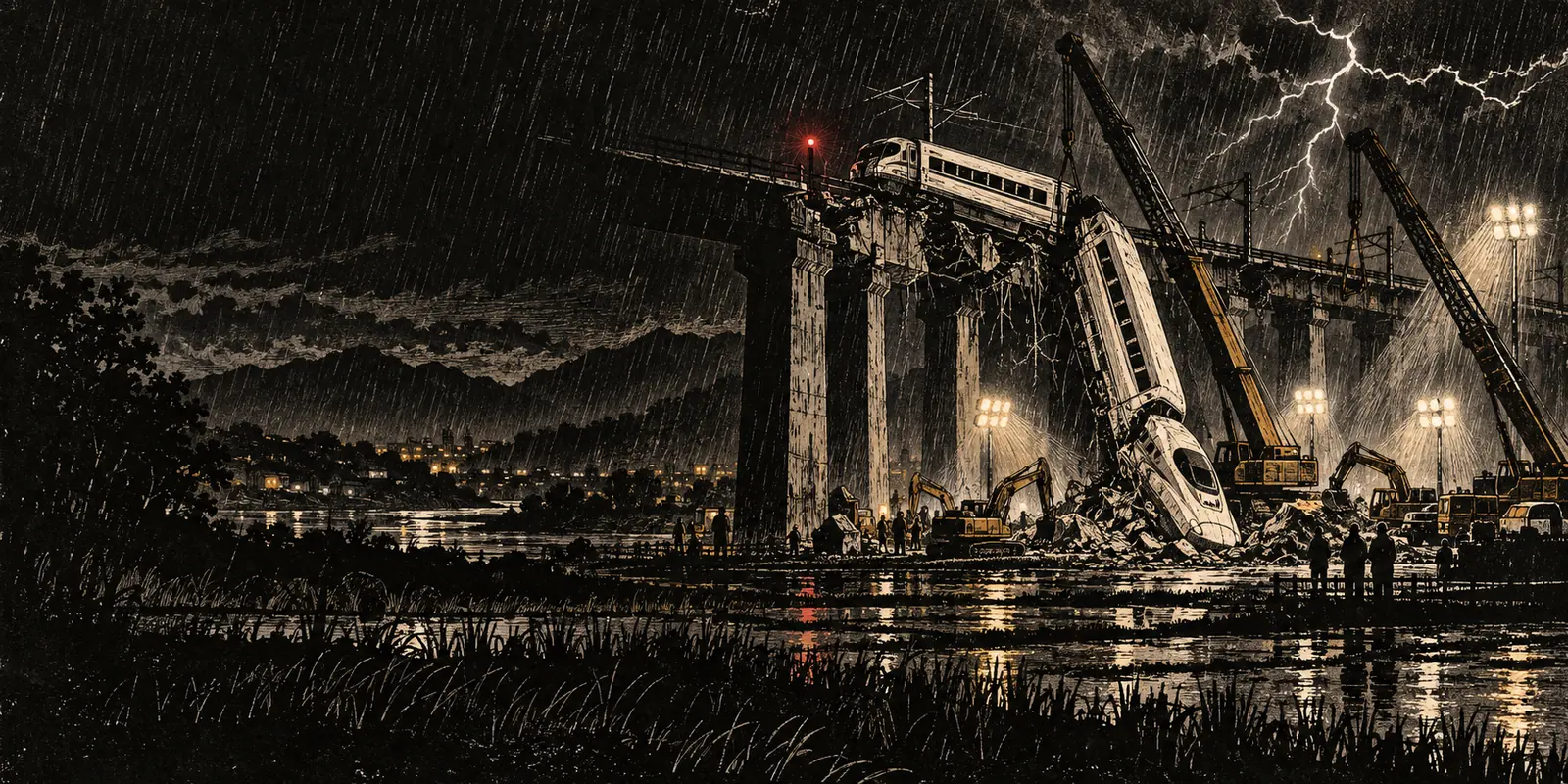
At 7:30 on the evening of July 23, 2011, lightning hit a signal assembly on the Yongtaiwen high-speed line near Wenzhou, in Zhejiang province. The assembly was called the LKD2-T1. A signal assembly is the trackside equipment that tells a train whether the stretch ahead is clear. If it fails, the safe default is a stop. This one did not default to stop. It kept sending a green proceed signal to trains coming up behind.
Train D3115 slowed on the affected section. Train D301 did not get a warning. It closed the gap at full speed.
At 8:34 p.m. D301 rear-ended D3115. Four rear carriages of D3115 and the lead cars of D301 came off the rails. Two carriages fell from the elevated viaduct onto the ground below. Forty people were killed. More than 170 were injured.
The line those trains were on sat inside a network that, in 2008, had not existed. In 2008 China had zero kilometers of high-speed rail. Not a single line. Not a test track carrying passengers between two cities at 250 kilometers per hour. Japan's Shinkansen had been running since 1964, France's TGV since 1981, Germany's ICE since 1991. China had conventional rail, some of it electrified, most of it slow. By 2024 the same chapter puts the high-speed network at over 45,000 kilometers, more than the rest of the world combined, carrying 4.26 billion passenger trips a year, roughly twelve times the Shinkansen's 300 to 350 million. Construction costs, it says, ran substantially below a global weighted average of 238.21 million dollars per kilometer. By 2025 the network had passed 50,000 kilometers. The chapter gives the same annual ridership figure, 4.26 billion trips, for that later count. The Beijing-Shanghai line, 1,318 kilometers, was completed in 2011, the year of the Wenzhou collision. The chapter says that line made an operating profit, and that only six to fourteen lines on the whole network did, depending on the accounting. It gives no separate profit or ridership figure for the stretch near Wenzhou. The remaining 80 to 85 percent of the network, it says, operated at a loss.
The trains themselves had been bought, then rebuilt, in public. In the early 2000s the Ministry of Railways under Liu Zhijun signed transfer deals with four companies that already built high-speed trains: Kawasaki in Japan, Alstom in France, Siemens in Germany, and Bombardier in Canada. The chapter calls the technology-for-contracts deal explicit. The foreign firms would provide core technology and train Chinese partners to produce it. In exchange they received contracts for the first fleet. The penalty for refusing the transfer was implicit: a firm that refused would be kept out of the rail market China was opening. No other country was planning to build tens of thousands of kilometers of high-speed rail at the same time. All four joined. Within a decade, the chapter says, Chinese state-owned enterprises had absorbed the transferred technology, adapted it, and in several areas surpassed it. CRRC, the merged Chinese rail manufacturer, became the world's largest producer of rolling stock.
The absorption was not a straight copy. Engineers took design approaches from four countries and turned them into domestic platforms. The CRH380A, introduced in 2010, drew on the Japanese Shinkansen and added Chinese changes to the bogies, the frames under the cars that hold the wheels, to the pantographs that draw power from the overhead wire, and to the shape of the train, for longer tunnels, hotter weather in southern provinces, and more frequent stops. By the mid-2010s the Fuxing series was, in the chapter's account, a fully Chinese-designed platform, with commercial speeds up to 350 kilometers per hour.
The building pace the chapter measures, from 2008 through 2024, is roughly 2,800 kilometers of new high-speed track a year. The network crosses the Yangtze, tunnels through ranges in Guizhou and Yunnan, and spans seismic zones. Part of the cost advantage, the chapter says, was labor, part was viaduct designs that could be repeated at scale, and part was taking land in a system without strong private claims against the state.
The debt sat beside the map. Cumulative borrowing was 6 trillion yuan, about 860 billion dollars. The chapter says that obligation, held by China Railway, the state entity that absorbed the former ministry, would not be repaid out of operating revenue. Lu Dadao, a geographer and a member of the Chinese Academy of Sciences, estimated annual operating losses at about 100 billion yuan. The system had produced more than 100 lines shorter than 300 kilometers, many with ridership well below what the finances required. In 2022 regulators imposed what the chapter calls an emergency brake: projected annual ridership of 15 million trips before a new line could be approved. The chapter reads that brake as an admission that parts of the build had run past demand. It also records what the debt bought off the railway's own balance sheet. The Beijing-Shanghai run, once an overnight train or a short flight, became a four-hour day trip. Cities the chapter names as nodes, Zhengzhou, Wuhan, and Changsha, became logistical hubs their older infrastructure could not have supported.
Within hours of the July 23 collision, heavy equipment was at the site. Workers began burying wreckage in pits dug at the scene. The cleanup started before the investigation had begun, and before all the victims had been accounted for. The speed of that burial produced immediate public outrage.
Twenty-one hours after rescue operations were officially declared complete, a two-year-old girl named Xiang Weiyi was found alive in the wreckage. She had been in it for nearly a full day after rescuers stopped looking.
The Ministry of Railways sent its spokesman, Wang Yongping, to a press conference. He faced questions about the premature burial of evidence and about a living child found after the rescue had been called off. The line he delivered is the one the chapter records: "Whether or not you believe it, I believe it." The chapter says the phrase entered Chinese internet culture as shorthand for official contempt toward public accountability.
The investigation that followed blamed 54 officials. The failures it named ran across design, construction oversight, and emergency response. Liu Zhijun, the railway minister who had driven the high-speed buildout, was already gone. He had been removed in February 2011 on corruption charges that predated the crash. The chapter puts the bribes, eventually, at approximately 800 million yuan. It does not claim the July collision was a payment. It places his removal earlier, on charges that were already in motion, and then describes the crash as a product of the same institutional pace that built the network.
That pace is in the chapter as a causal reading, not as a second set of wreckage details. The pressure to build fast, to meet political deadlines, and to expand coverage had created safety shortcuts in signal systems and in emergency-response protocols. The burial of wreckage before an investigation is described as a cover-up instinct, a bureaucratic reflex built by decades of handling bad news through concealment. Xiang Weiyi, alive in wreckage that officials had declared cleared, is the chapter's exhibit for what that reflex does when the situation required the opposite.
Signal systems were audited. Construction timelines were extended. Safety-review periods were lengthened. The chapter says the learning took the deaths, and a public-relations catastrophe, to start, and that since Wenzhou the high-speed network has kept a strong safety record across billions of passenger trips. In 2013 the Ministry of Railways itself was dissolved. Its regulatory functions went to a new National Railway Administration. Its operations went to the China Railway Corporation.
Comments
Reader notes
Comments aren't live yet. Send notes to @slop_dealer.