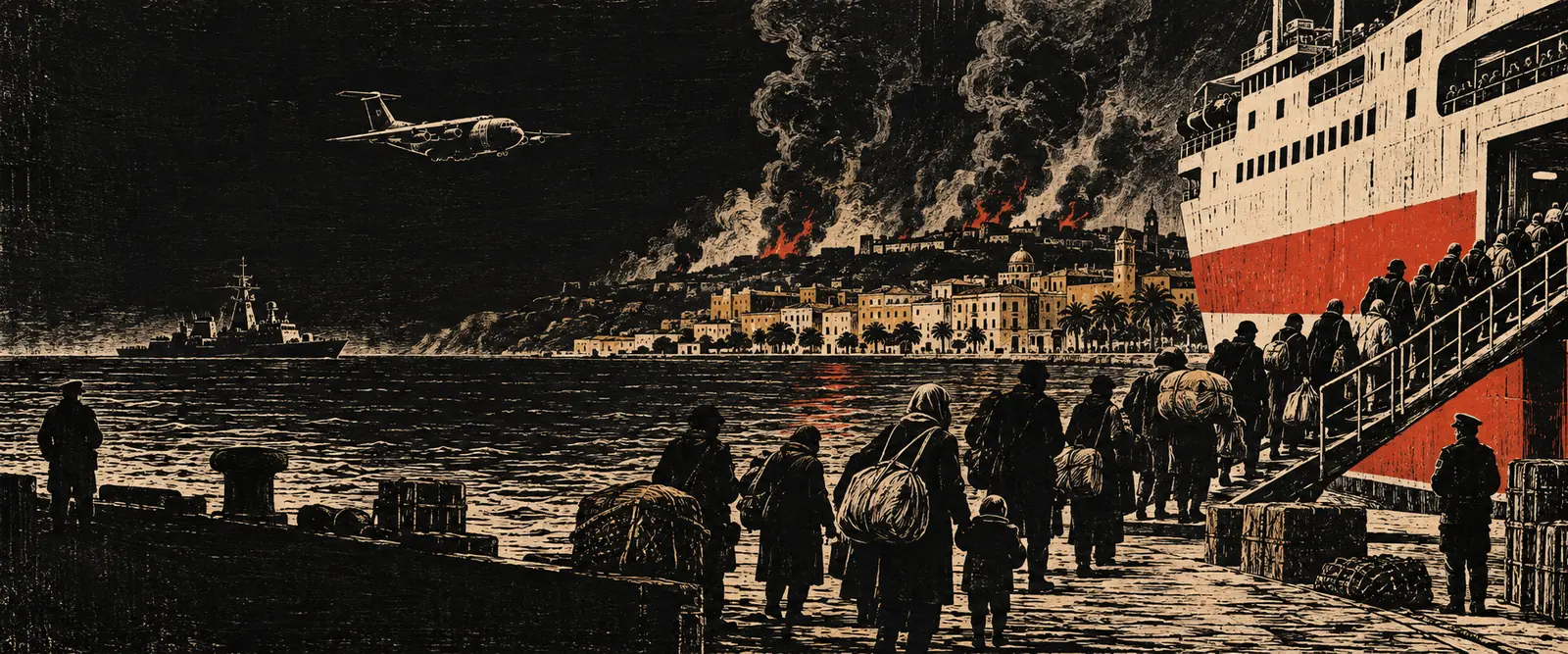
On February 22, 2011, Muammar Gaddafi's security forces opened fire on protesters in Tripoli, and the Libyan state started to come apart. About 35,860 Chinese citizens were scattered across the country. They were construction workers, oil-field technicians, telecommunications engineers, and project managers, employed by roughly 75 Chinese companies. Many of them were on large infrastructure contracts worth billions of dollars together. Libya supplied about 3 percent of China's crude oil imports, around 150,000 barrels a day. About 50 large projects were underway: railways, telecommunications, oil-field services. The security around any of it was not built for a civil war.
Over the next twelve days, from February 23 to about March 5, China got all of them out.
Chartered aircraft left Tripoli while the airport was still partly open. Commercial ships left Benghazi's port. Buses carried workers overland into Egypt and Tunisia, across borders of countries whose own politics were unsteady. Tunisia's revolution had ended barely a month earlier. Four IL-76 military transports, the PLA Air Force's heavy cargo plane, able to carry about 40 tons, flew through Khartoum in Sudan because direct flights out of Libya had become impossible. They shuttled people out in repeated trips. The PLA Navy frigate Xuzhou, a Type 054 warship that had been on anti-piracy patrol in the Gulf of Aden, hundreds of miles away, was turned around to escort the evacuee ships through water that was getting more dangerous by the hour. The Chinese embassy in Greece chartered cruise ships within 48 hours of the crisis worsening. By March 5, 2011, the operation was finished. The chapter calls it the largest and most complicated overseas evacuation in the history of the People's Republic, and one of the major non-combatant evacuations by any country in modern history. A non-combatant evacuation is the removal of civilians, not a battle. Most Western analysts, policymakers, and journalists, the chapter says, did not know it had happened.
Chinese intelligence had not expected Libya to collapse that fast, and had not set up an extraction system in advance. A SIPRI assessment noted that Chinese contractors overseas routinely spend too little on risk prevention. The operation was crisis management after the fact. The people were not in one camp. They were on construction sites, oil installations, and work camps in a country breaking along tribal and regional lines. Roads were contested. Airports opened and closed. Ports depended on which faction held the ground that day.
The Foreign Ministry arranged diplomatic access so overland corridors could cross into neighboring states. The Ministry of Commerce tracked where workers were, through the state-owned companies that employed them. The army supplied the IL-76s. The navy redirected a ship already in the region. Chartered airlines and passenger ships moved most of the bodies. No one ministry ran it. A location had to travel from a company on a work site, to a ministry in Beijing, to a naval command, to a commercial ship chartered through the embassy in Athens, while the country around the workers was coming apart. The Xuzhou was built for hunting submarines and fighting other ships. It was used as an escort for civilian evacuees. That was not the drill. It was whatever ship happened to be near enough. It reached its escort station in the Mediterranean within days of leaving the Gulf of Aden patrol.
The gaps were real. The evacuation started only after the violence had begun. There was no security force already in place for the first, most dangerous hours. Civilian planes and ships meant the operation depended on assets China did not own. If Gaddafi's forces had targeted the evacuees, or if neighbors had shut their borders, the chapter says the outcome could have been different. Nearly 36,000 people still crossed international borders in less than two weeks of civil war, on a chain assembled as it ran.
Afterward, a search for "Libya Xuzhou Navy" on Baidu, China's main search engine, returned about 98,800 entries. The same search on Google returned about 1.2 million. The Chinese internet, which the government controls tightly, held roughly 92 percent fewer results about a naval operation that had succeeded. The chapter offers two explanations and says they can both be true. One is that Beijing did not want to advertise how far it could reach. The Xuzhou's trip was an early time the PLA Navy had run a military operation in the Mediterranean. In 2011 China was still under Deng Xiaoping's guidance to hide capabilities and bide time. A loud naval role in someone else's civil war did not fit that posture. The other explanation is that the success had also shown the holes: companies in a dangerous country with thin security, intelligence that missed the crisis, an operation that needed neighbors' goodwill and civilian ships. Publicizing it would have invited questions about why it was necessary, not only about how it worked. Western assessments over the next decade, the chapter says, barely registered the evacuation. The standing assumption was that China lacked expeditionary ability because it had not fought a war since 1979 and did not sail carrier groups in distant water.
In 2017 China opened its first overseas military base, in Djibouti, a small country on the Horn of Africa at the mouth of the Red Sea. The base covers about 0.5 square kilometers and houses an estimated 1,000 to 2,000 people. It cost about 590 million dollars. It has a 400-meter runway and an underground facility of roughly 23,000 square meters, large enough to store equipment, fuel, ammunition, and supplies out of sight of surveillance and out of easy reach of an airstrike. The runway can take military transports, though not the biggest heavy-lift cargo planes. The United States runs Camp Lemonnier, its largest permanent base in Africa, a few kilometers away, with more than 4,000 personnel. France, Japan, and Italy also have facilities there. China's is the smallest of the major foreign bases in the country.
About 40 percent of China's foreign trade crosses the Indian Ocean. The Bab el-Mandeb strait, which Djibouti looks over, is one of the narrow passages ships cannot avoid. A permanent logistics stop there changes what China can sustain: naval time in the Indian Ocean, anti-piracy patrols, and another evacuation of the Libya kind. It is not a carrier group and not a marine expeditionary force. It is a supply node. In 2018 the Pentagon reported that people at the Chinese base aimed military-grade lasers at U.S. aircraft approaching Camp Lemonnier and injured two American airmen. China denied it. The incident was never independently judged. The Pentagon's formal protest showed it took the report seriously. The chapter leaves open whether the lasers were a deliberate provocation, a local commander's choice, or a misattributed event. The proximity itself was new. Before 2017 the two militaries did not have to manage bases that close.
The site, the chapter says, was a direct answer to what Libya had exposed. The Horn covers Indian Ocean trade routes. Foreign bases were already normal in Djibouti. The host government was willing to lease ground. The underground rooms and the runway were built for keeping operations going, not for a parade.
A different kind of projection happened on the night of June 15-16, 2020, in the Galwan Valley in Ladakh, about 14,000 feet up, on the disputed Line of Actual Control between China and India. It was the deadliest clash between the two countries in 45 years. India confirmed 20 soldiers killed. Chinese casualties were estimated at 35 to 43. Beijing officially acknowledged only four deaths for months. The weapons were not missiles. They were stones, iron rods, and clubs wrapped in barbed wire. Both sides had agreed to keep firearms off that border. The fighting was hand to hand, in the cold, on rock, in the dark. Soldiers fell into the Galwan River and died of hypothermia.
PLA forces advanced about one kilometer west at the Galwan site. The wider pattern of Chinese positions along the western part of the line may have shifted as much as 2,000 square kilometers of effectively controlled ground toward China. In that terrain, ridgelines and river valleys are hard to talk back once they are held. India answered with Operation Snow Leopard on August 29-30, 2020, taking dominating ground on the Kailash Range south of Pangong Tso lake, and recovering leverage it had lost in the first Chinese advance. Both sides then put 50,000 to 60,000 troops on the border and kept them there for four years, until a partial pullback in October 2024. Beijing's public number of four deaths, against estimates of 35 to 43, reads in the chapter either as an attempt to keep the clash politically small at home or as a failure to know the real count. The chapter does not decide which.
In the weeks after Libya, a Global Times editorial on February 28, 2011, argued that China must speed up building its ocean cruising fleet. Song Xiaojun, a military analyst, said in public that the Libya operation would help the army fight for more funding. The chapter records the case built from those lines. Millions of Chinese citizens work in unstable parts of Africa, the Middle East, and Central Asia. Belt and Road infrastructure, the set of overseas building projects financed from China, runs to hundreds of billions of dollars. Maritime routes across the Indian Ocean, the South China Sea, and the Strait of Malacca carry 40 percent of China's foreign commerce. The United States keeps about 750 overseas military installations in 80 countries and has run civilian evacuations dozens of times since 1945. The same chapter notes the limit of that comparison. A base that can pull workers out can also collect intelligence and sit three miles from Camp Lemonnier.
By March 5, 2011, the last of the 35,860 were out. The Xuzhou had been an anti-piracy frigate a few days earlier. In 2017 the runway in Djibouti was there. On the Galwan River in June 2020, Beijing's public death count stayed at four.
Comments
Reader notes
Comments aren't live yet. Send notes to @slop_dealer.