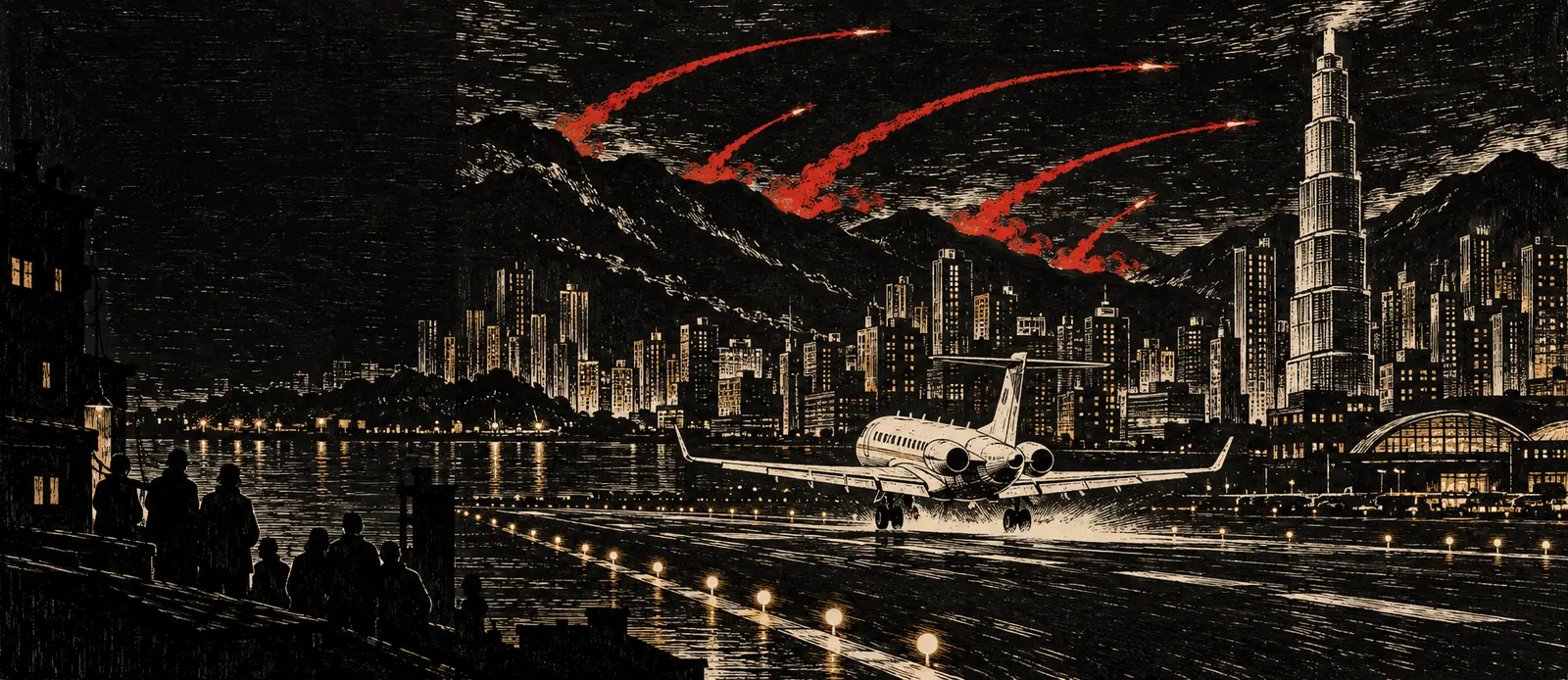
On the evening of August 2, 2022, a U.S. Air Force Boeing C-40C carrying House Speaker Nancy Pelosi landed at Taipei Songshan Airport. Millions of people had watched the flight on Flightradar24, a public plane-tracking site that briefly became the most watched feed on the internet. In Beijing the landing started a sequence that had been prepared for weeks. Within hours the PLA Eastern Theater Command announced exercises in six zones around Taiwan. Within forty-eight hours the Rocket Force launched nine ballistic missiles. Four of them flew directly over the island of Taiwan, a line that had not been crossed in the seventy-three years since the People's Republic was founded. Five of the nine came down inside Japan's exclusive economic zone, the band of sea where a coastal country has special rights over resources. That was a second line broken in the same salvo. On August 5 the PLA sent forty-seven fighter aircraft and two reconnaissance planes across the Taiwan Strait median line, the informal boundary that had governed military conduct in the strait since the 1950s. The following days brought fourteen warships and sixty-six combat aircraft working together along that line, with ground forces, coast guard ships, and electronic-warfare units. The chapter calls it the most complex joint exercise the PLA had ever run around Taiwan.
Chinese state media called it punitive deterrence. American analysts called it an invasion rehearsal. Taiwan's Ministry of National Defense described the air operations as simulated attacks on high-value assets. The chapter says each description held part of the truth.
Before August 2022, PLA aircraft had crossed the median line a documented twenty-three times over several years of tracking. By the end of 2022 alone the cumulative count passed 563. The line had never been written into a treaty. Both sides had observed it anyway, as a working boundary. Crossing it had been treated as a provocation. After August 2022, crossing it was ordinary. In 2025 PLA aircraft made 3,764 incursions into Taiwan's air defense identification zone, the sky where Taiwan asks aircraft to identify themselves, a 22.4 percent rise over the already record totals of 2024. The December 2025 exercises, named Justice Mission, brought PLA forces closer to Taiwan's territorial baseline than any earlier drill. Some zones entered Taiwan's territorial waters. Chinese state media acknowledged that.
Each large exercise followed a political event. Pelosi's visit produced the first set. President Tsai Ing-wen's transit through the United States in April 2023 triggered the Joint Sword exercises, announced the same morning they began, with no notice ahead of time. William Lai Ching-te's inauguration in May 2024 prompted Joint Sword-2024A, the largest naval deployment of any cross-strait exercise to that date: forty-six warships and J-20 stealth fighters. Lai's National Day speech in October 2024 drew Joint Sword-2024B, including 153 aircraft sorties. Justice Mission in December 2025 included twenty-seven rocket launches and, for the first time, an explicit rehearsal of an amphibious seizure of Taiwan's outlying islands. An amphibious landing is an assault that comes from the sea onto a shore.
What the three years produced, in the chapter's account, was a continuous military presence that made the median line useless as a limit, a demonstration to the Central Military Commission and the Politburo Standing Committee that the 2015 reforms requiring the services to fight together could be done at the scale of a major crisis, and repeated practice in the actual water where a fight would happen. Chinese military writers had described a golden window of twenty-four to forty-eight hours for getting forces moving. From April 2023 the same-day announcements showed that window as practice, not only as a paper goal. The August 2022 drills focused on blockade and control of the air. They did not include amphibious landings or a ground-force call-up. By December 2025, Chinese military media described tri-domain landings, ships and aircraft working together, helicopter assault, and precision strikes on eastern Taiwan, targets the PLA had not practiced against before. The chapter says that progression can be read as building a real plan or as raising the threat without deciding to act. Both readings fit. Neither is proved.
The coercion reading, as the chapter lays it out, is that China does not need to invade. It needs Taiwan's leaders to decide that accommodation costs less than resistance. The exercises show that the PLA can impose catastrophic costs at a time it chooses, that informal lines no longer bind it, and that outside help looks less certain as China's conventional and nuclear forces grow. China's missile inventory had tripled to about 3,500 by 2024. The exercises did not produce a direct military clash, which the chapter treats as evidence that Beijing stayed under the line of an American shooting response. What would break that reading, the chapter says, is a later military balance that makes a Chinese option less viable in 2030 than in 2022, or a formal collective-defense promise among Japan, the United States, and Australia.
The audience that watched the August 2022 drills included every government in the Indo-Pacific, and they answered. Taiwan's defense budget moved from about 2.4 percent of GDP in 2022 to 2.5 to 2.6 percent by 2024, with plans to reach about 3 percent by 2028. Taiwan started mass production of cruise missiles it had designed itself, widened long-range air defense with newly arrived PAC-3 systems, and sped up buying mines, anti-ship missiles, and drones meant to make a landing expensive rather than to hold ground in a conventional battle the island would lose. Polling in September 2022 found about 80 percent of Taiwanese respondents saw China's response as a serious threat. That view held into 2024.
The Biden administration raised Taiwan-related arms sales to about 2 billion dollars a year by late 2024. By early 2025 the United States had quietly put small groups of Marines on Taiwan for training, a reversal of a long unofficial policy. Biden said in public, more than once, that the United States would defend Taiwan militarily if it were attacked. The White House walked the remarks back each time. The words still broke with strategic ambiguity, the decades-old habit of not saying whether Washington would fight. Beijing had treated that silence as a restraint on Taipei.
Japan's answer may have been the largest. Prime Minister Kishida Fumio announced plans to double the defense budget and said Japan would not stand aside in a Taiwan contingency. Japan authorized long-range missile units on Yonaguni Island, about 110 kilometers from Taiwan's eastern coast, with anti-ship and air-defense missiles. The defense ministry tied the strait's security to Japan's own, reversing decades of careful vagueness. The five missiles that fell in Japan's economic zone told Tokyo that a fight over Taiwan was also a fight involving Japan. Australia under Prime Minister Albanese kept its trade and security framework with Taiwan despite Chinese pressure and increased military contacts. The Philippines moved closer to the American-led security network, pushed by Chinese assertiveness in the South China Sea and around Taiwan. South Korea, which had tried to sit evenly between Washington and Beijing, began writing Taiwan into its security planning.
In June 2024 Taiwan added Huawei and SMIC to export-control lists, blocking those firms from advanced Taiwanese chip technology, and framed the step as a response to military pressure. TSMC, the island's dominant chipmaker, sped up investment in factories in Arizona, a hedge against the contingency the exercises were practicing. The pressure that was supposed to make Taiwan more compliant, the chapter says, made it more determined to spread its leverage and less willing to keep the economic ties Beijing had counted on.
The nuclear backdrop is separate and not separate. Between 2020 and 2021, satellite analysts identified about 350 new intercontinental ballistic missile silos under construction in Gansu, Xinjiang, and Inner Mongolia, the largest expansion of China's nuclear arsenal in its history. By 2024 the Department of Defense assessed that China's inventory of precision-attack ballistic and cruise missiles was about 3,500, nearly triple the 2020 level. The older posture kept warheads and missiles stored apart, at low alert, built to strike back after an attack rather than to answer in minutes. The new silos, with solid-fueled missiles that can sit ready, are what Pentagon analysts read as a move toward launch-on-warning: detecting an incoming strike and firing back before the warheads land. A survivable second strike, the ability to absorb a first blow and still answer, changes the arithmetic of any conventional fight over Taiwan. Chinese strategists have asked the United States to acknowledge that mutual vulnerability, the condition in which each side can destroy the other. American reluctance, the chapter says, comes from a fear that the acknowledgment would encourage conventional action in the region, especially over Taiwan. The Rocket Force corruption purge of 2023 and 2024 removed senior commanders, including officers responsible for the nuclear missile program, for corruption rather than for operational failure. The chapter leaves both readings open: a deterrent built on rotten procurement, or a leader willing to take a short disruption to clean the force.
Kevin Rudd, a former Australian prime minister who later served as U.S. ambassador to China, has argued for what he calls managed strategic competition, with explicit guardrails. Applied to Taiwan, his point is that one congressional visit, however symbolic, produced a military answer that moved the two strongest countries measurably closer to a conflict neither can concede without a political cost each treats as existential. Wang Jisi, dean of Peking University's School of International Studies, co-wrote a Brookings study with Kenneth Lieberthal on mutual strategic distrust. From Wang's side of that study, the United States does not only compete with China. It seeks to contain, divide, and in the end change China's political system. Every arms sale, every senior transit, every promise to defend the island is read in Beijing as another piece of a project to deny what Beijing calls the restoration of sovereignty over territory it considers its own. The chapter says Wang's frame does not excuse the missiles or the erased median line. It explains why a visit American officials called a routine act of Congress was, in Beijing, an intolerable provocation. On July 28, 2022, Xi told Biden that those who play with fire will perish by it. The chapter treats that as a declaration that the visit had been classed as a red-line breach, not as empty talk.
Jessica Chen Weiss, a political scientist who studies Chinese nationalism, has shown that nationalism limits how far leaders can bend. It is not only a tool they switch on. When the state stirs nationalist feeling on sovereignty, public demand for action rises, the cost of looking weak rises, and the room to step back shrinks. Xi had publicly staked credibility on opposing Pelosi's visit. Social media demanded military action. State media amplified the demand. By the time the plane landed, the domestic cost of not using force may have been higher than the international cost of using it. Weiss's work treats that as a standing feature on sovereignty questions, and especially on Taiwan, not as a one-week accident.
The invasion-by-2027 claim says Xi set a deadline for the PLA to be ready for a Taiwan contingency by the army's hundredth anniversary in 2027, and that readiness means an intention to act. Chinese defense documents refer to the 2027 target. The exercise tempo rose. The nuclear expansion could serve as a shield for conventional operations. The chapter says the claim mixes readiness with intention. A force that prepares to fight is not, by that fact, a force that has chosen a date. The opposite claim, that China will never risk a war because the costs are too high, assumes a cost-benefit sheet that outsiders can read and that stays stable. The chapter says the history of major wars is full of leaders who decided the costs were acceptable, or that the window was closing, or that not acting was worse. Pentagon assessments note that PLA capabilities are still short in long-distance logistics, in joint-operations skill, and in urban warfare, and that China is learning with each exercise. The purge hurt continuity of command. Exercises after the purge suggest the damage was not crippling in the field. Xi has tied his personal legacy to the great rejuvenation of the Chinese nation, and Taiwan sits inside that story. The same concentration of decision-making that unifies the order also removes internal checks that might flag a risk as unacceptable.
Twenty-three million people live on the island. About 2.45 trillion dollars in trade a year passes through the strait. The chip factories on the island make most of the world's most advanced semiconductors. Four of the nine missiles on the night after Songshan flew over the island itself. Five fell in Japan's economic zone. By the end of that year the median line had been crossed more than 563 times. The chapter does not say which of those facts decides whether force will be used.
Comments
Reader notes
Comments aren't live yet. Send notes to @slop_dealer.