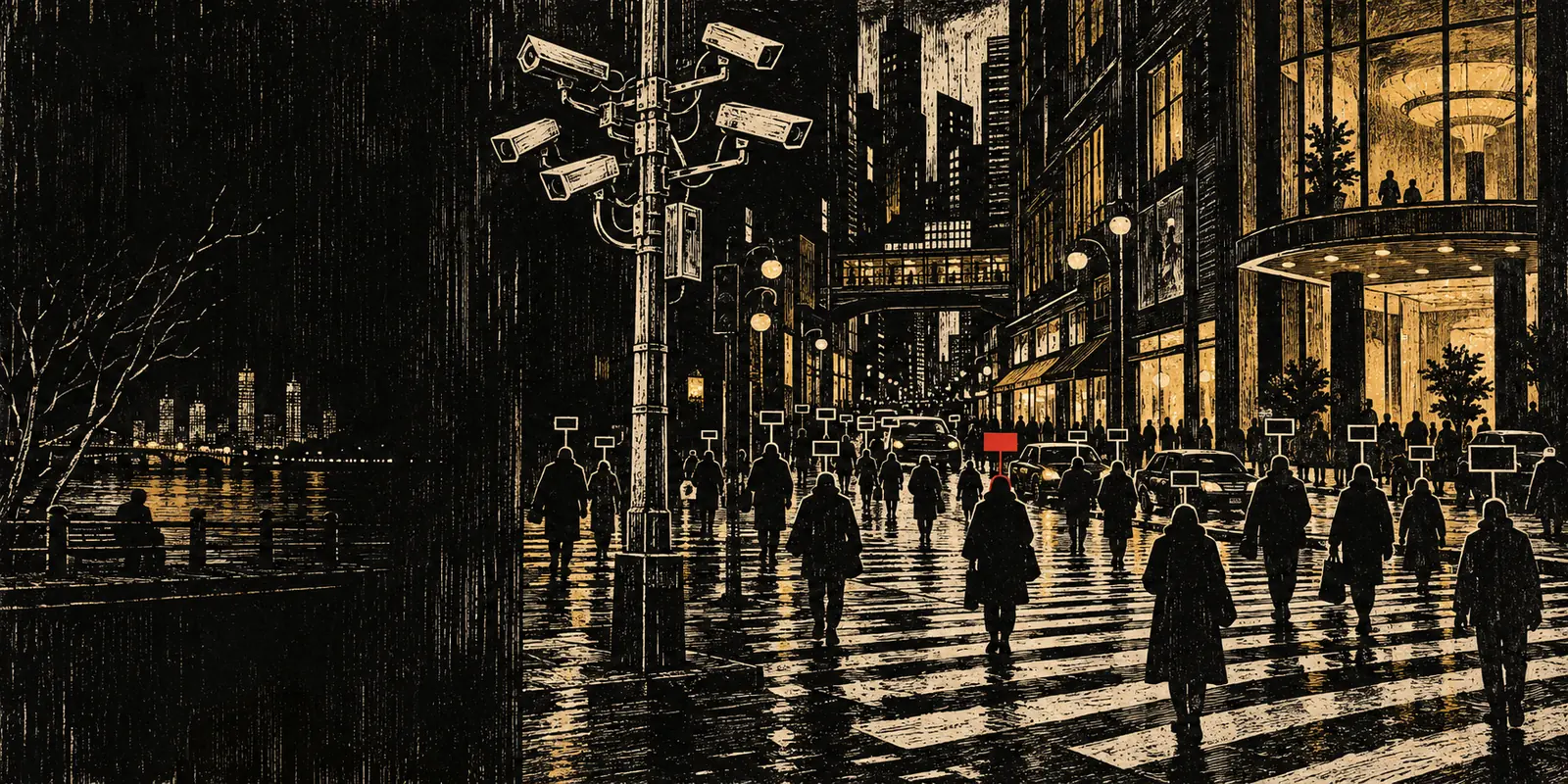
In October 2018 a feature in Wired described China's social credit system as one algorithmic score given to every citizen, deciding whether that person could board a plane, get a loan, put a child in school, or book a hotel. The picture was exact, frightening, and it spread. Within months the social credit score was a fixture of English-language commentary, in editorials, podcasts, congressional testimony, and Netflix documentaries, offered as proof that Beijing had built a surveillance state of unusual completeness. The frame was Orwellian in the plain sense: a center assigns each person a number for compliance, and rewards and punishments follow from the number.
The system being described did not exist.
What existed in 2018, and what still exists, is a scattered set of local pilots, corporate blacklists, and compliance tools that differ by city, province, and agency. Some cities experimented with scores for businesses. Others kept lists of people who had defied court orders or committed financial fraud. Alibaba's Sesame Credit scored consumers for commercial credit, in a structure close to a FICO score in the United States, the number lenders use to judge whether a borrower will pay. Several pilots tracked whether companies followed regulations. None of these were fused into one national score. No central algorithm rated every citizen. The dystopia in the press was more coherent than the thing it claimed to document.
James Palmer, a senior editor at Foreign Policy who has spent years on how English-language media covers China, has described the machine that produces this kind of story. The China-watching ecosystem, he argues, is paid, in attention, for pieces that are dramatic, easy to picture, and that confirm what readers already believe about authoritarian surveillance. The score was a perfect product. It fit a headline. It was scary enough to be shared. Most readers could not check it, so corrections never caught the original. The myth did not come from one bad article. It came from a system tuned for attention rather than accuracy.
A single national score would have needed technical plumbing China did not have, and a joining-up of bureaucracies that cuts against how the state actually runs. Provinces and cities guard their data. Local databases do not talk to each other well. The same center-versus-local split that shows up in economic policy and in pandemic response shows up in surveillance.
The blacklist that does exist works differently. Courts keep lists of people who have defied enforcement orders, mostly in debt cases. Those people face limits on luxury spending: high-speed rail tickets, air travel, premium hotels. That is punitive. It raises real civil-liberties problems. It is closer to a contempt-of-court tool, the penalty for ignoring a judge, than to an algorithm watching everyone. The corporate systems track regulatory violations, taxes, and product safety, closer to an FDA inspection or an SEC case than to a novel about total control. The policy answer to a unified score is different from the policy answer to a patchwork. Treating the myth as real produces a response aimed at a threat in the wrong shape, and it misses the blacklists, the facial-recognition deployments, and the local experiments that do exist, in forms less dramatic than the myth.
Kaiser Kuo, former head of international communications at Baidu and co-host of the Sinica Podcast, has compared the habit to a Rorschach inkblot: what the viewer sees says more about the viewer than about the blot. The blot was a set of local experiments. The viewer saw one dystopia, because that was what the viewer expected. The chapter's warning runs both ways. Overstating the surveillance sells. Understating it, by treating a debunking as a pardon, is the other error. The fragmented system still restricts people. The blacklists still punish. The local pilots still collect data that citizens cannot review, challenge, or leave. Saying the Western story was wrong does not make the systems benign.
The Great Firewall has been written about in English almost only as a censorship tool. That reading is correct and badly incomplete. By blocking Google, Facebook, Twitter, YouTube, and Amazon from operating freely in China, the wall created a protected home market in which Chinese technology companies could grow without fighting established Western incumbents. Baidu took the search market Google could not contest. Alibaba built the commerce Amazon could not enter. Tencent built the social and messaging platforms Facebook could not challenge. ByteDance created Douyin, the predecessor of TikTok, in a market walled off from Instagram and YouTube.
The hawk reading in the chapter is blunt, and it points at outcomes. The wall worked as protectionist industrial policy, a set of barriers that shelter domestic firms, of a kind the technology sector had not seen. ByteDance did not build TikTok by beating YouTube inside China. It dominated a closed market, tuned its recommendation algorithm on 600 million Chinese users, and then took that algorithm abroad. Baidu, Alibaba, and Tencent became three of the most valuable technology companies on earth. ByteDance's private valuation rivaled Meta's. The four together passed 2 trillion dollars in combined market value at their peaks. The digital economy behind the wall produces annual revenue in the hundreds of billions and employs tens of millions. WeChat, Tencent's messaging platform, has more than a billion daily active users and has become the operating system of daily life in China: messages, payments, government services, and shopping in one application with no Western match in scope. Alibaba's Singles' Day shopping festival routinely moves more money in 24 hours than Black Friday and Cyber Monday combined.
The film quota lets in only 34 foreign films a year, and overseas studios get only 25 percent of the box office on those films. The protected market let the industry make Ne Zha 2, the first film to gross 1 billion dollars in a single market, reaching 1.69 billion domestically. In games, Black Myth: Wukong sold more than 20 million copies and broke Steam's record for players online at once. A model that says the wall exists only to censor political speech answers with circumvention tools and VPNs. A model that also says the wall protects a multi-trillion-dollar ecosystem has to account for jobs, for interests that make taking the wall down structurally impossible for Beijing even if politics loosened, and for companies that grew up sheltered and then walked into open markets. The TikTok security argument and the trade argument are the same argument once the wall has two jobs.
As of 2026, Western writing on TikTok swings among three frames and does not hold them together. One is a commercial success: a recommendation engine that took more than a billion users through product design. One is a national-security threat: a Chinese-owned app with user data that could, in theory, be compelled into the hands of Chinese intelligence. One is an influence machine: a feed that could be tuned to push or bury stories in Beijing's interest. Each has evidence. TikTok has more than 1.5 billion monthly active users, an algorithm that beats competitors on engagement, and a business that has made tens of billions in advertising. The security hole is structural because of China's 2017 National Intelligence Law, which requires organizations to support and cooperate with state intelligence work. ByteDance's headquarters is in Beijing, and its core engineers work under Chinese jurisdiction, a legal path through which agencies could in theory demand data no matter where the servers sit. The influence worry is plausible. Documented evidence that Beijing has directed the recommendation algorithm for political ends in Western markets remains thin. Internal documents and former employees have not produced the proof the strongest version of that claim needs.
Hearings swing between ban it as a spy tool and regulate it like any other social network. The ecosystem rewards a clear story and punishes a sentence that says the app is a product, a structural vulnerability, and a possible influence tool whose risk depends on variables outsiders cannot see. The result has been years of proposed bans, forced-sale deadlines, executive orders, and reversals of those orders. Palmer's point lands here as a competence gap: speaking Mandarin, or citing a Chinese source, does not by itself produce a strategic reading. Security judgments get made from structural assumptions rather than from the regulatory documents, the corporate papers, and the Party directives on technology firms.
A corpus study of Western coverage found English-language outlets framing China through five recurring roles: politician, upstart, vendor, aggressor, and dictator. Each can be true in a given case. Together they crowd out other frames: infrastructure builder, development financier, cultural producer, adaptive bureaucracy, a fragmented system whose institutions compete. The common-prosperity campaign of 2021 was read as a Maoist turn. Crackdowns on technology companies, private tutoring, and real estate were assembled, with the Didi listing fight, the Ant restructuring, and the tutoring ban, into one story that Xi was dismantling markets and returning to state planning. Technology stocks lost hundreds of billions as funds priced in a party systematically hostile to private business. Chinese officials and state media said, repeatedly, that common prosperity meant regulatory adjustment inside a market, not Maoist redistribution. Western analysts mostly dismissed that as propaganda, which it may partly have been. The later path was closer to the clarification. The companies were not nationalized. Private enterprise continued. By 2023 Beijing was courting technology entrepreneurs back with tax breaks and lighter rules. Analysts who had moved money on the Maoist reading missed the recovery.
The more damaging habit, the chapter says, is treating China as one rational actor. The People's Liberation Army, the Foreign Ministry, the National Development and Reform Commission, the provinces, the state-owned enterprises, and the Party's internal security apparatus do not move as one body. They compete for money, chase conflicting goals, and sometimes produce contradictory results. Outcomes that are really institutional fights get read as a single decision.
China is genuinely hard to read. The state controls information, manipulates statistics, punishes unauthorized disclosure, and keeps an opacity built to stop the outside assessment Western analysts attempt. The social-credit myth did not come only from laziness. Primary sources were scarce. Official descriptions were unreliable. The few data points, scattered pilots and corporate experiments, were ambiguous enough to support a unified score if you squinted. Training a Mandarin-fluent analyst who knows institutions, governance, and regional difference takes years. There are few of them relative to the demand for commentary. The gap is filled by generalists carrying frameworks from elsewhere, often Cold War analogies to the Soviet Union, and applying them to a system that runs on different principles. Western analysis was more accurate from 2001 to 2012, when the information environment was more open, academic exchange was thicker, and the government was more willing to tolerate foreign research. Xi-era tightening, the expulsion of foreign journalists, limits on fieldwork, and prosecution of foreign researchers degraded that base. The closing of channels that had let scholars work in provinces, interview local officials, and see municipal data removed the granular input that had made pre-2012 work more reliable. Kuo's related point is a loop. As access falls, institutional knowledge falls. Remaining analysts lean harder on imported frameworks. The frameworks miss. The miss is blamed on Chinese deception rather than on the framework. China is treated as illegible. The incentive to build the expertise that would make it legible shrinks. Under geopolitical tension the people with the deepest access are the ones most likely to be expelled, and the people with the least expertise are the ones most likely to fill the airtime.
The chapter does not treat the misreading as a plan Beijing seeded. No documented case shows Beijing planting the social-credit myth or steering analysts toward a censorship-only reading of the wall. The wall's two jobs were designed. Policymakers understood that blocking foreign platforms opened space for domestic ones. The film quota's protection is equally deliberate. What was not designed was the specific Western mistake. The opacity that served domestic control also let analysts fill gaps with their worst assumptions. There is a version of the argument already visible in artificial intelligence: companies trained mainly on Chinese-language data behind the wall may be at a structural disadvantage in global markets that need multilingual, multicultural training data. Whether that weakness shows up is a test for the next decade.
In October 2018 the score in the Wired feature did not exist. Sesame Credit did. Court blacklists did. Douyin was being tuned on 600 million users behind a wall that also kept Google out. Ne Zha 2 later grossed 1.69 billion dollars in one market. The hearings on TikTok were still swinging between a ban and a rulebook.
Comments
Reader notes
Comments aren't live yet. Send notes to @slop_dealer.