In September 2015, Xi Jinping stood beside President Obama in the Rose Garden and said China had "no intention to militarize" the artificial islands it had built in the South China Sea. The chapter describes the setting as arranged for reassurance: two heads of state, sunlight on white columns, a bilateral agenda that included climate change and cybersecurity. The words were measured. They came through translation. They went out through the White House press corps to capitals across the Pacific. The Philippines, Vietnam, Malaysia, Japan, and Australia all had reason to listen. What the leader of the People's Republic said about those islands in the Spratly archipelago would shape defense planning, alliance calculations, and the willingness to challenge Beijing's claims.
The sentence was not an aside. It answered the question then sitting in the middle of Asia-Pacific security: what did China mean to do with the 3,000 acres of new land it had made, seemingly out of nothing, on seven reefs in the Spratlys? Satellite imagery had already shown runways, harbors, and multi-story buildings on features that, two years earlier, had been submerged coral barely visible at low tide. The open question was whether this was civilian infrastructure or the base of a military archipelago. Xi, next to the president of the United States, in front of the cameras, answered it in the clear.
The dredging that produced the acres had started in December 2013, when Chinese vessels arrived at Spratly reefs and began pumping sand, coral, and sediment onto features the chapter says no reasonable person would have called islands. Through October 2015, about twenty-two months, China reclaimed approximately 3,000 acres at seven sites: Fiery Cross Reef, Mischief Reef, Subi Reef, Cuarteron Reef, Johnson South Reef, Hughes Reef, and Gaven Reef. The work took between 40 and 50 million cubic meters of sand and coral off the seabed. The chapter's comparison is that this is roughly enough material to bury Manhattan under three feet of sand. Other claimants in the South China Sea had reclaimed land before. Vietnam, the Philippines, Malaysia, and Taiwan all kept outposts on features they claimed. China outpaced all of them combined by a factor of more than ten. What had been a slow contest among several states became, in the chapter's account, a unilateral build that changed the map in under two years.
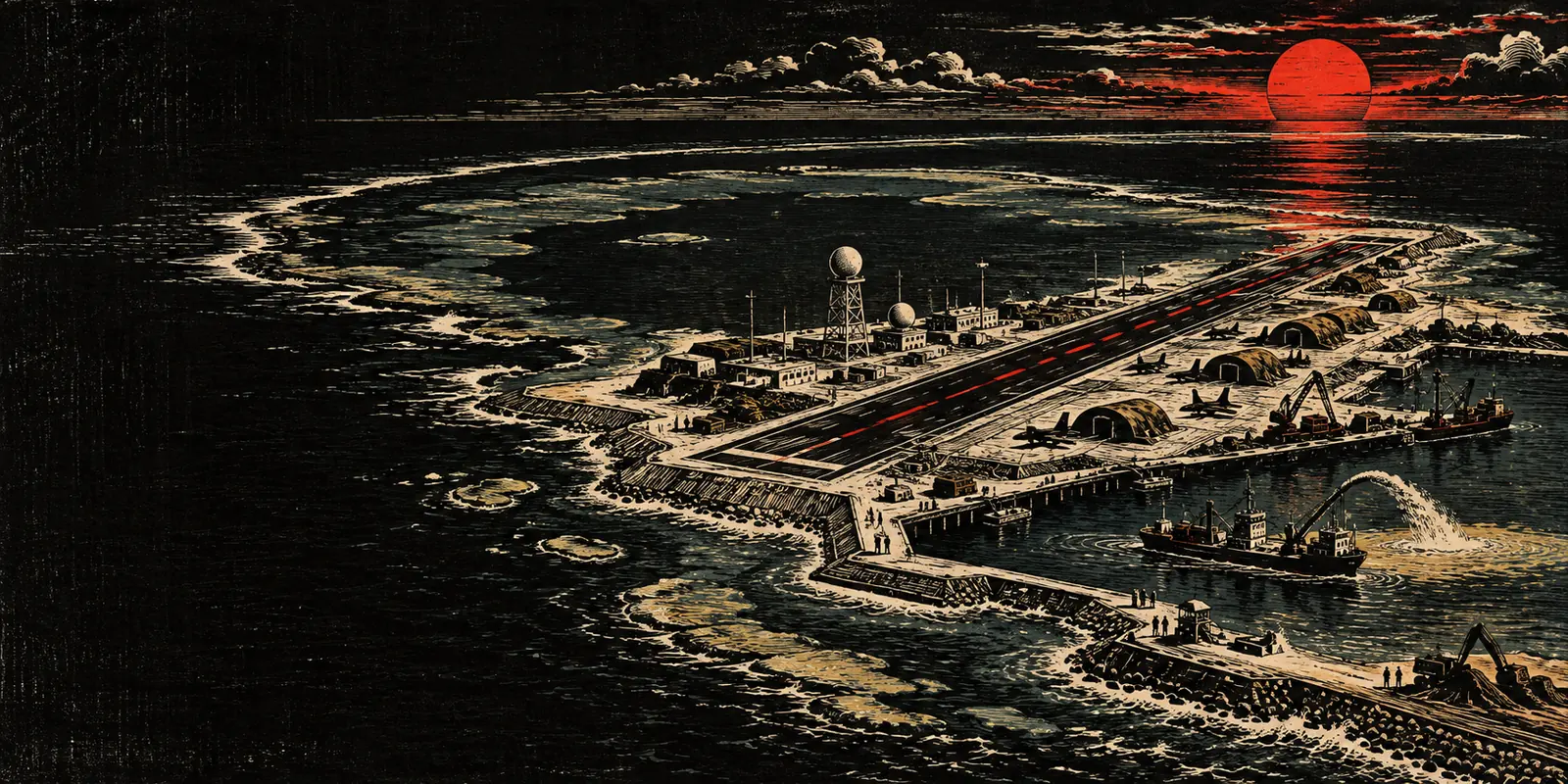
Fiery Cross shows the scale in one reef. Before the sand, it was a submerged reef with a small concrete platform and a few structures above the water. By late 2015 it had a runway longer than 10,000 feet, long enough, the chapter says, for any military aircraft in the Chinese inventory, including heavy bombers and large transports. It had a harbor, barracks, communications towers, a weather station, and reinforced buildings whose dimensions were consistent with weapons storage and command facilities. The chapter notes, dryly, that there was always a weather station. Mischief Reef and Subi Reef got the same treatment. Each became a fully equipped installation where, two years earlier, there had been ocean. The three large features made a triangle across the Spratlys. The four smaller ones, Cuarteron, Johnson South, Hughes, and Gaven, filled gaps with sensors and support.
The speed is part of the chapter's account, not only the acreage. It says China compressed what would normally have been a decade of military construction into less than two years, and that this was not improvisation. The dredging fleet, the engineering plans, and the chain for concrete, steel, and equipment required years of preparation before the sand moved. The chapter names the Tianjing as one of the major cutter-suction dredgers in Asia, able to process thousands of cubic meters of seabed an hour and spray a slurry of sand and crushed coral through discharge pipes onto the reef. Several dredgers worked at once, across sites that had no port, no fuel store, and no freshwater of their own. Supply lines ran hundreds of miles from the mainland.
By the time satellite images showed the outside world the scale, the chapter says, the work was already far along. Dredging began in late 2013. Western governments began public statements of concern in early 2015. That left more than a year in which, as the chapter puts it, a particularly intensive construction proceeded with little international friction. The chapter reads that window as deliberate: a campaign that started quietly, on features far from major shipping lanes, at a pace set to stay under the level of a crisis.
Within two years of the Rose Garden statement, satellite imagery showed missile batteries, radar arrays, fighter-aircraft hangars, and reinforced bunkers on every major reclaimed feature. The missiles included HQ-9 surface-to-air systems, able to engage aircraft at ranges exceeding 100 miles. A later passage in the chapter describes the same HQ-9 coverage as roughly 125 miles. Both figures are the chapter's. This draft does not collapse them into one. The anti-ship weapons were YJ-62 and YJ-12B cruise missiles. The chapter calls the YJ-12B a supersonic weapon designed to sink warships. Hangars were built for more than seventy fighter jets. There were radar installations, communications equipment, and hardened shelters built to survive bombardment. By 2016, commercial satellite subscriptions were common enough that journalists, think tanks, and attentive members of the public could watch the quarterly updates. The chapter's description of those updates is concrete: more concrete, more antennae, more military hardware on islands Beijing had described as serving fishermen and weather stations.
The chapter treats the civilian description as a phase, not as a stray adjective. From 2013 through about 2015, China kept a civilian-purposes account: weather observation, fisheries management, and search and rescue. Sensors, radar, and communications gear could be described, if you squinted, as dual-use kit for maritime safety. Dual-use means the same dish or building can serve a civilian job and a military one. Only after construction was largely finished did the account shift to defensive necessity: the installations were military, and any sovereign state would defend its territory. The order the chapter lays out is build under a civilian cover, install equipment that could be either, then, once the concrete had set and the runways worked, put in the openly military hardware and change the justification. The Rose Garden sentence sits inside that sequence, in September 2015, while the sand was still being counted in acres and before the missile batteries showed up on the later images.
A common Western description, the chapter says, treats the islands as firepower platforms, and the missiles, runways, and hangars do read that way. Analysts the chapter cites argue that the more significant function is intelligence, surveillance, and reconnaissance. Radar, signals equipment, and communications gear on the seven features gave China persistent awareness of movement across about 1.4 million square miles of ocean: ship transits, aircraft sorties, submarines that surface or transmit, and exercises by the United States, the Philippines, Vietnam, Japan, or Australia inside sensor range. The chapter's point is that the sensors arrived under a definition of militarization that still sounded like weapons and combat aircraft. Even without a missile or a fighter, it says, the sensor grid was a permanent change in the military balance, from near-blindness across much of the Spratlys to continuous, multi-spectrum coverage. No later legal ruling, protest, or freedom-of-navigation operation, on that account, undoes the coverage.
One line in the chapter is explicitly unsteady, and it stays that way here. A remark attributed to a chief executive of a Chinese firm involved in the dredging says, in substance, that the firm found the Obama administration so empty of consequence that it decided to go ahead. The chapter says the precise phrasing may not be accurately attributed. What the chapter says is consistent with the visible pattern, phrasing aside: the United States registered objections during the construction window from late 2013 through 2015, and it did not impose costs. Statements of concern and calls for restraint, and a lack of consequences, are the chapter's record of that window. China's 2015 Defense White Paper put a strategic sentence next to the work. The "traditional mentality that land outweighs sea must be abandoned," it said.
The legal case ran on a parallel clock. On January 22, 2013, the Philippines filed an arbitration against China under the United Nations Convention on the Law of the Sea. The case challenged the legal basis of China's claims, including the nine-dash line, and asked the tribunal to rule on the status of features China occupied and was starting to develop. China refused to take part. It filed no counter-memorial, sent no legal team, and appointed no agent. The chapter reads that absence as a choice: showing up would have implied that the tribunal had jurisdiction, and Beijing's position was that it had none. China pressed other states not to support the case and published a position paper arguing that the tribunal lacked competence under the convention to decide territorial sovereignty.
The case took more than three years. On July 12, 2016, the tribunal ruled. The chapter calls the decision sweeping. It found that the nine-dash line had no legal basis. It classed several features China had developed as low-tide elevations or rocks, not islands, so they could not generate exclusive economic zones. It found that China had violated the Philippines' sovereign rights. It went Manila's way on nearly every significant claim.
China's response was immediate. The ruling, in the eight words the chapter quotes, was "null and void and has no binding force." Beijing refused the tribunal's jurisdiction and refused every part of the decision. The Foreign Ministry held a press conference the same day. State media ran editorials the chapter says were written in advance. The chapter reads that speed as evidence Beijing had expected an adverse ruling and had decided, before the tribunal spoke, to reject whatever it said. As of July 2025, the chapter says, Chinese officials were still calling the ruling "waste paper."
The United States issued statements supporting the ruling. It did not impose sanctions. It did not, the chapter says, change its military posture in ways that created material consequences for the refusal. The ruling established a legal finding. It did not change a fact on the water. The Philippines won the law. China kept the islands.
The regional body that might have spoken together did not. In June 2016 the foreign ministers of the Association of Southeast Asian Nations drafted a joint statement of concern about the South China Sea. Within three hours the statement was retracted. Cambodia, which had received substantial Chinese economic support, blocked the consensus ASEAN needs in order to speak as one. The chapter says this was not the first time. In 2012 Cambodia had similarly prevented an ASEAN joint communique on the South China Sea, a first such failure in the organization's forty-five-year history. The chapter's reading is that Beijing had acquired a veto inside the regional group most likely to organize collective opposition.
The chapter's verdict is camouflaged strategy, and it marks three conclusions as high confidence. The construction was deliberate and prepared in advance, not a spasm after some single provocation. The logistics, dredgers, concrete, and steel across open ocean to reefs with no port, no fuel store, and no freshwater of their own, took years of preparation before the sand moved. The misrepresentation of intent was sequential, matched to the building, not a story invented after the missiles were photographed. And China judged that the United States and regional states would not raise costs high enough to stop the work during 2013 to 2015, and that judgment held for the construction window.
The chapter also records alliance moves it will not pin on the islands alone. The Philippines, under President Rodrigo Duterte from 2016 to 2022, had taken a conciliatory line toward Beijing, then reversed under President Ferdinand Marcos Jr. and granted the United States access to four more military bases under the Enhanced Defense Cooperation Agreement. Japan, citing the security environment in the East and South China Seas, undertook its largest defense-spending increase since the Second World War. Australia entered AUKUS, a security partnership with the United States and the United Kingdom centered on nuclear-powered submarines. The Quad, a dialogue among the United States, Japan, Australia, and India, moved from a dormant idea to a regular meeting of leaders. None of these, the chapter says, can be attributed solely to the island building. All of them, it says, were sped up by the perception that Beijing would change the map and break a public assurance while doing it. The chapter says that longer cost is still unfolding, and that Beijing may not have anticipated the timetable.
What came after the concrete was a different record, and the chapter does not score it as finished. By 2024 the China Coast Guard was logging 359 patrol days at Luconia Shoals near Malaysia, 354 at Vanguard Bank near Vietnam, and 313 at Scarborough Shoal near the Philippines. Analysts the chapter cites have documented at least eighteen gray-zone tactics by Chinese maritime forces, from water-cannon attacks and hull-to-hull ramming to military-grade lasers against Philippine vessels. A maritime militia of ostensibly civilian fishing boats, crewed by trained personnel with ties to the PLA Navy, operates as what the chapter calls a "third sea force," mass on the water with a civilian cover. China's 2021 Coast Guard Law, Article 22, authorized "all necessary measures including weapons" against foreign vessels in waters China claims.
At Second Thomas Shoal, where the Philippines keeps a deliberately grounded warship as a sovereignty marker, Chinese Coast Guard vessels escalated confrontations through 2023, 2024, and into 2025. On June 17, 2024, Coast Guard personnel boarded Philippine resupply boats, confiscated firearms, and in one incident severed a Filipino sailor's thumb. The chapter says China fully blocked Philippine resupply missions in only about two of roughly thirty attempts. The harassment imposed costs, drew international coverage, and tested the limits of the U.S.-Philippines Mutual Defense Treaty.
Comments
Reader notes
Comments aren't live yet. Send notes to @slop_dealer.