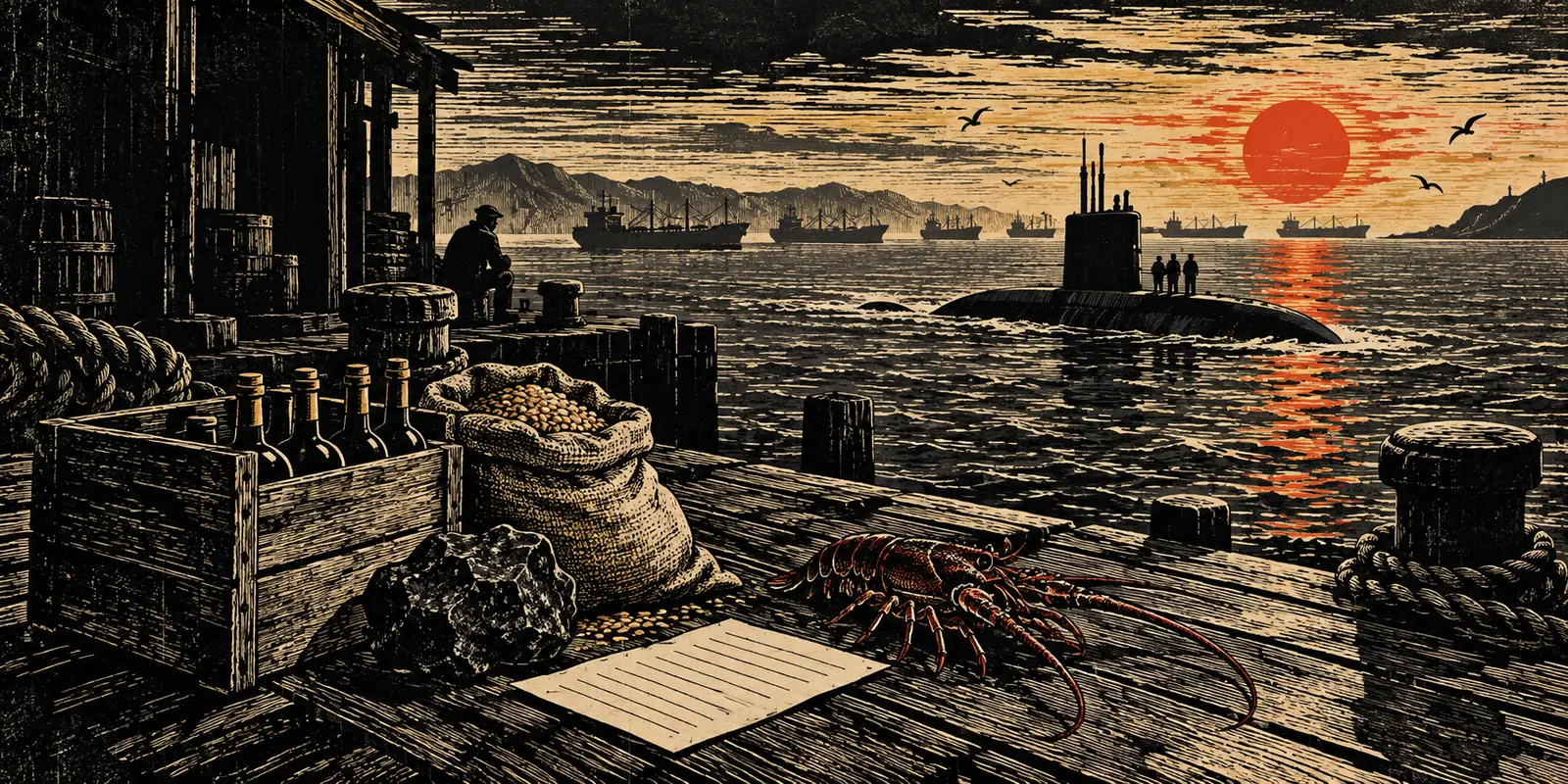
In April 2020 Australian foreign minister Marise Payne called for an independent international investigation into how COVID-19 started. The tone was not a direct attack, and the call was not aimed only at China. The European Union and others had already signaled support for some kind of inquiry. Beijing read it as hostile. Ambassador Cheng Jingye warned in public that Australia's position could spark a Chinese consumer boycott of key Australian services and products. What followed was one of the broadest economic-coercion campaigns in recent international politics. Coercion, here, means using trade and money to force a political change.
By late 2020 China had put combined anti-dumping and countervailing duties of 80.5 percent on Australian barley. Anti-dumping duties are tariffs imposed when a country claims goods are being sold below cost. Countervailing duties answer subsidies. Wine, beef, lamb, lobster, timber, cotton, and coal joined the list, through formal tariffs and through informal holdups at customs. Coal shipments to China, worth 7.5 billion dollars a year, effectively stopped. By June 2021 there were zero Australian coal shipments to mainland China, against 11.9 million tonnes in 2020. The targeted exports were worth about 20 billion Australian dollars, roughly 1.2 percent of Australian GDP.
In November 2020 the Chinese embassy in Canberra published fourteen grievances. They ran from the COVID inquiry to criticism of Chinese conduct in Hong Kong, Xinjiang, and the South China Sea, to Australian funding of the Australian Strategic Policy Institute, to media coverage, to what the document called racist attacks against Chinese or Asian people in the Australian parliament. In writing, it asked Australia to restrain parliamentary speech, independent reporting, think-tank research, and security screening of investment. Those were not ordinary trade asks. They were asks to rebuild how a liberal democracy governs itself.
On September 15, 2021, about six months after the most intense phase of the pressure, Australia, the United Kingdom, and the United States announced AUKUS. The partnership would transfer naval nuclear-propulsion technology to Australia so it could build nuclear-powered attack submarines. It was aimed at China as a strategic competitor in the Indo-Pacific. Former prime minister Scott Morrison later described AUKUS as something like the logical end of Australia's recent time at the sharp end of Chinese coercion.
The playbook, as the chapter lays it out, rested on three assumptions, and all three failed wherever the target sat inside a democratic alliance. First, that the country would decide short-term economic pain outweighed the politics of its position, and would reverse within six to twelve months. Second, that hurt businesses would push their own government to give in. Third, that the pressure could stay opaque enough, dressed as customs delays, plant-health rules, or quiet guidance to importers, that the fight would look like a commercial quarrel rather than state economic warfare. Inside China those assumptions often hold. Provinces move when the center moves the money. Business leaders soften their public lines when they are signaled. Informal pressure works because both sides understand it and because it never has to be written down. The people who built the playbook, the chapter says, understood their own system and projected it outward.
Canberra did not drop the inquiry call. It did not lift the ban on Huawei and ZTE in the 5G network. It did not gag the press, the parliament, or the think tanks. It deepened security ties with the United States and Britain through AUKUS, widened work with Japan and India through the Quad, and hardened its public line toward Beijing in both major parties. The economic hit was real and shorter than either side expected. When China stopped Australian coal, Russia and Indonesia sent less coal to their usual buyers, and India, Japan, and South Korea bought more from Australia. By January 2021 Australian coal exports to the rest of the world were running 9.5 billion dollars higher, annualized, than before the ban. Barley, copper, cotton, seafood, and timber found other buyers as the restrictions tightened. The Lowy Institute's assessment was that the total economic impact seemed to have been quite limited thus far.
The political impact was not limited. Lowy polling put trust in China at 12 percent, a forty-point drop since 2018. Confidence in Xi Jinping halved from 22 percent to 11 percent between 2020 and 2022. Two-thirds of Australians called China more of a security threat. Three-quarters thought China would be a military threat within twenty years, up twenty-nine points since 2018. Asked whether Australia should use its military if China invaded Taiwan and the United States intervened, a slim majority said yes. ASPI's Danielle Cave called the fourteen grievances ham-fisted diplomacy and quite the strategic error. By writing the demands down and making them public, Beijing removed any quiet compromise. No Australian government of either party could accept limits on the press and on parliament without looking as if it had handed over sovereignty.
Lithuania's collision started in November 2021, when Taiwan opened a Taiwanese Representative Office in Vilnius. Other countries that host such offices use Taipei, keeping the fiction that the office stands for a city. Lithuania used the word that named a polity. Beijing downgraded its embassy in Vilnius to chargé d'affaires, the most severe diplomatic step it had taken against a European Union member since it established relations with the EU. A chargé d'affaires is a stand-in, not a full ambassador. Trade from Lithuania to China fell 80 percent between January and October 2022. China banned Lithuanian alcohol, beef, dairy, logs, and peat on plant-and-animal health grounds that, as the EU later noted, China failed to prove were justified. The harder blow was aimed at European supply chains. Multinationals using Lithuanian parts, including Siemens and Bosch, faced quiet pressure to cut those links.
Lithuania did not fold. It left China's 17+1 framework, the forum Beijing had built with Central and Eastern European countries, citing thin economic benefits and rising political worries. It left the Belt and Road. It rejected Chinese investment proposals for the Klaipeda port on security grounds. Taiwan announced a 200 million dollar investment in Lithuanian industry and technology. Lithuanian exports to the Indo-Pacific rose 60 percent in early 2022, about four times the value of what had gone to China. The EU opened a World Trade Organization case against China for discriminatory trade practices and put up a 130 million euro package for companies hit by the measures. Lithuania's experience became the spark for the EU Anti-Coercion Instrument, approved by the European Parliament in October 2023, the first formal EU tool for answering economic coercion by a country outside the union. Lithuania's whole trade with China was less than 1 percent of its exports. Prime Minister Inga Ruginiene later said Lithuania really jumped in front of the train, and that it had probably been a huge mistake to think that going first would make the world suddenly grateful. The chapter's point is that the train was already moving. A single word on an office door showed every EU member what Beijing was willing to do. The demonstration did not do what Beijing wanted.
South Korea is the case that does not fit a simple story of clumsiness. On July 8, 2016, Seoul announced it would deploy THAAD, Terminal High Altitude Area Defense, a missile-defense system, because North Korea's missile program was speeding up. China opposed it on the ground that the X-band radar could see military movement about 2,000 kilometers into Chinese territory and might threaten the survival of China's intercontinental ballistic missiles. Within hours Beijing summoned the American and South Korean ambassadors. Over the next eighteen months Chinese foreign-ministry officials restated the opposition in more than fifty official statements.
Chinese tourist arrivals fell 66 percent, from 758,534 in June 2016 to 254,930 in June 2017. K-pop concerts were cancelled across China. CCTV banned South Korean television dramas. The Korea Development Bank put entertainment-sector losses at about 22 trillion won, roughly 20 billion dollars. Lotte Group had provided the land for the THAAD site. Chinese regulators closed 87 of its 99 hypermarkets through fire-code and safety inspections. The losses ran to 1.78 billion dollars a year. Lotte left China entirely by October 2018.
What China did not touch is the part that shows calculation. Semiconductors were about 50 percent of South Korea's goods exports to China and were built into Chinese factories. They were left alone. Chip exports to China rose substantially during the worst of the campaign. Total South Korean exports to China rose 15 percent in 2017, the year the pressure was supposedly fiercest. China held about 18 percent of South Korea's public debt, as Seoul's largest foreign creditor, and never used that. The financial sector was never hit. South Korea still deployed THAAD at full operational capacity by September 2017. In October 2017 Seoul signed what were called the Three Nos: no more THAAD batteries, no part in a U.S. regional missile-defense network, and no three-way military alliance with the United States and Japan. It looked like a partial win for Beijing. It lasted as long as the politics that produced it. The 2023 Camp David summit of the United States, Japan, and South Korea formalized the trilateral security cooperation the Three Nos were supposed to stop. Chinese favorability in South Korea fell from 5.54 to about 4.5 on a 10-point scale. American favorability rose above 5.6. Trust that China would stay out of an alliance with North Korea in a conflict on the peninsula fell from 56.8 percent to 30.2 percent. The Asan Institute's reading was that China had used up its political capital on THAAD, and that the episode reminded many South Koreans that Beijing had not truly been on their side.
The historian Odd Arne Westad has argued that great powers keep misreading rivals by using their own institutions as the model. He has documented how the Soviet Union misread Western democracies by assuming elected leaders had the top-down authority of a Politburo. The chapter applies that pattern here. Diplomats in democracies can see that Australian or Lithuanian or South Korean opinion is not managed the way opinion is managed in China. The incentive structure, the chapter says, still rewards a cable that says Australia depends on China and will fold, and punishes a cable that says voters will rally.
The same miss shows up in the war in Ukraine. On February 24, 2023, one year after Russia's full-scale invasion, Beijing published a twelve-point paper, China's Position on the Political Settlement of the Ukrainian Crisis. It called for respecting sovereignty, stopping the fighting, restarting talks, and ending unilateral sanctions. It never used the words war or invasion for Russian operations. It never named Ukraine as a victim of aggression. It did not demand that Russia leave occupied land. Point two, calling for abandoning the Cold War mentality, echoed Russia's account of NATO expansion. The European Commission's answer was that the plan leaned on so-called legitimate security interests in a way that blurred who attacked and who was attacked. By December 2025 about 80 percent of critical dual-use goods reaching Russia, goods that can serve a civilian line or a weapon, came through or from China. At least 130 Chinese and Hong Kong-listed companies were advertising restricted chips for sale in Russia, including parts used in cruise missiles fired at Ukraine. China-Russia trade hit 237 billion dollars in 2023, up 70 percent since 2021, and about 92 percent of it was in currencies other than the dollar by 2025. NATO's 2024 Washington summit called China a decisive enabler of Russia's war, the most direct accusation the alliance had ever aimed at Beijing.
Poland, the Baltics, and Central European states read the neutrality not as clever positioning but as proof that Beijing did not mean the territorial-integrity principle it invokes about Taiwan. At the Shangri-La Dialogue in May 2025, French president Emmanuel Macron asked what it would mean if Russia could take part of Ukraine without restriction, and warned that the common credibility of protecting sovereignty would be undermined. The 16+1 framework with Central and Eastern Europe had not met since April 2022. The EU sped up a three-layer de-risking plan: economic resilience, competition policy, and defensive tools including screening of foreign investment, investigations of foreign subsidies, and export controls. NATO added Finland. European defense budgets were 32 percent above pre-2014 levels. A transatlantic relationship that had strained in Donald Trump's first term was pulled back together by a shared reading of Chinese help to the Russian war.
The hawk reading the chapter records is that the coercion was never mainly meant to flip the target. It was a signal at home and a warning to third countries. Australia and Lithuania, in that reading, were examples for Jakarta, Hanoi, New Delhi, and Nairobi. Mongolia, the Philippines, and other states that depend on Chinese markets watched. Xi's model also needed a visible show of resolve. Cheap Russian energy, a partner that complicates American planning, and a live lesson in how the West answers a land grab, useful for thinking about Taiwan, are listed as real benefits. The chapter's confidence in that reading is medium-low, because the alliance machinery, the new laws, and the opinion shifts will limit Chinese freedom of action for decades, against a modest gain among countries outside those alliances.
Coal shipments to the mainland were at zero in June 2021. AUKUS was announced on September 15 of that year. The office in Vilnius still carried the word Taiwanese. THAAD was operational. NATO's sentence in Washington in 2024 was decisive enabler.
Comments
Reader notes
Comments aren't live yet. Send notes to @slop_dealer.