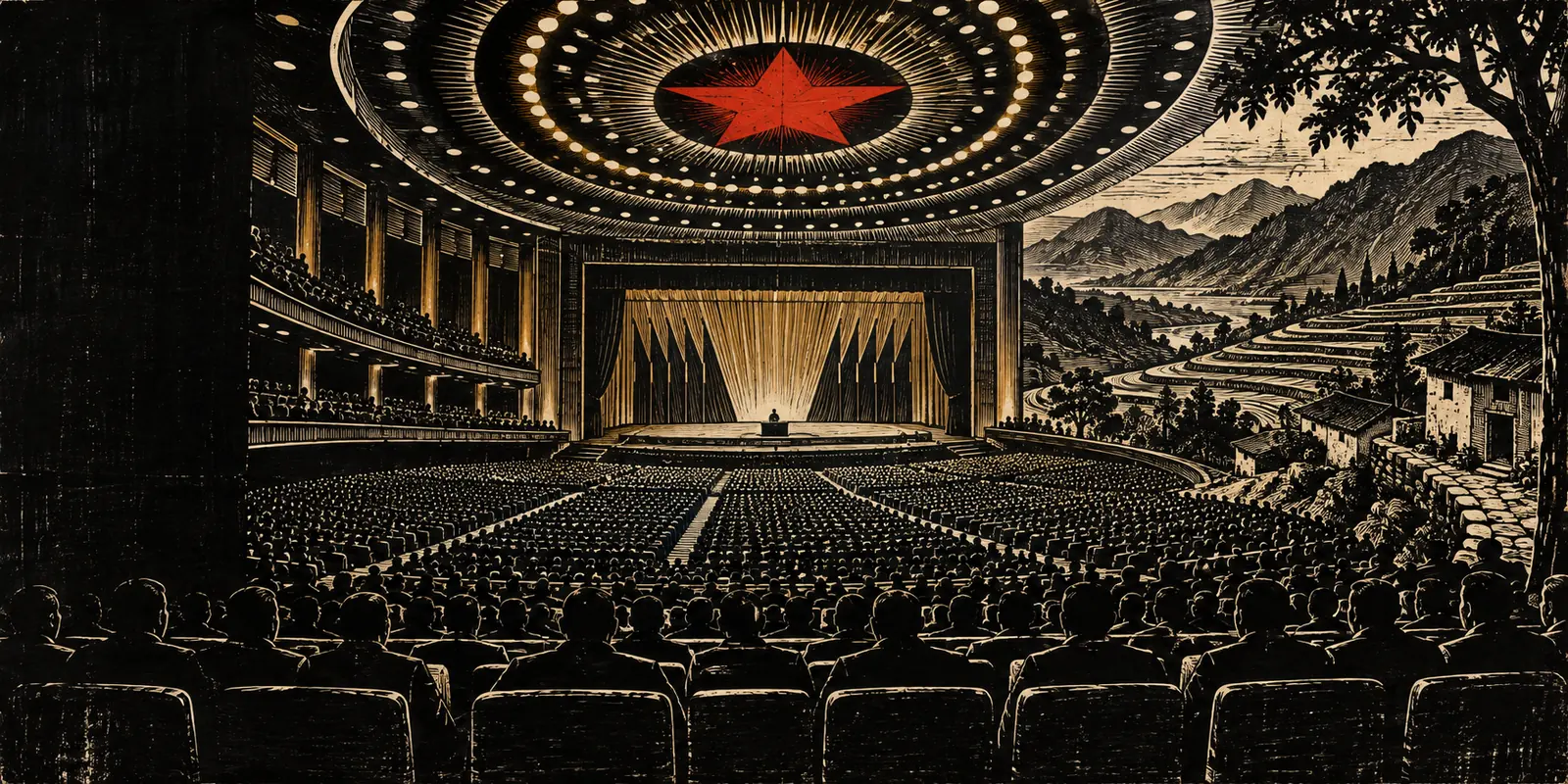
On February 25, 2021, Xi Jinping stood in the Great Hall of the People in Beijing and said China had achieved a complete victory in its fight against poverty. He called it a miracle on this earth. The list behind the sentence had 832 names. Those were the counties officially marked impoverished. Together they covered territory about the size of Western Europe. Every one of them had been taken off the list. Nearly 99 million rural residents, more people than live in Germany, had been counted above the national poverty line in eight years. The number of impoverished villages that had received basic infrastructure and services was 128,000.
The obvious doubt came from the same government's other numbers. Provincial officials had been caught inventing GDP figures for years. Inner Mongolia, Liaoning, Tianjin, and other provinces admitted statistical fraud in the late 2010s. A government that fakes growth has earned suspicion about household poverty rolls too.
Then there were the satellites. Nightlight analysis uses pictures from orbit to measure how much artificial light a place gives off, and how that light changes. Across the 832 counties the night got brighter in a sustained way, the pattern you would expect from electricity, roads, newer housing, and shops. Light is hard to invent on a form. The World Bank's own 2021 assessment verified what it called the main dimensions of the poverty-reduction claim. The China Beige Book, a private service that surveys Chinese businesses and households without using government statistics, reported rising rural consumption and infrastructure improvement in the same regions.
The program that produced the list was not a welfare expansion in the ordinary sense. Xi formally launched Targeted Poverty Alleviation in 2013. The design was the one China uses for disasters and for building things: name the objective, send the people, tie careers to the result, measure it. Earlier anti-poverty work had sent money by region and by blanket subsidy. Local governments got richer. Households often did not.
By 2014 every household in the 832 counties had been surveyed one by one. Each poor family went into an electronic register: who lived there, where income came from, health, housing, and the specific reason that family was poor. The file sorted households into five kinds of help. Some were to be reached through local industry. Some were to be moved. Some fit ecological compensation, payment for protecting land rather than farming it hard. Some needed school support. Some needed a direct social-security transfer.
The state then sent 255,000 resident work teams into the countryside, more than three million officials from central, provincial, and county agencies. They were not visitors who filed a report and left. They lived in the villages, often for years, and were personally responsible for named households. The chapter's description of the work is domestic and specific. They ate in village canteens. They sat in village meetings. They were supposed to know which families had a sick child, which had a father who drank, which had land and no water, which had water and no road to a market. The entire U.S. Peace Corps, over 65 years, has fielded about 240,000 volunteers. This campaign put more than ten times that number into one effort, and they were not volunteers. Promotion depended on whether the families on the list crossed the line.
Yuen Yuen Ang, a political scientist at Johns Hopkins, called the structure directed improvisation. Beijing set the targets, the measurements, and the career consequences. The village chose the method. Teams in Guizhou might push mushroom growing. Teams in Yunnan might push tourism built around local ethnic culture. Officials in Gansu might move people off unstable ground. She described the result as normatively weak institutions being functionally strong: no independent judiciary, no free press, no democratic accountability, and still a measurable result on one defined job.
The money matched the staffing. Fiscal transfers for poverty alleviation rose from 7.5 billion yuan in 2015 to 126.1 billion yuan in 2019, nearly seventeen times in four years. Total government spending on the campaign over three years passed one trillion yuan, roughly 150 billion dollars.
Between 2013 and 2020, 98.99 million rural residents crossed China's national poverty line. Per capita income in the designated poor areas reached 11,567 yuan in 2019, up 11.5 percent from the year before. By 2021, 31.45 million of the people who had been lifted out of poverty had found jobs. The campaign tied the exit from poverty to work: supply chains, farm cooperatives, factories moved closer, and managed channels into city labor. Since 1978, China's share of the worldwide drop in extreme poverty was about 75 percent.
The World Bank's 2021 review, done apart from simply repeating Beijing's press line, confirmed that China had met the main dimensions of its targets. It also flagged whether the gains would last, and whether the poverty line itself was high enough.
Branko Milanovic, an economist known for work on global inequality, put the eight years inside a longer story. He argued that Chinese poverty reduction was driven first by GDP growth and by managed urbanization, the planned movement of people into cities. Most of the hundreds of millions who rose above extreme poverty did so between 1978 and 2013, as workers left farms for factories. A one percent rise in migration rates lined up with a 3.2 percent drop in poverty risk. By 2020 China had about 286 million migrant workers. In that framing, the 2013 campaign was the last push: the roughly 100 million people in remote, disadvantaged places that growth had not reached. Villages with no road. Counties with no working hospital. Places where a factory job was days of travel away. Growth and urbanization concentrate. They do not, by themselves, finish the last percentiles. The campaign mopped up. It did not start the job.
The doubt does not disappear because the nightlights rose. The same career link that made officials care also made it useful to reclassify a family as non-poor before the family had really crossed. Chinese media carried reports, through the campaign, of what was called checkbox poverty alleviation: cadres pressing families to sign that they had left the rolls. The central government acknowledged the problem and added audits. The incentive to game the number remained. Satellite light measures buildings and power, not income or health. The Beige Book's sample may miss the most remote places. The World Bank used some data that Chinese agencies supplied, though it also noted limits, and it had worked with China on poverty for decades. Taken together, the chapter's conclusion is that the claim of roughly 100 million people above the line is substantially accurate, even if the headline number is more precise than the evidence.
Martin Jacques, a British political theorist who describes China as a civilization-state, argued that Western judgments keep using the wrong test. Competitive elections, an independent court system, and a free press are absent, and the material record, in his argument, still favors Beijing if the test is whether citizens' material lives improved. The chapter records the comparison he and the hawk reading use. India's rural employment guarantee, launched in 2005, took a decade to reach its coverage target and still had implementation gaps. Brazil's Bolsa Familia, a celebrated cash program, reached about 50 million people at its peak. The Chinese campaign reached nearly 100 million and tracked households more finely. The hawk reading treats the missing elections as the feature that lets a career be tied to twelve named families rather than to a campaign advertisement. The chapter says that argument is serious, and that waving at abuses does not answer the narrow question of whether aligned institutions hit a measurable target.
The line itself is the first limit. China's national threshold was 2,300 yuan per person per year at 2010 prices, about 0.93 dollars a day. The World Bank's lowest international line was 2.15 dollars a day. At the Bank's 5.50-dollar line, the one it recommends for upper-middle-income countries, a category China has been in since 2010, about 330 million people were still poor when Xi declared victory. That is more people than live in the United States. Moving from destitution to bare subsistence is a real change for the person who makes it. The phrase eliminated absolute poverty depends on a definition no international institution treats as adequate for a country with China's income.
Yasheng Huang, an economist at M.I.T., argued that the sharpest drop in Chinese poverty came in the 1980s, from farm reform and rural businesses under the township and village enterprise model, a period of looser local control and markets, not a state campaign. In his account, the turn to state-led industry in the 1990s slowed rural income growth and widened the gap between city and countryside. The 2013 campaign, on that reading, was partly cleaning up a problem state-heavy investment had made by pouring money into cities and state-owned firms and leaving villages behind.
Inside the targeted regions, women's average income stayed about 20 percent below men's. A household could cross the line while the women in it stayed economically dependent. Ethnic minorities were overrepresented among the people still poor, in line with where minority populations live, in the remote western provinces.
The hukou system is the limit the campaign did not touch. Hukou is the household registration that decides which city's schools, hospitals, and pensions a person can use. The 286 million migrant workers who staffed urban factories were denied those urban services in the cities where they actually lived and worked. Fewer than 20 percent of them were in any social insurance. They left the 832 counties for Shenzhen, Dongguan, Hangzhou, and Chengdu. Remittances, the money sent home, lifted families over the rural line. In the cities that produced the GDP, they could not put their children in local schools on equal terms, could not use urban health care the same way, and could not buy housing on the same terms as registered city residents. The village problem was counted as solved. The city status of the people who had left was not.
The demographic numbers sit beside that victory. In 2025 China's fertility rate was 0.96 births per woman, under half of replacement, the level that keeps a population stable. The population fell by 3.39 million in 2025, the fourth straight year of decline. Births were 7.92 million, the lowest since the People's Republic was founded. Raising a child to eighteen cost 538,000 yuan, about 75,000 dollars, or 6.3 times per capita GDP. Housing prices jumped 54 percent between 2016 and 2021. That surge lined up with a 45 percent drop in the birth rate, and the chapter identifies housing cost as the main driver of fewer births.
Lying flat, tang ping, and let it rot, bai lan, spread among young adults in the early 2020s as a refusal of the bargain the chapter states as work hard, give up personal autonomy, and the state will keep raising living standards. The children of rural families who had migrated, gone to school, and entered the workforce were declining to have children of their own.
On February 25, 2021, the 832 counties were off the list. The line they had cleared was about 0.93 dollars a day. Three hundred thirty million people were still under the World Bank's line for a country at China's income. The nightlights over the counties were brighter than they had been in 2013. The hukou book in Shenzhen had not been rewritten for the workers who sent the money home.
Comments
Reader notes
Comments aren't live yet. Send notes to @slop_dealer.