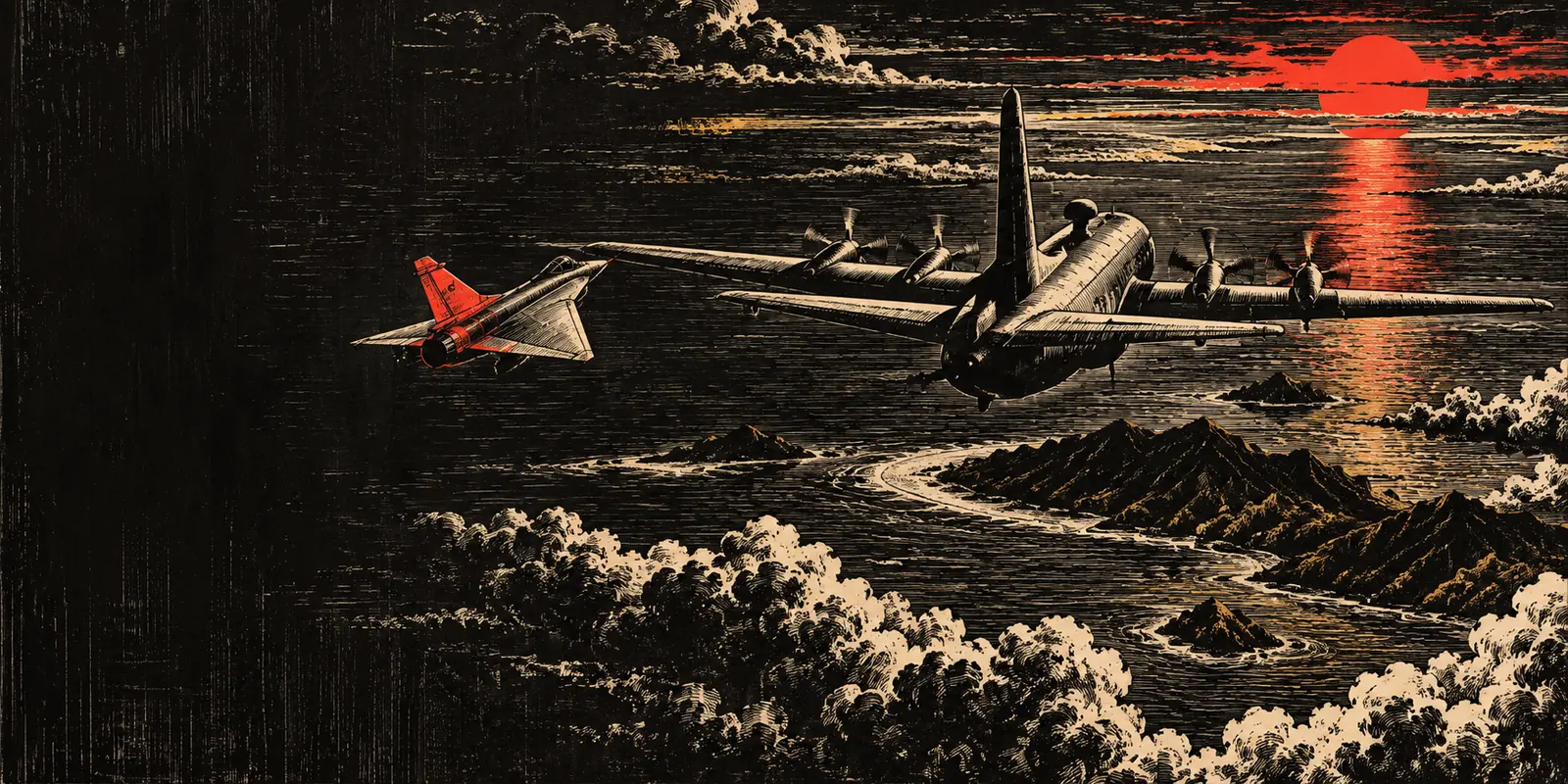
On January 24, 2001, a Chinese fighter closed to within twenty feet of an American surveillance plane. Twenty feet is near enough for the crew to read the markings on the other aircraft's fuselage. It is also near enough to read an email address written on a piece of paper.
The American plane was an EP-3E ARIES II, a four-engine turboprop packed with surveillance electronics. Its job was signals intelligence, which means collecting the electronic noise a military gives off: radar emissions, communications traffic, and the telemetry that tells a distant listener how a weapon or a ship is behaving. The chapter describes it as a flying vacuum cleaner for those signals, working along China's southern coast. The flights were in international airspace, and the chapter says they were legal under international law. They were also, the same account says, deeply provocative to Beijing. The Bush administration, then new, understood that in the abstract and chose not to dwell on it.
The jet alongside was a Chinese interceptor, flown by Lieutenant Commander Wang Wei. On that January day he intercepted an EP-3 and closed to within twenty feet. Then he held up a piece of paper with his email address written on it. A fighter pilot, at the controls of a supersonic interceptor, flew alongside the foreign surveillance aircraft and held up a piece of paper with his email address.
The United States formally protested the January incident through diplomatic channels. Nothing changed. Wang Wei kept flying. His commanders kept clearing him to intercept.
The next time the chapter puts him in the same sky is April 1, 2001. Lieutenant Shane Osborn was at 22,500 feet, about seventy miles southeast of Hainan Island, in an EP-3E on what the crew treated as a routine signals mission. The plane was doing roughly 300 knots. A pair of J-8II interceptors was shadowing it. Wang Wei was in one of them. The pass Osborn was watching was Wang Wei's third close pass of the morning.
On that third pass, Wang Wei misjudged. His J-8 clipped the EP-3's number one propeller. The collision ripped the nose cone off the American aircraft and damaged two of its four engines. Wang Wei's fighter broke into two pieces. He ejected. His body was never recovered. He was thirty-three years old. The Chinese Navy searched for fourteen days. Searchers found debris from his aircraft and nothing else.
The EP-3 dropped between 8,000 and 14,000 feet in seconds. It rolled inverted. The crew were pinned to the ceiling of the fuselage. Twenty-four people were inside a metal tube over water, with two engines damaged and the nose sheared off. The chapter records Osborn's first thought in five words: "This guy just killed us." He had not been killed. He fought the aircraft back to level flight and assessed the damage. He decided a water landing would likely be fatal, given the structural damage. Then he made the call the chapter says defined the next eleven days. He turned toward Lingshui airfield on Hainan Island and put the crippled plane down on a Chinese military runway. He did it without clearance, without radio contact, and without any certainty about what would happen when the wheels stopped.
Twenty-four American service members were on Chinese soil, sitting in a surveillance aircraft full of classified intelligence equipment. The Pentagon later rated that equipment among its highest-sensitivity Pacific assets. The crew understood the stakes. They had roughly twenty-six minutes before Chinese personnel boarded. In that window they smashed classified equipment with axes and poured coffee into hard drives. The standard destruction protocol needed more time than they had, and more thoroughness than the field conditions allowed. The destruction was only partly successful.
A Pentagon assessment later concluded it was "highly probable" that China obtained enough classified material to develop countermeasures against American surveillance. The chapter is careful about the contents of that haul. It says the material reportedly included cryptographic keys, operating manuals for signals intelligence, lists of National Security Agency employees, and data revealing the United States' ability to track Chinese Navy submarines. If that reporting is accurate, the chapter says, an accident of pilot recklessness had opened a window onto methods the NSA had classified at the highest compartmented levels. Compartmented, here, means the material was walled off even from people who held ordinary high clearances. The implications the chapter draws for submarine warfare are specific: if Beijing could see which of its submarine movements the United States was tracking, and how, it could change those operations and reduce American visibility. The chapter places that possibility at the start of a long modernization of the People's Liberation Army Navy. The same chapter treats the haul as accidental. It was not a plan. It was a midair collision, then twenty-six minutes of axes and coffee that did not finish the job.
What followed the landing was eleven days over a form of words. Washington wanted the crew back. Beijing wanted an apology. The early hours, the chapter says, were a fog of competing signals, and neither side was working from a single playbook.
On the American side the Bush administration was barely three months old, still calibrating its Asia posture. The chapter's account of the split is between named officials, not a private conversation: Vice President Cheney and Secretary of Defense Rumsfeld favored a hard line, and Secretary of State Powell, a former chairman of the Joint Chiefs, pushed for a diplomatic resolution. That tension constrained how fast Washington could move. The chapter says that, next to Beijing, the American process was still the more coherent of the two.
Three Chinese institutions held pieces of the crisis, and the chapter says each defined the problem differently. The People's Liberation Army had lost a pilot and had the intelligence hardware on the tarmac at Lingshui. The chapter reads the military's incentive as national honor, a demonstration that American surveillance flights carried consequences, and time to exploit the aircraft. The Ministry of Foreign Affairs held the relationship with the world's sole superpower, including trade, investment, and World Trade Organization accession, then in its final negotiating stages. The chapter reads the ministry's incentive as a face-saving formula, reached quickly. The propaganda apparatus needed a domestic story of national honor. Once state media was broadcasting American arrogance and Chinese victimhood, the chapter says, those narratives developed their own momentum. Walking them back required political authority the propaganda bureaucracy did not have on its own.
The person who might have sorted those interests was not in the capital. President Jiang Zemin was traveling internationally and would not return until April 9. The chapter pauses on that absence. It calls the collision a particularly serious military incident between China and the United States since the 1999 bombing of the Chinese embassy in Belgrade, and it says the system Jiang led could not, while he was abroad, produce a coherent negotiating position. For nine days the talks went essentially nowhere. The PLA pushed its narrative. State media amplified it. The foreign ministry met American diplomats and produced formulas, counter-formulas, and rejected drafts. No single authority was choosing among them.
The framework the chapter uses for those nine days comes from Philip Saunders, whose assessment of China's security decision-making in the Jiang era described a system that was "fragmented" across military and civilian channels, with insufficient coordination between them. The chapter's reading is not a monolith. It is a tangle in which several actors held partial vetoes and nobody held full authority. The PLA could block concessions it opposed. The foreign ministry could block escalation it feared. Neither could force the other to accept a resolution.
Then Jiang came home. Darryl Johnson, the Deputy Assistant Secretary of State handling the American side of the talks, noted the shift as it happened. The chapter records that he placed the first real progress on Monday, April 9, which he tied to the return of Jiang and his delegation. Within twenty-four hours of that return, the two sides agreed on a letter that would secure the crew's release. The chapter's timeline is nine days of institutional paralysis, then one day of presidential engagement.
The letter that ended the standoff went from Ambassador Joseph Prueher to Chinese Foreign Minister Tang Jiaxuan. It contained two expressions of regret. The first, which the chapter quotes, was "We are very sorry for the loss" of pilot Wang Wei. The second is longer than this draft will set down as one quotation. In substance it said the United States was very sorry that the entry into China's airspace and the landing had not had verbal clearance. The chapter's reading of the first sentence is sorrow for a death without an acceptance of responsibility for causing it. Its reading of the second is regret for a missing radio call, not a concession that the landing was unauthorized in a legal sense. An aircraft in distress, the chapter notes, has a right under international convention to land at the nearest available airfield. The letter does not dispute that. It notes that the crew did not radio ahead. The reason the letter leaves unmentioned, as the chapter states it, is that the crew were trying not to die in an aircraft with its nose ripped off.
Secretary of State Colin Powell was explicit about what the letter was. He told the press it was an "expression of regret and sorrow." It was not an apology. The United States, he said, "had not done anything wrong." Chinese officials immediately described the same letter as an American apology. State media broadcast the word "sorry" without Powell's gloss. For the domestic audience, the chapter says, the message was that the Americans had apologized.
The chapter keeps both readings as defensible inside their own languages. The English word "sorry" runs from sympathy to an admission of fault. The Chinese translation of the letter, the chapter says, selected terms closer to fault. Powell could tell the American press it was not an apology. Chinese state media could tell a domestic audience it was. The chapter's line is that neither side was exactly lying, and that the letter was built to sit in the gap between those meanings.
The chapter also records what each institution could claim once the letter existed. The PLA got a public acknowledgment of Wang Wei's death and his posthumous elevation to a national hero. The foreign ministry got a path to de-escalation. The propaganda system got a word it could broadcast as an apology. In the months after the crisis, the chapter says, China briefly lessened the aggressiveness with which it monitored reconnaissance flights. The older pattern of close intercepts eventually resumed. No policy on the flights themselves changed. American surveillance along the coast, and Chinese objections to it, continued.
The crew was released on April 12. The chapter says they came home unharmed. The EP-3 stayed on Hainan for months while Chinese intelligence teams, the chapter says, presumably extracted what value remained in its systems. In July 2001 the aircraft was returned to the United States, taken apart and loaded onto two Russian-built Antonov An-124 cargo planes. The bill the Chinese government presented for the crew's food and lodging during the eleven days was $34,567. The United States paid it.
Comments
Reader notes
Comments aren't live yet. Send notes to @slop_dealer.