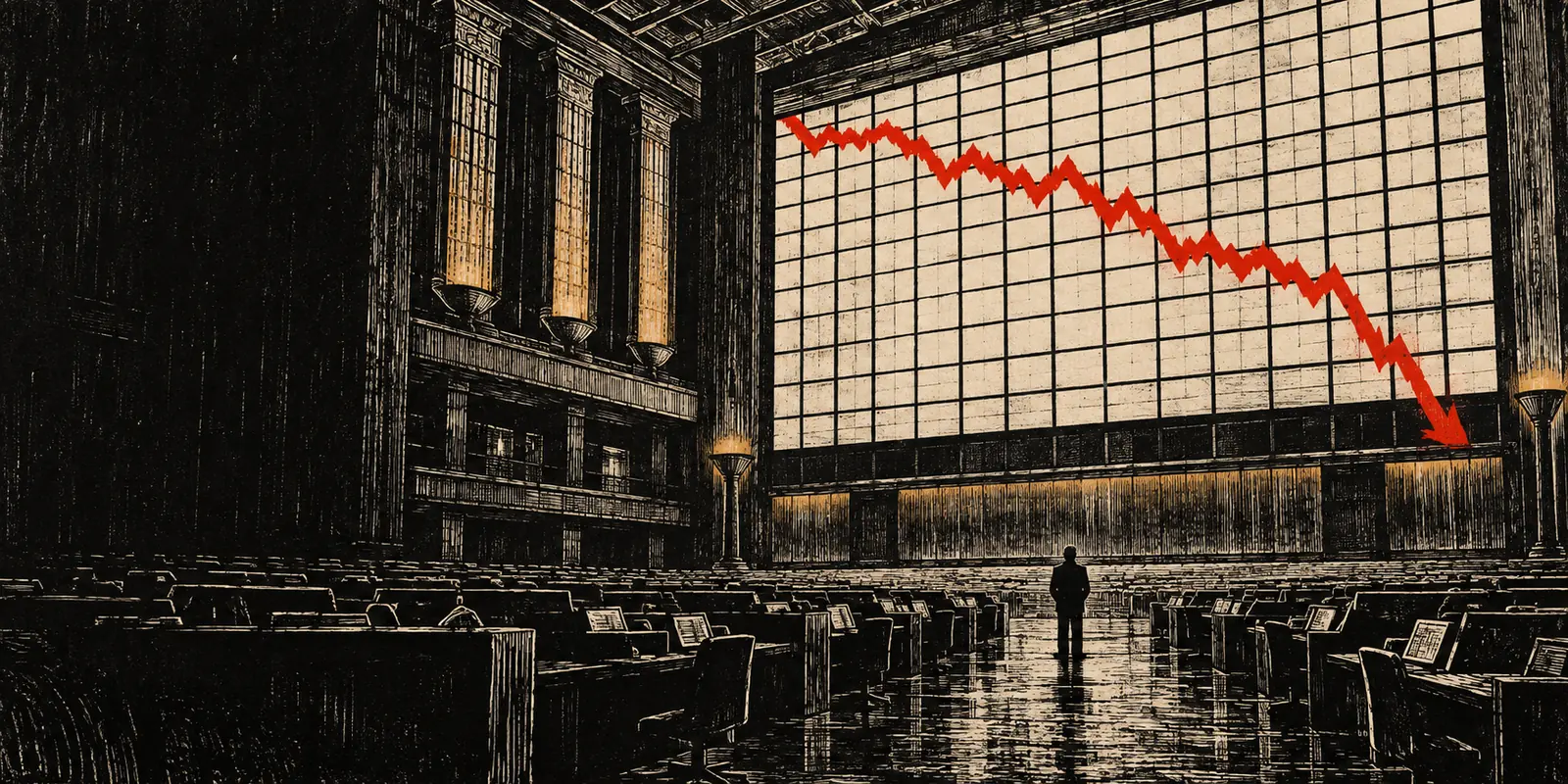
On January 4, 2016, the new circuit breaker tripped. A circuit breaker, in a stock market, is a rule that stops trading when prices move too far, too fast. The idea is to interrupt a panic long enough for people to think. This one had been live for exactly one business day. It was modeled on a system the United States had used since the 1987 crash. Public consultation on the Chinese version drew 4,861 responses. The thresholds were calibrated against eleven years of historical trading data.
Two numbers governed the CSI 300, an index of 300 large companies on the mainland exchanges. A swing of 5 percent would pause trading for fifteen minutes. A swing of 7 percent would shut the market for the day.
At 1:13 p.m. Beijing time on January 4, the CSI 300 hit the first threshold. Trading halted. At 1:28 p.m. it resumed. Six minutes later, at 1:34 p.m., the index crossed 7 percent and the market closed for the day. The blue-chip CSI 300 dropped 8 percent. The Shanghai Composite, a broader index of shares in Shanghai, fell 6.9 percent. The technology-heavy Shenzhen Composite lost more than 8 percent. Together, the chapter says, the rout erased more than 1 trillion dollars in market value. The same day, the chapter records, the People's Bank of China injected 130 billion yuan, about 20 billion dollars, in short-term liquidity.
Three days later, on January 7, the same mechanism triggered again. This time it took less than thirty minutes of the session. At 9:42 a.m. the first threshold hit and trading paused. At 9:57 a.m. trading resumed. Within two minutes the index fell another 2 percent, crossed the 7 percent line, and the market shut for the rest of the day. The chapter calls it the shortest full trading session in the history of Chinese securities markets. That evening the commission suspended the circuit breaker, effective the next morning. The commission said the mechanism "had not achieved its expected effect" and that it "had intensified investors' concerns" rather than calming them.
Four days of operation. Three triggered halts. Then the kill switch. By January 15 the stock market had shed over 18 percent of its value. The chapter says the meltdown set off a global rout, with the Dow Jones Industrial Average falling 8.2 percent from January 4 to January 15. Wu Hong, director of the School of Economic Law at East China University of Political Science and Law, offered a muted defense to the Global Times. He did not claim the device had worked. He said, in substance, that a circuit breaker does not itself intensify stock fluctuations, but that the system might not be mature enough in China.
The design process looked, on paper, like the one a Western observer would ask for.
From September 7 to September 21, 2015, the Shanghai Stock Exchange, the Shenzhen Stock Exchange, and the China Financial Futures Exchange asked for public comments on draft rules. The exchanges analyzed eleven years of volatility data. The original proposed halt, thirty minutes, was cut to fifteen after consultation, because most respondents thought half an hour was too long. The mechanism was formally published on December 4, 2015, and activated on January 1, 2016, after a week of technical testing. CSRC Chairman Xiao Gang would later maintain that the circuit breaker needed no approval from the State Council, which is China's cabinet. The chapter treats that detail as evidence that the decision sat at the regulatory level, with a degree of technical autonomy, rather than being rammed through by political fiat. Regulators believed they were importing an international practice, with data, public comment, and a test before launch.
The concept was borrowed. The United States had run circuit breakers since the October 1987 crash, and the chapter says most major markets operated similar systems. The commission's justification for two thresholds, as the chapter quotes it in pieces, was that China's market had "relatively high two-way volatility," and that a graduated system was "more conducive in curbing excessive trading and controlling market fluctuations." The whole path from the opening of public consultation to the switch being thrown compressed, the chapter says, into roughly three and a half months. Calls for a breaker, in the chapter's quoted phrase, had "gained momentum after a stock market rout in the summer."
It failed within hours of meeting a real market. The chapter's name for the failure is the magnet effect. When traders know a hard halt sits at a known price, they do not wait. They sell before the halt, because once trading stops they are stuck in a falling position with no exit. The threshold pulls prices toward it. Academic writing on the effect goes back at least to the 1990s. MIT Sloan professor Markus Brunnermeier and colleagues had warned that a circuit-breaker threshold could "backfire" if it was set too tightly for the market's ordinary volatility. The chapter says this was not obscure knowledge. China's own China Financial Futures Exchange had researched how other countries ran these mechanisms.
The structure of the mainland market made the magnet worse, on this reading. More than 80 percent of trading on the Shanghai and Shenzhen exchanges was done by individual retail investors, against about 15 percent in the United States. A 5 percent threshold, in a market with that mix and with higher day-to-day swings, would trip during ordinary reactions to news. The gap between the two thresholds was only 2 percentage points. One analysis in the chapter's sources says that narrow gap, in most cases, makes a second trigger almost unavoidable once the first halt has happened. The chapter quotes that analysis in nine words: "in most cases makes a second trigger almost unavoidable." January 4 left six minutes between the restart and the close. January 7 left two. The fifteen-minute pause did not cool the selling. It packed the remaining fear into a window where everyone could see how little further the index had to fall before the doors locked.
Ding Jianping, director of the Research Center for Modern Finance at Shanghai University of Finance and Economics, put the design failure in practical terms after the suspension. The commission should have run simulations with research institutions to see how the levels should be set for domestic markets. The exchanges had tested from December 25 until launch. They had not simulated the panic of a market still shaken by the 2015 crash.
That crash is the floor the January decision stood on. Between June 2014 and June 2015 the Shanghai Composite ran from roughly 2,037 to a peak of 5,166, a gain of more than 150 percent in twelve months. A large part of the rally was retail investors using borrowed money. Credit Suisse estimated leveraged funds in the market at between 4.4 trillion and 5.9 trillion yuan, roughly 621 billion to 833 billion dollars, or 6 to 9 percent of the Shanghai exchange's total capitalization. State media, including People's Daily, ran editorials describing the rise as a sign of national economic strength and encouraging retail investors to take part. The chapter says the rally was, in significant part, a policy-encouraged phenomenon, aligned with Xi Jinping's "China Dream" of prosperity and a higher international standing. It was not, on that account, only a spontaneous vote of confidence.
On June 12, 2015, the bubble popped after the commission released draft rules restricting shadow-financed margin accounts, meaning loans for stock purchases arranged outside the formal margin system. Margin investors sold as their accounts neared the limits of their leverage. The chapter describes a loop: forced sales pushed prices down, which forced more sales. Within a month the Shanghai Composite lost roughly a third of its value. From mid-June to early July 2015 the index plunged 32 percent. The chapter says that drop wiped out more than 18 trillion yuan in share value, equivalent to about 30 percent of China's 2014 GDP.
The response from July to September 2015 was a buying campaign the chapter calls the national team. State-owned financial vehicles, led by the China Securities Finance Corporation and China Central Huijin Investment, were directed to buy shares in the open market. The People's Bank of China provided about 42 billion dollars in direct funding for that purpose. Brokerages were ordered to buy stocks with cash the government supplied. Two hundred ninety-two state-owned enterprises committed to purchasing their own shares. Around 1,300 firms, representing 45 percent of the stock market, suspended trading of their shares entirely, so that for nearly half the listed universe there was no price to discover. Initial public offerings were frozen. Short selling was restricted. Investors were allowed to pledge their homes as collateral to buy more stocks.
Spending by the national team in those months reached approximately 1.6 trillion yuan, about 240 billion dollars. Academic analysis by Huang and colleagues, as the chapter reports it, found net value gains of 2,464 billion to 3,402 billion yuan, roughly 5 percent of GDP, through demand effects and lower default probabilities. The costs of the purchases, depending on the valuation method, ranged from 321.9 billion to 818.6 billion yuan. By late August, after a "Black Monday" on August 24 sent global markets reeling, the chapter says all the bailout funds were underwater.
The official story during that summer added a second confusion. Officials blamed "foreign forces" for the instability and cracked down on financial journalism. The chapter says 197 people were arrested, including reporters accused of "spreading rumors." For the securities regulator, the chapter's reading of the lesson was that it needed to be seen as competent and in control. It needed a mechanism. The circuit breaker was conceived in that aftermath, as something regulators could point to and call one.
The chapter does not let the magnet story stand alone. One empirical study of intraday trading in this period found that the breakers were "not easily reachable and have no 'magnet effect' between two thresholds." That study's conclusion, as the chapter reports it, is that Chinese markets still needed a circuit breaker to protect investors and to keep the market liquid, but with different settings. If the magnet was weaker than the critics say, the failure looks less like a bad drawing and more like terrible timing: a new, unfamiliar halt switched on in a market already primed to panic.
The chapter also records the hawk reading that the breaker did not cause the January selling. On January 7 the People's Bank of China set the daily renminbi reference rate 0.5 percent lower against the dollar, which investors read as official worry about the economy. December manufacturing data, released January 3, showed contraction at 48.2 on the purchasing managers' index, where a reading under 50 means the factory sector was shrinking. A ban on large shareholder sales was set to expire on January 8, which the chapter says created the anticipation of a wave of extra shares. The market was going to fall anyway, on that account. The breaker did not create the selling. It stopped orderly trading in the middle of it. The chapter also records that shareholder-sale bans were extended as part of the wider response.
Xiao Gang made a version of that case in a 2019 speech. He called the 2015 crash "inevitable," a liquidity crisis caused by too much leverage, and said the plunge set off widespread panic. He maintained that the national team's purchases had been "necessary and correct" because liquidity had dried up, mutual-fund investors had started redeeming, buying and selling were extremely unbalanced, and a collapse of confidence was likely to become a systemic risk. The chapter reports that argument. It does not treat it as the last word.
Adam Tooze, in the chapter's account, supplies the wider frame. China's equity trouble cannot be separated from the global financial system. When China's economy, in Tooze's phrase as the chapter quotes it, "seemed to be wobbling in 2015," the effects were large enough that Janet Yellen's Federal Reserve postponed a rate increase in September 2015 and cited China as the reason. The August 2015 yuan devaluation, which the chapter places in the panic backdrop, is described there not mainly as a bid to boost exports but as an acknowledgment that, in the chapter's quotation, "the reference exchange rate has been overvalued more than the market perceptions." The commission was not, on this reading, designing a rule in a closed domestic room.
The hawk account in the chapter has two further points. Suspending the breaker after four days, rather than defending a device that was visibly failing, looked like pragmatism the stereotype of a rigid bureaucracy would not predict. The market rose 1.97 percent on the first trading day after the halt was lifted. And the comparison is not only domestic. American circuit breakers needed several redesigns after 1987, including a major overhaul after the 2010 Flash Crash. The European Union, the chapter says, debated harmonizing such rules for years without a consensus. Scrapping the mechanism in four days, rather than defending it for months, can be read, on that account, as a fast reversal. The chapter leaves that reading on the table.
It also records costs that outlasted the four days. The breaker's lifespan, the chapter says, created an impression of regulatory incompetence that damaged China's credibility with international investors for years. In February 2016 Xiao Gang was replaced as chairman by Liu Shiyu, which the chapter reads as a turn from reform toward risk-averse regulation. The mechanism was never reintroduced. By suspending it in response to panic rather than recalibrating it, the chapter says, the commission reinforced an expectation that Beijing would reverse a policy that proved unpopular.
Foreign-exchange reserves fell a record 107.9 billion dollars from December to January, leaving total reserves at 3.33 trillion dollars. Capital left China at an annualized rate of roughly 1 trillion dollars in the second half of 2015, even with a record trade surplus of 595 billion dollars that year. The chapter's parallel count of that flight runs through portfolio outflows, trade misinvoicing, and the "net errors and omissions" line in the balance of payments. Federal Reserve economist Sarah Simon estimated that disguised outflows through the travel account alone grew to around 1 percent of GDP in 2015 and 2016, about a quarter of recorded net private financial outflows. Official reserves, which had peaked at just over 4 trillion dollars in June 2014, stood at 3.12 trillion by October 2016, a loss of roughly 880 billion dollars, or 22 percent of the peak. The chapter is explicit that the circuit breaker did not cause that hemorrhage. It says the failure accelerated a collapse of confidence that made every other tool more expensive.
The national team's holdings did not vanish with the panic. By 2024, the chapter says, cumulative equity holdings had grown to approximately 4 trillion yuan in mainland A-shares, with close to 80 percent concentrated in bank shares, a distortion in price discovery that lasted nearly a decade.
Under the design, the chapter places a further problem the commission could not have fixed by itself: the numbers it had to work with. Li Keqiang, the chapter says, had privately told the U.S. ambassador in 2007 that GDP figures were "man-made" and "for reference only." By 2016, provincial GDP fraud was extensive enough that the sum of regional GDP figures exceeded the national total by 3.6 trillion yuan, roughly 5 percent of reported output. Independent satellite-based estimates, as the chapter cites them, suggest that cumulative Chinese growth from 1992 to 2006 may have been overstated by as much as 65 percent. The chapter's conditional is the point it keeps: if the regulators who set the thresholds were using official volatility data from that statistical environment, the calibration was working from a corrupted baseline.
Comments
Reader notes
Comments aren't live yet. Send notes to @slop_dealer.