On March 12, 2020, Foreign Ministry spokesman Zhao Lijian posted a tweet suggesting the United States military might have brought COVID-19 to Wuhan during the Military World Games in October 2019. The claim had no credible evidence behind it. The tweet was not cleared with his superiors. It spread anyway.
Zhao had been on Twitter since 2010, years before most Chinese diplomats treated the platform as relevant. He had 780,000 followers by the end of 2020 and 1.9 million by 2023. Around 2019, performance reviews for Chinese diplomats added a public-relations section that rewarded active social-media use and controversial media appearances. A headline could be scored as achievement in a way a quiet negotiation could not.
Journalists named the new style wolf warrior diplomacy, after a pair of nationalist action films released in 2015 and 2017. The films were domestic box-office hits. They celebrated uncompromising Chinese power abroad. Xi Jinping had already moved the formal posture away from Deng Xiaoping's hide your strength, bide your time, toward what officials called striving for achievement. The films supplied the nickname. The reviews supplied the reason a diplomat might choose a fight.
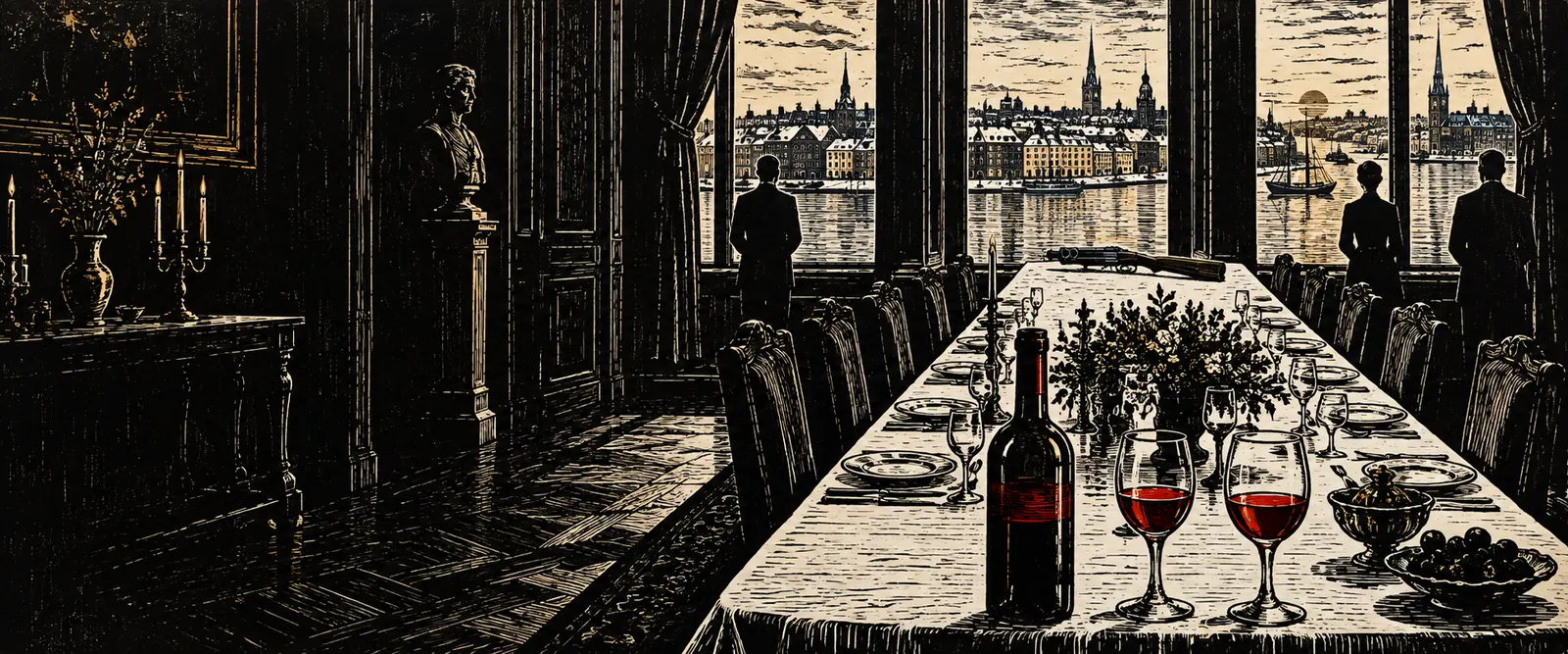
In Sweden, Ambassador Gui Congyou answered a Swedish literary group's decision to give a prize to imprisoned Hong Kong bookseller Gui Minhai. In November 2019 he said, in public, to his host country: "We treat our friends with fine wine, but for our enemies we have shotguns." It was not one remark. Over the following months the embassy in Stockholm threatened Swedish journalists, including reporter Rune Lykkeberg at the newspaper Expressen. In his first two years as ambassador, Sweden's Foreign Ministry summoned him more than forty times. Several Swedish parties asked that he be declared persona non grata, the status that tells a diplomat to leave. Sweden had not been a focus of Chinese foreign policy. The ambassador made it one.
In France, Ambassador Lu Shaye criticized French lawmakers, scholars, and media over Taiwan. In April 2023 he questioned whether former Soviet republics in Eastern Europe, including Ukraine, were sovereign states. Later he called in public for the re-education of Taiwan's population to eliminate separatist thought, and compared the situation to how West Germany had treated its eastern counterpart. Europe was in the middle of Russia's full-scale invasion of Ukraine, the continent's most serious security crisis since the Cold War. A Chinese ambassador in Paris had just undercut the borders of Ukraine and of several European Union members. Asked about the wolf-warrior style, Lu said the work was not judged by how foreigners saw it, but by whether people at home were happy with it. The chapter treats that as a real metric, not a dodge. The audience that paid the career was domestic.
In November 2020 Zhao posted again. The image was computer-generated. It showed an Australian soldier cutting the throat of an Afghan child. He released it in answer to the Brereton Report, which documented Australian military misconduct in Afghanistan. Prime Minister Scott Morrison called the tweet truly repugnant. Leaders across Australian parties condemned it. A relationship that was already worsening hardened further.
The permission from the top is dated. At the 18th Party Congress in 2012, Xi opened what scholars describe as a shift from defensive economic consolidation toward active great-power competition. The formal phrases were striving for achievement and major-country diplomacy with Chinese characteristics. In 2017 Xi said China has stood up, grown rich and is becoming strong. In May 2021 he chaired a Politburo study session on international communication, framed around discourse power, meaning the ability to set the terms in which the world talks about China. That was permission to stop deferring to Western criticism. It was not a written order naming which diplomat should threaten which country on which app.
The acceleration from below is in the numbers. A study of 4,556 Foreign Ministry press-conference exchanges from 2020 to 2024 found that aggressive questions from foreign journalists were more likely to draw a wolf-warrior answer, especially when Western criticism was intense. Looking soft on foreign interference was already a career risk inside the bureaucracy. The external propaganda system, waixuan, had started as a way to reduce misunderstandings and attract investment. Critics came to call it an incompatible mixture of diplomacy and propaganda. A related phrase, waixuan neixuan hua, means doing foreign propaganda with the methods used at home: repetition, emotion, nationalist framing, and a refusal to grant that criticism might be legitimate. Diplomacy's older tools, negotiation and a way for the other side to save face, lose that contest.
Shi Yinhong, an international-relations professor at Renmin University and an adviser to the State Council, said in September 2020 that the aggressive posture had missed how complicated the pandemic world had become, and that it was being done too hastily, too soon, and too loudly. He described a wide gap between what was intended and what was achieved.
The ideas behind the permission have a name. Wang Huning sits on the Politburo Standing Committee and is widely treated as the main ideological writer behind three successive leaderships. In 1991 he published America Against America, after a year as a visiting scholar at the University of Iowa in 1988. He argued that radical individualism, consumerism, and the coming-apart of social ties were eating American society from inside, and that Americans treated their crises as technical problems rather than as cultural ones. If liberalism was the cause of decline, then Chinese diplomats had no reason to treat Western criticism as legitimate authority. The Century of Humiliation, the period of foreign domination from 1840 to 1949, sits inside Party legitimacy stories, school lessons, and strategic doctrine. In that script, a diplomat who refuses a lecture is refusing the powers that once divided Chinese territory. The chapter says that feeling helps explain domestic support for a style that was alienating foreign governments. It also says a hypothesis about Western decline does not cancel a real embargo or a real alliance.
Australia is where the bill has the clearest numbers. After Canberra called in April 2020 for an independent inquiry into how COVID-19 started, China put restrictions on Australian barley, beef, lamb, lobster, wine, timber, cotton, and coal. Research estimates gross export losses in the Chinese market rose from 3 billion Australian dollars in 2020 to 31 billion in 2022, at then-current prices. Net losses, after trade was diverted to other buyers, were about 20 billion Australian dollars over 2020 to 2022. Australia did not fold. It banned Huawei and ZTE from its 5G network and deepened defense ties with the United States through AUKUS. Public opinion that had been split unified against China.
In France, Lu's remarks on sovereignty fed a harder European Union line. In June 2023 the European Council restated that China is simultaneously a partner, a competitor, and a systemic rival. Before this period the EU's China policy had been mainly commercial. After it, security and values sat beside trade. Cambridge researchers found that negative public diplomacy is largely ineffective and can backfire, especially against rivals. Pew Research Center polling across 19 countries found views of China growing more negative, with human-rights concern at a median of 79 percent. Outside Singapore and Malaysia, majorities had little or no confidence in Xi: 89 percent in Japan, 88 percent in Australia, 87 percent in South Korea, 85 percent in Sweden, 83 percent in the United States, 80 percent in France.
Kaiser Kuo, who hosted the Sinica Podcast for more than a decade, has argued that both Western and Chinese stories about China are substantially wrong. Applied here, the chapter uses his point against two shortcuts: that the diplomats did not know what they were doing, or that the point was simply to bully smaller states. The diplomats were answering the reviews in front of them. Geremie Barmé, a cultural historian who founded the Australian Centre on China in the World, has argued that Communist Party governance still shows imperial-era habits of claiming a monopoly on truth, treating outside criticism as interference, and using propaganda as the form of speech. The chapter sets the two readings together. One is the mechanism. The other is why the mechanism felt normal to the people inside it.
Confucius Institutes are the same pattern on a slower clock. Launched in 2004, they reached about 500 sites at the peak. China spent an estimated 2 billion dollars worldwide and more than 150 million dollars in the United States alone between 2006 and 2019. The stated job was language teaching and cultural exchange. The operating assumption, the chapter says, was that Western universities given generous money would accept the conditions that came with it: stay off Taiwan, Tibet, Tiananmen, and Xinjiang, and let Hanban, the government's language council, hold real control over courses and teachers. That assumption matches how money moves inside China's own system. It does not match universities whose accreditation, faculty votes, and reputations are tied to academic freedom. The break became public when Hanban's director-general, Xu Lin, ordered staff to tear pages from the printed program of a European Association of Chinese Studies conference so that references to Taiwanese institutions would be gone. The American Association of University Professors called the institutes partnerships that sacrificed the integrity of the university. By 2023, 104 of the 118 Confucius Institutes that had operated in the United States were shut or closing. The chapter calls that an 88 percent attrition rate in the country where the project mattered most.
Beijing's own later words are part of the record. In May 2021 Xi called for efforts to create a loveable image of China. In September 2022 Foreign Ministry special envoy Wu Lenggui visited Europe and conceded that China had made mistakes, with wolf warrior diplomacy on the list. A European business leader who was in one of the meetings reported that the Chinese understood they had gone too far. In January 2023 Zhao Lijian was moved from the spokesman job to the Department of Boundary and Ocean Affairs, a sideways shift to a less visible post. By early 2025, belligerent answers at Foreign Ministry press conferences had fallen back to 2018 levels. Shaoyu Yuan, writing in September 2024, attributed the retreat mainly to domestic economic trouble, including a slowing economy, rather than to the diplomatic damage itself.
Gui Congyou had been summoned more than forty times. Zhao's Afghan image was still the one Morrison had called truly repugnant. The barley, the wine, and the coal had already been held at the dock. In January 2023 the man who posted the Military World Games tweet was no longer at the podium.
Comments
Reader notes
Comments aren't live yet. Send notes to @slop_dealer.