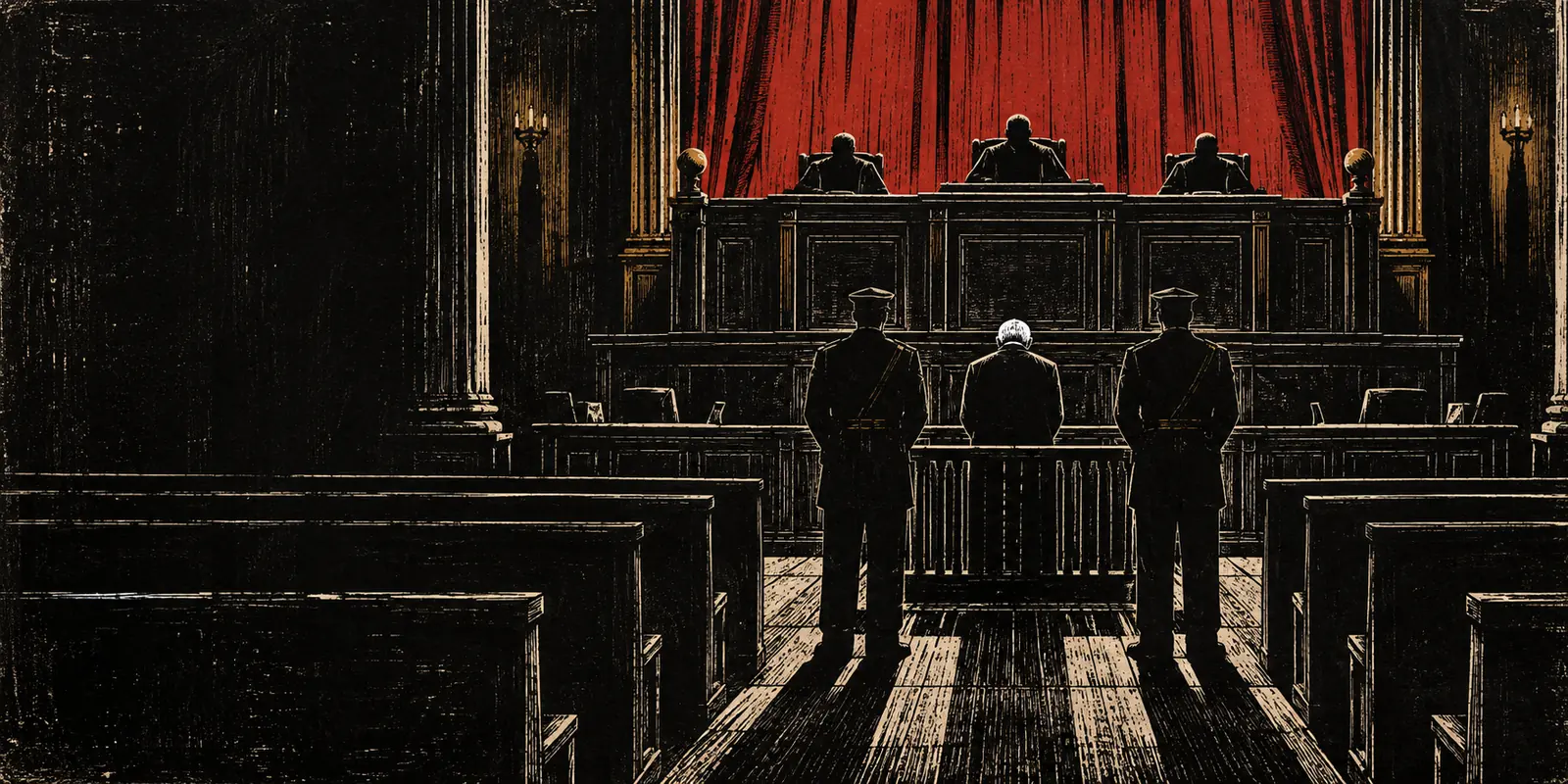
Zhou Yongkang had sat on the Politburo Standing Committee, the handful of men at the top of the Chinese Communist Party. For about thirty years, that seat had come with a practical immunity. Senior leaders of that rank were not sent to prison. Zhou Yongkang was. He received a life sentence. The chapter treats that sentence as the moment a convention broke.
The same campaign reached two generals who had been vice chairmen of the Central Military Commission, Xu Caihou and Guo Boxiong. Both were investigated and expelled from the Party. In June 2024 the defense minister, Li Shangfu, was expelled for taking financial bribes. In January 2026 the investigation named Zhang Youxia, a vice chairman of that same military commission, and the chapter calls him the highest-ranking military official the campaign had ever targeted.
The count behind those names is the other half of the story. Since 2012 the Party has investigated nearly five million government officials for corruption. The chapter sets that figure beside the population of New Zealand. By 2022, about 4.7 million officials had been found guilty of various violations and crimes. The yearly discipline numbers did not fall after the first sweep. They rose, from roughly 160,718 people in 2012 to a peak of about 415,000 in 2016. In 2023, about 110,000 Party officials faced disciplinary action, 13 percent more than the year before. From January through September 2025, the Central Commission for Discipline Inspection investigated 789,000 cases. One hundred fifteen of those officials were at provincial or ministerial rank, a record, and the chapter says that 2025 stretch was 30.87 percent above the same months of 2024.
A reader who stops at the names hears a purge. A reader who stops at the counts hears a cleanup. The chapter's point is that the file contains both, and that the institution was built so the two would be hard to pull apart.
The institution has a name. The Central Commission for Discipline Inspection, the CCDI, is the Party's internal enforcement body. When Xi Jinping took power in November 2012, he put Wang Qishan in charge of its day-to-day work. Wang was one of seven Standing Committee members, and he was known for his work in the financial sector. The first public document was short. On December 4, 2012, the Central Committee issued the Eight-Point Decision on Improving Party and Government Conduct, a little over 600 words. It named four habits it called the four decadences: formalism, bureaucratism, hedonism, and extravagance. It set rules for research tours, meetings, paperwork, and official duties. After more than a decade, the chapter says, that short paper has been described as a game changer in how China is governed. The machine built around it was not short.
Before Xi, the chapter describes Party discipline as split. Scholars called the older arrangement fragmented authoritarianism: power divided among the center and the provinces, and among ministries that did not answer to one enforcer. Under Jiang Zemin and Hu Jintao, decisions were spread across the State Council, ministries, provincial governments, and factions inside the Politburo. Anti-corruption cases existed. They were sporadic, selective, and bargained. The chapter cites a figure for the odds that a corrupt official would go to jail: less than three percent.
The CCDI's method was the inspection team. Teams went out to provinces, ministries, state-owned enterprises, universities, and military units. A state-owned enterprise, an SOE, is a company the state owns. The teams reviewed conduct, finances, and political alignment. The older detention practice was called shuanggui, an extralegal form of Party detention that existed before Xi. In 2018 the Supervision Law put a detention system into statute under a new name, liuzhi, and gave a legal basis to supervisory commissions at every level of government. In March 2018 the National Supervisory Commission was set up. It folded the anti-corruption work of several government bodies into the CCDI. The chapter says the result let the Party watch government officials, Party members, and, more and more, private business executives who mattered.
The reach, in the chapter's account, has no match in the history of the People's Republic. The campaign hit dozens of ministerial-level officials, senior officers of the People's Liberation Army, hundreds of deputy-ministerial officials, SOE executives, and five national leaders.
Shanxi is where the machine becomes a place. The chapter calls Shanxi the most heavily targeted province. Nine officials of provincial rank were investigated or dismissed. Five of them were sitting members of the provincial party standing committee at the time of the 18th Party Congress. In 2014, seventeen county-level party chiefs in Shanxi were investigated. Inspection teams found widespread collusion between officeholders and people the chapter calls coal bosses, who traded money for favorable treatment on development projects. In 2015 the pressure was high enough that 300 government jobs in Shanxi sat empty.
The sweep did not stay at that altitude. From January to November 2025 the CCDI investigated 251,516 cases said to violate the Eight-Point Regulation, and grassroots investigations grew 31.28 percent. A local CCDI official called the county level the main battlefield and the grassroots the last mile of putting policy into practice. The chapter lists new priority sectors for 2026: finance, state-owned enterprises, energy, pharmaceuticals, universities, sports, and engineering construction. It also says the campaign would go after capital moving into politics, and the revolving door between business and government. A revolving door, in this use, means people moving back and forth between public office and private firms.
The chapter then turns to what corruption looked like before 2012, because a cleanup story that starts from a clean room is not the one the studies tell. Work from the mid-2000s estimated that roughly ten percent of government spending, contracts, and transactions involved kickbacks, bribes, or outright theft. The jail odds, again, were under three percent. A study of one city found that between 8 and 65 percent of officials, depending on rank, took unofficial income from bribery or graft. Another study estimated that about half of Chinese officials had engaged in corruption, especially locally. Direct costs were put as high as 86 billion dollars a year. Indirect costs, including lost efficiency, environmental damage, and lost credibility, the chapter calls incalculable.
Cheng Li, a scholar at the Brookings Institution, argued in 2014 that the campaign had to be read against corruption that was, in his account, ruining the Party and producing a legitimacy crisis. He put the question on the twenty-fifth anniversary of Tiananmen: if a similar mass movement came, would the public and the military support the Party? His answer was no, because they were too corrupt. From the first day, the chapter says, Xi made fighting corruption the top priority.
Behavior changed in places a shopper could see. Luxury watches, premium liquors, and high-end restaurants, the goods tied to official banquets and gifts, fell as the campaign intensified. Officials' wives were called out on social media for luxury logos on handbags. The chapter reads that as ostentation becoming dangerous to a career. The 2018 Supervision Law then extended oversight past the Party and into the state structure.
Yuen Yuen Ang, a political scientist, supplies the distinction the chapter uses so the word corruption does not flatten everything into one crime. She separates petty theft, grand theft, speed money, and access money. Speed money is a bribe paid to make a bureaucrat move a file faster. Access money is a payment to lock in a contract, a deal, or influence over policy. Not every kind blocks growth the same way. In the Deng and Jiang years, the chapter says, some corruption became a sophisticated trade of power for wealth that kept the growth model running even while it widened inequality. Ang calls that reform period a Gilded Age of Chinese capitalism, a parallel to the American one: fast growth beside extensive corruption.
Xi's campaign broke that arrangement. The kinds of corruption that had become part of how growth worked were cut back, and the chapter says they were not replaced with anything that kept the same local hustle. On paper the system got cleaner. More cases were prosecuted. Fewer officials grafted in the open. The same system, the chapter says, also got slower at answering opportunities and constraints. That trade is the fact a pure-purge story has trouble holding: the campaign hit real corruption, changed real behavior, and taxed a government that had used corruption as informal grease.
There is an economic reading as well. Analysts called state-owned enterprises bastions of entitlement, vested interests, and glaring inefficiency. Cutting graft there, the chapter says, put the government in a better position to push market-opening reforms and less state control. That sits next to a line Xi set out in 2017, when he recast the main contradiction in Chinese society as the gap between unbalanced, inadequate development and what people wanted from a better life. The chapter's argument is that a campaign aimed only at rivals would not have kept pressing SOE reform and market liberalization for this long. The governance reason was real.
Then the other ledger.
Victor Shih, a political scientist at the University of California, San Diego, builds datasets of elite Chinese politics. Research on promotions from 1997 to 2012 found that a personal tie to the sitting general secretary was an extraordinarily strong predictor of who rose. For provincial leaders connected only to that incumbent, the chance of promotion was more than eight times the chance for officials without that tie. Those ties worked as a substitute: a well-connected official could be promoted without regard to the province's economic record, the official's past experience, or age.
Under Xi, the chapter says, that factional piece became more open and more consequential. He centralized formal decisions and used personnel to remove competing centers of power. He was more effective than Jiang or Hu at keeping opposing factions from challenging him, and he broke an earlier habit of balancing factions against each other. The anti-corruption campaign was the instrument.
Peter Lorentzen and Xi Lu studied who was targeted from 2012 to 2015. People with personal ties to Xi Jinping appeared exempt from investigation. People tied to the other six Standing Committee members had no special protection. The chapter does not treat that as proof that only enemies were arrested. Lorentzen and Xi Lu also found arrests linked to departures from merit-based promotion, not only to faction. The exemption still matters. Xi's own network was sheltered. Everyone else's network was exposed. That is a structural advantage for the person already in the chair.
Cheng Li's list of the four largest early cases points the same direction and then complicates it. Bo Xilai, Liu Zhijun, Xu Caihou, and Zhou Yongkang were all heavyweights in the Jiang Zemin faction. Li notes that Xi's main patrons were Jiang and Jiang's ally Zeng Qinghong, so going after Jiang's closest associates would be an odd purge if the only goal were to protect a patron's network. The chapter calls that a fair point and says it does not erase the asymmetry. Xi could break with a patron's people because doing so built an authority that was his own. An official can be both corrupt and a rival. The campaign can punish both facts at once.
The provinces that took the heaviest scrutiny were Guangdong, Shanxi, Sichuan, and Jiangsu. The chapter reads that concentration as a sign of specific networks, not a random spray. In Shanxi the coal collusion was real, and it also sat inside networks tied to factional competitors. The chapter states both.
The rulebook moved with the arrests. Revisions of the Party's penalty code in 2015, 2018, and 2023 expanded political and organizational violations more than anything else. Acts that had been informal or unclear were written down as violations of political discipline, punishable up to expulsion. The provisions went after forming factions, joining unauthorized groups, seeking political influence, and running personal fiefdoms. The chapter says the most likely motives for those revisions include deterring criticism of the top leadership, blocking personal networks outside Party channels, and suppressing passive resistance to Party policy. That is wider than bribery.
Twelve years after the launch, the number of Party members and officials punished for violating discipline had more than doubled. If the campaign were mainly shrinking corruption, the chapter says, the punishment count should have dropped after the first wave. It escalated instead.
Cai Xia watched this from a particular room. She was a professor at the Central Party School, the place where mid-career and senior officials are given ideological training before the next posting. She had spent decades there. In 2020 she left for the United States. Her assessment, as the chapter reports it, is that the system under Xi monitors and controls the Party elite as thoroughly as it monitors the public. She called it an exquisite totalitarian era. She claimed that Xi's ruling faction had genuine support from only about ten percent of officials at middle and higher levels, and that many of the rest went along out of fear. The chapter does not certify the ten percent. It says that if the estimate is even roughly right, the campaign did more than remove corrupt officials. It put the elite under permanent watch. Survival, in that reading, is compliance, not cleanliness. A system held by fear is not the same as a system held by shared belief. The first lasts while the fear works. The second lasts while the belief does.
The behavior the chapter cites next is the bureaucracy's version of lying flat. Tang ping began as a youth protest against exhausting work. It moved into officialdom. Afraid of reprisal, officials stalled projects, deferred decisions, and hid behind paperwork. The Party then treated that lethargy as a kind of corruption of its own. The chapter reads the move as the campaign turning into a tool for behavioral conformity, not only for bribes.
Evaluation forms changed in parallel. Local officials had been scored on hard economic targets, above all GDP growth. Gross domestic product is the standard tally of what an economy produces. The newer system stressed collective responsibility at the office or the city, not the person. The criteria widened to morality, capability, hard work, performance, and incorruptibility. One local official explained the vagueness this way: if cadres show up and do not commit crimes, anyone can pass. The workforce, in the description the chapter uses, carried out duties passively, striking the bell like a monk every day.
Xi also removed the legal term limit on the presidency and did not name a successor for his other posts. The chapter says that unsettled an elite bargain and the power-sharing habits that had grown since the 1980s. Personal authority of a kind not seen since Mao, it says, sets up a succession problem when he steps down or cannot continue. The campaign is part of how the position is held: the capacity to investigate, detain, and destroy a person who becomes a threat. The charge sheet often says the official seriously violated the Party's political discipline. The chapter says the ambiguity is the point. The phrase can mean adultery, conspiracy, or thin ideological alignment. The vagueness leaves wide discretion.
The economic side effect shows up in land. After the eight-point rules, the share of residential land parcels awarded to state-owned enterprises rose by 7.2 percentage points, more than a 60 percent increase from the average before the campaign. Clean officials, not only dirty ones, moved toward SOE partners to protect themselves.
The same system that publishes discipline statistics also publishes the economic numbers those statistics sit beside, and the chapter spends time on how unreliable those numbers have been. Liaoning Province admitted in January 2017 that it had falsified economic data from 2011 to 2014. One county had reported revenues 127 percent above the real figures. Inner Mongolia later said it had inflated industrial output by 290 billion yuan and fiscal revenue by 53 billion yuan. Tianjin's Binhai New Area revised its 2016 GDP down by 33.4 percent. Researchers using satellite pictures of nighttime lights suggest official GDP growth has been overstated by 1 to 3 percentage points a year. In 2007 Li Keqiang, then Party secretary of Liaoning and later premier, told the American ambassador that GDP figures are man-made and therefore unreliable. He said he preferred electricity use, rail freight, and bank loans. The chapter asks, without answering for the reader, whether a leadership can fully trust the economic data its own bureaucracy produces, and how confident it can then be in the campaign's own success metrics.
The furnace did not stop at public office. On November 3, 2020, the Shanghai Stock Exchange suspended Ant Group's initial public offering, the sale of shares to the public, two days before the scheduled debut. The offering was 34.5 billion dollars, which would have been the world's largest. The near trigger was a speech Jack Ma gave on October 24 criticizing financial regulators. He said they operated with a pawnshop mentality. Reports indicated that Xi personally ordered the halt. An investigation found that, behind opaque investment vehicles in Ant's ownership, there were investors tied to Jiang Zemin and the Shanghai Clique, a factional group Xi had been marginalizing through the anti-corruption campaign. Those people, along with Ma and Ant's top managers, stood to take billions from a listing that would have valued the company at more than 300 billion dollars. Within months Ma's voting rights in Ant fell from over 50 percent to 6.2 percent, and the Hangzhou city government was put in as a minority shareholder. The chapter says this was not improvised punishment. Regulators issued a rectification order: Ant had to form a financial holding company under the central bank, meet capital rules of the kind applied to banks, and split consumer lending from the payment platform. Within months of the halt, regulators opened coordinated cases against Alibaba, Tencent, ByteDance, DiDi, Meituan, and JD.com.
At the Fifth Plenum of the 20th Central Commission for Discipline Inspection in January 2026, Xi tied the campaign to carrying out the Central Committee's decisions and called the fight against corruption a struggle the Party cannot afford to lose and must not lose. The chapter says the battle was being framed as the enforcement arm of the 15th Five-Year Plan, not only as a hunt for bribes. Local officials were to execute what the center directed.
The civilian file, in the chapter's last pages, runs into the military one. In late 2025 and early 2026 the campaign investigated Central Military Commission members He Weidong and Zhang Youxia, removed defense minister Li Shangfu, and expelled nine senior generals. Twenty-seven of the military's forty-two Central Committee members were absent from the Fourth Plenum of the 20th Central Committee. The chapter calls that a 63 percent no-show. One Asia Society analyst argued that the purge makes the threat toward Taiwan weaker in the short term and stronger later: a high command in disarray now, and later an army with more loyal and less corrupt leadership. The chapter leaves those two assessments standing next to the empty seats.
Comments
Reader notes
Comments aren't live yet. Send notes to @slop_dealer.