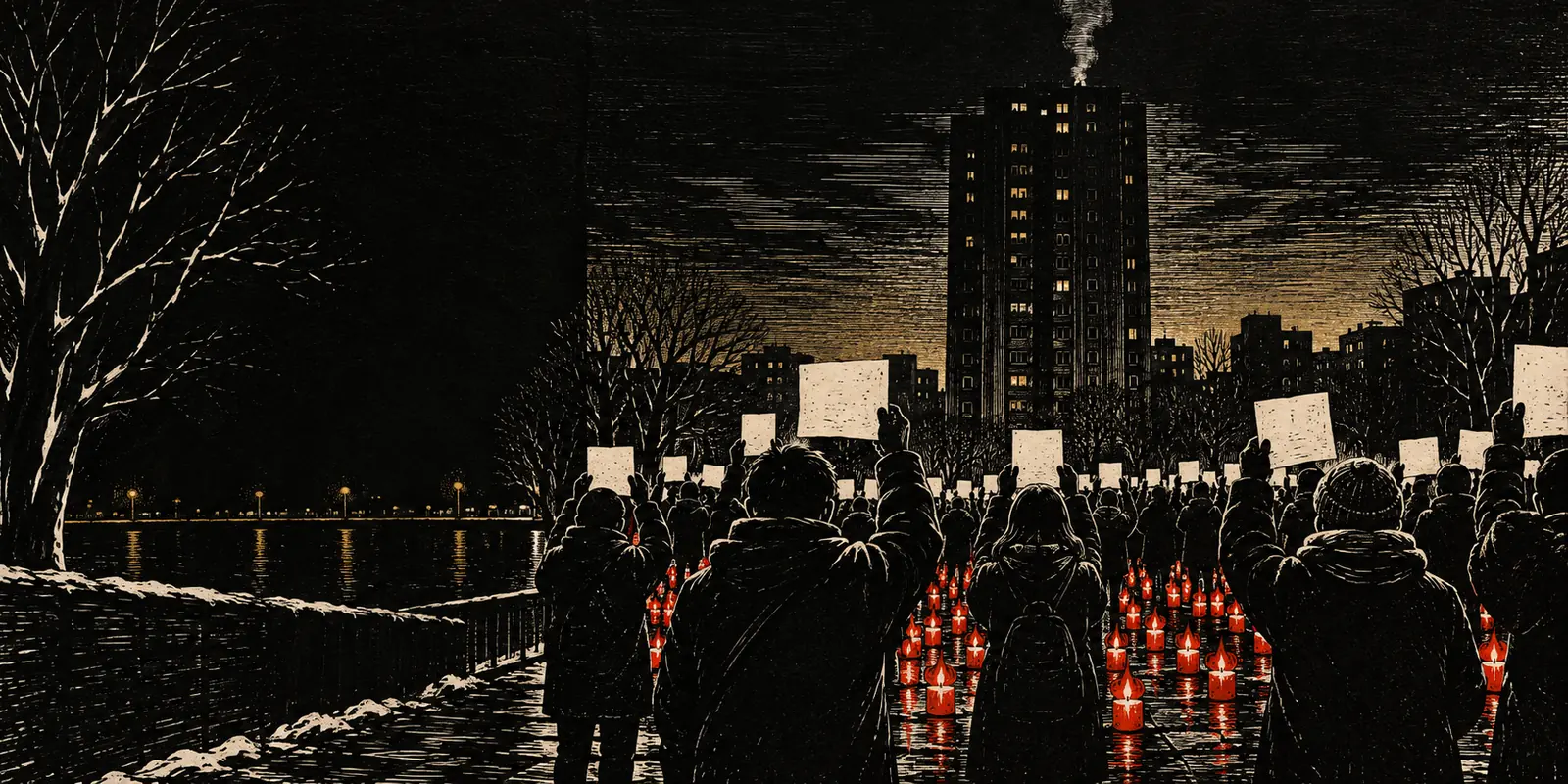
The fire started on a Thursday evening, November 24, 2022, in a residential tower in Urumqi, the capital of Xinjiang. Residents of the building had been locked down continuously for more than 100 days, inside their apartments since August. Firetrucks arrived and could not reach the flames. Videos on Chinese social media showed hoses spraying from too far away, the water falling short of the blaze. At least ten people died, including a three-year-old child.
Within hours, hundreds of Urumqi residents marched to the municipal government building, sang the national anthem, and demanded the lockdown be lifted. Within 24 hours the city said it would lift restrictions in neighborhoods it called low-risk. Within 72 hours the fire was no longer only a local disaster.
On the weekend of November 27 and 28, thousands gathered in Shanghai, Beijing, Guangzhou, Wuhan, and other cities. On Middle Urumqi Road, in Shanghai's French Concession, people lit candles. They chanted lines the chapter says had not been heard at this scale since Tiananmen in 1989: Communist Party step down, and Xi Jinping step down. At Tsinghua University, Xi's own university, students held blank sheets of A4 paper. The blank page was a way to protest censorship without printing the words that would be censored. The protests took their name from the paper: the White Paper protests, also called the A4 Revolution. Chinese communities abroad held solidarity protests in more than a dozen cities, from Taipei to Toronto to Amsterdam. Analysts later called the demonstrations the largest nationwide protests in China since 1989, and the most direct challenge to Party authority in decades. Within ten days of them, Beijing dropped zero-COVID entirely.
What followed was not a staged reopening. There was no phased plan, no mass vaccination drive aimed at the elderly, no antiviral stock sent to nursing homes, and no public-health message preparing 1.4 billion people for what was coming. The government stopped enforcing the policy, took apart the national testing system, and twice changed the rules for what counted as a COVID death.
Epidemiologists would call the population immunologically naive: almost no one had met this virus in the body before, because the controls had kept it out. China CDC sentinel surveillance, the watch-posts that sample cases so the center can estimate what the whole country is doing, suggests about 90 percent of the population was infected in a concentrated 35-day stretch. Crematoriums were overwhelmed within weeks. Hospitals took a sudden surge they were not staffed for.
Beijing's official count of COVID-related deaths from December 2022 through February 2023 was about 60,000. A peer-reviewed study in JAMA Network Open estimated 1.87 million excess deaths among people 30 and older in just the first two months after the reversal. Excess deaths are deaths above the number expected in an ordinary period. The study's 95 percent confidence interval, the range statisticians treat as compatible with the data, ran from 0.71 million to 4.43 million. Mortality rose between 77 and 279 percent across provinces. Ningxia had the sharpest spike. A second study, using the CDC sentinel data, estimated about 1.41 million deaths in the December-to-February window, 0.80 million of them among adults over 80, and calculated that official reports may have undercounted by a factor of 17. Deaths from secondary infection, multiorgan failure, and respiratory failure in COVID-positive patients were increasingly filed as non-COVID deaths.
Those ranges had been forecast before the opening. Chinese and international health experts had expected 0.97 to 2.10 million excess deaths if the immunity gaps stayed and the opening was fast. CSIS analysts had warned that so much of the population was immunologically naive that losses might pass a million if China reopened before protections were in place. Hong Kong's spring 2022 outbreak had already shown mortality jumping when restrictions loosened. China's own CDC, in a November 2021 analysis, had said ending zero-COVID would cause mass extreme illness and deaths and would cripple the health system. The opening happened without the preparations those warnings described. Between 1.4 and 1.9 million people died in roughly three months, most of them elderly, in a country that had spent three years building an unusually complete apparatus of testing, tracing, and control.
The policy had not started as an obvious mistake. Wuhan was locked down on January 23, 2020. No vaccines existed. Treatment was unknown. How lethal the virus was remained uncertain. The government used what scholars call infrastructural power: the ability of the state to reach into a territory and carry out a decision. The tools were mass testing, contact tracing through QR codes, surveillance, and neighborhood grids. By early April 2020, Wuhan's 11-week lockdown had pushed transmission down. China reported only 5,232 COVID deaths through the end of 2021. The United States passed one million deaths by May 2022. The gap was real, and it became political.
In September 2020 Xi Jinping took personal credit. He said the fight had achieved significant strategic results and had shown the advantages of Communist Party leadership and China's socialist system. State Council documents went further and credited his personal command and decisive action. The chapter treats that as personal ownership of the policy, not routine slogans. Once his name was on it, a reversal risked looking like a reversal of him. The question inside the system stopped being whether zero-COVID was still the right public-health policy. It became whether he had been right.
Cadre evaluation locked the policy into careers. Officials whose areas reported outbreaks faced removal. Officials who suppressed cases were promoted. Studies of the bureaucracy describe the result as rising harshness, not careful adjustment. Shanghai's 2022 lockdown ran two months and disrupted 21 million residents. The central government blamed local officials rather than the policy.
A second lock was the vaccines. Beijing refused to approve Western mRNA vaccines, the kind that use a snippet of genetic instructions to teach cells to make a viral protein, and insisted on domestically developed inactivated vaccines, the older method of using a virus that has been killed. The grounds the chapter records are national self-reliance and competition with the United States for legitimacy. By August 2022, full vaccination among adults over 60 was 85.6 percent and booster coverage 67.8 percent, both well below comparable rich countries. People over 80, the most vulnerable, were at 72 percent fully vaccinated and 47 percent boosted. Chinese health officials said they were not confident enough to lift zero-COVID because Chinese vaccines were less effective. The chapter calls that a real technical constraint, and one the government had made by its own choice. Later it ties that choice to the political line summarized as a rising East and a declining West.
A third lock was the same incentive system, which one scholar described as better to kill a thousand wrong than let one slip through. Zero outbreaks were rewarded. Reported cases were punished. Each success justified a harder measure next time. Local governments that sealed neighborhoods, welded apartment doors shut, or sent residents into centralized quarantine were, in the chapter's account, answering the incentives in front of them. The design of the system, not the arithmetic of one official, was where the irrationality sat.
By mid-2022 Omicron had changed the health numbers. Clinical data from Shanghai in April and May 2022 showed a COVID case fatality rate of 0.1 percent, the same as seasonal flu. Only 22 of 34,000 hospitalized COVID cases in Shanghai in that period became severe. Omicron's estimated case fatality ratio was 0.70 percent, against 2.01 percent for Delta. The health case for staying closed, the chapter says, had become indefensible on the numbers. The political case had not.
The economic cost of staying closed was already large. Growth targeted at 5.5 percent came in at 3 percent for 2022. The Shanghai lockdown alone was estimated at 1.7 trillion yuan, about 233 billion dollars. Foreign direct investment fell sharply. More than 100,000 foreign companies left during 2020 and 2021. Youth unemployment for ages 16 to 24 hit 20 percent, then a record. Local governments carried 86 percent of China's fiscal spending and covered only about 77 percent of expenditures from their own revenue. Hidden local-government debt reached 14.3 trillion yuan, about 11 percent of GDP, by the end of 2023. Lockdowns paid from local budgets sped that deterioration. Capital flight picked up as wealthy and skilled people tried to leave or move assets. A cost-benefit analysis put zero-COVID's lost GDP growth at about 384 billion dollars. The same analysis said that if China had used vaccination strategies like Singapore's or Japan's, deaths would have been roughly 183,000: far above the near-zero then being reported, and far below the exit wave. By late 2022, the chapter says, even internal analyses had the economic costs above the health benefits.
The exit did not bring a quick recovery. Hospitals filled in December 2022 and January 2023. Workers fell ill. Activity dropped again in the fourth quarter of 2022. Analysts at MERICS noted that hopes for a roaring comeback opened instead on a surge of infections. Growth recovered in the first quarter of 2023 as the wave eased. College graduates turned toward government and state-owned jobs and away from private firms. Lying flat, the choice to step back from competitive work, which had already worried the leadership before COVID, was reinforced. Youth unemployment reached 21.3 percent by mid-2023. A record 12.2 million university graduates were due to enter the market in summer 2025, with private hiring weak. Marriage rates were already at historic lows.
The information problem was older than Omicron. When SARS appeared in 2003, authorities held back information for weeks, and the delay let the virus spread abroad. After SARS, China built a national disease-reporting network so a frontline clinician could report a case straight to Beijing, skipping the layers that had slowed 2003. When COVID-19 appeared in December 2019, that direct line was not used. Reports went hospital to municipal health commission to province, because local officials judged the ordinary channels politically safer than the fast one. The lesson from SARS was built into the architecture and unused in practice. Elizabeth Economy, an analyst of Xi-era governance, has argued that his centralizing reforms made the system more brittle. When the leader personally owns a policy, reporting that the policy is failing is a career risk. Bad news is filtered. Analysts of the leadership observed that clear signals from the center made it extremely risky for local officials to prepare for a reopening in 2022. Through that year the top leadership signaled that zero-COVID would continue indefinitely. Stockpiling antivirals, rushing elderly vaccination, or drafting a phased opening would have looked like disloyalty. In April 2022, during the Shanghai lockdown, Xi publicly defended zero-COVID and said it had withstood the test of the 2022 Winter Olympics.
The political calendar moved first. Xi's third term was confirmed at the 20th Party Congress. On October 22, 2022, that term was secured. On November 10, a Politburo Standing Committee meeting signaled willingness to adjust, about two weeks before the protests. Analysts reading internal communications interpreted an emergency Standing Committee meeting on November 27, the second day of the White Paper protests. The evidence was indirect: state-media language changed between commentaries on November 27 and November 28. The earlier piece pledged to maintain zero-COVID unswervingly. The later one dropped the phrase zero-COVID. Vice Premier Sun Chunlan announced the start of what was called optimization on November 30, three days after the largest protests. On December 7 the government said major restrictions would be lifted. On December 16 China disbanded the national testing system. The policy Xi had commanded for three years was gone within two weeks of the first sustained public opposition. No public guidance on protective measures went out. Hospitals were not warned about the surge. A later U.S. government analysis concluded that the abrupt relaxation, without measures to protect high-risk people, likely led to the surge in hospitalizations and deaths. China had not prioritized vaccines and antivirals for older adults and people with chronic disease, the approach Singapore, Japan, and others had used. One analyst's reading, which the chapter presents as the most reasonable conclusion rather than as a proven motive, is that Xi had likely meant a gradual relaxation late in 2022, and that the protests pushed a sudden exit instead of a managed one. The protests, in that reading, changed the timing and the manner, and were a real but marginal added reason to end the policy.
The response to the protests themselves was concession and punishment together. The reversal was redescribed as optimization and as a downgrade in how the disease was classified. Authorities also arrested White Paper participants. A young Uyghur student, Kamile Wayit, was sentenced to three years in prison for promoting extremism after she shared protest videos online.
Other facts sit beside the death counts and keep the story from being only a story of collapse. By 2025 people 60 and older would number 323 million, 23 percent of the population, so any exit carried mortality risk. The reversal came after the third term was already secure. GDP growth in 2023 recovered to roughly 5 percent. The exit-wave toll the chapter calls China's true figure, about 1,014 deaths per million, was about double Japan's concurrent Omicron death rate and about 30 percent of the cumulative American rate. Some share of the deaths, the chapter says, would have come under any transition, given the immunity gap. The health QR codes, the phone passes that governed movement during the emergency, also outlasted the emergency as a tool of social control. CSIS analysts noted that pandemic measures can be resurrected to deal with other issues.
The official figure remains about 60,000. The peer-reviewed estimates remain 1.4 to 1.9 million. On December 16, 2022, the national testing system was disbanded. Kamile Wayit received three years.
Comments
Reader notes
Comments aren't live yet. Send notes to @slop_dealer.