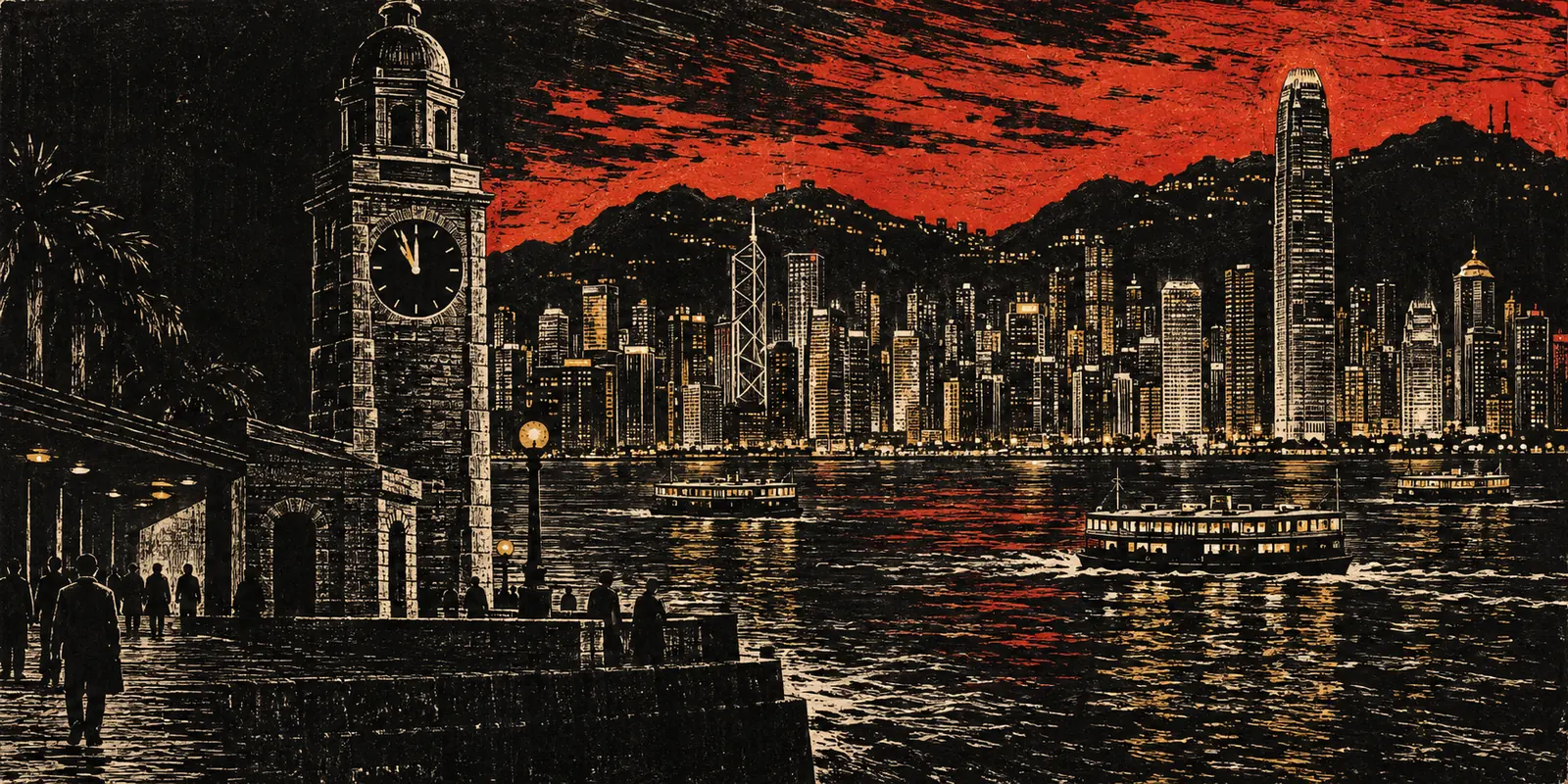
On June 30, 2020, at 11:00 p.m. local time, the National Security Law for Hong Kong took effect. It was one hour before the twenty-third anniversary of the handover from Britain. The world was six months into a pandemic. The National People's Congress Standing Committee had drafted and approved the law in days, not in the three rounds of deliberation usual for Chinese legislation. Hong Kong's chief executive, Carrie Lam, had not seen the final text before it was enacted. Xi Jinping signed it. By the time most residents woke, the city's legal architecture had been rewritten.
Within a year the pro-democracy movement was dismantled. Leaders were imprisoned. Newspapers were shut. The chief executive appointed the judges who would hear national-security cases, a break from selection by professional standing. Electoral reform cut the share of directly elected legislators from 90 percent to 20 percent. Voter turnout fell from 71 percent in 2019 to 27.5 percent in 2023, a 62 percent drop.
The protests the law answered had run from June 2019. By early 2020 authorities had arrested more than 1,500 protesters and fired more than 16,000 tear-gas canisters. What began as opposition to an extradition bill had become a broader challenge to Beijing's authority over how Hong Kong was governed. Article 23 of the Basic Law, the city's mini-constitution, had required Hong Kong to pass its own national-security legislation. It had never been enacted. From the center's view, that gap was being used, and the local government had failed to close the streets with the laws it already had.
By 2024 nearly 300 people had been arrested under the new law. Amnesty International's analysis found that at least 84.6 percent of concluded cases involved expression that, under international human-rights standards, should not have been a crime. Publisher Jimmy Lai was imprisoned. Apple Daily, the largest pro-democracy paper, stopped. Stand News followed. Civil-society groups dissolved themselves rather than risk prosecution under definitions the chapter calls deliberately vague. Self-censorship became the way a newsroom stayed open. The legal separation between Hong Kong's courts and the Party's political interests, which had been a reason international business used the city, eroded.
About 700,000 non-foreign residents left between June 2020 and 2024, roughly 9 percent of the population, the largest sustained decline since the early 1990s. A 2024 Hong Kong University Business School study of LinkedIn migration data found the leavers were disproportionately professionals aged 25 to 45, with advanced education and higher earning potential. Britain opened a British National (Overseas) visa in 2021 in direct response to the law. BN(O) status is a form of British nationality held by many Hong Kong people from before the handover. The pathway approved 96 percent of applications and granted more than 191,000 visas through 2023. About 140,000 people actually arrived in Britain. The UK government estimated those arrivals would bring more than two billion pounds in net economic benefit.
The Bank of America projected in 2021 that capital flight from Hong Kong could reach 76 billion dollars by 2025. The labor force shrank by about 140,000 people between 2020 and 2022. The Hang Seng Index fell through 2020 to 2023. When it recovered, mainland Chinese companies were 70 percent of the index's weight by 2025, up from 60 percent in 2021. Mainland investors were about 45 percent of daily trading. By 2023 the number of foreign regional headquarters in the city was at an eleven-year low. Goldman Sachs, JP Morgan, and other large financial firms began moving assets and people to Singapore. Residential prices by 2024 were 28 percent below 2021, back at levels last seen in 2011. Empty homes were up 74 percent since 2020.
Mainland Chinese investment held 70 percent of investment-banking jobs in Hong Kong. Hong Kong natives held 30 percent. The Top Talent Pass Scheme, opened in December 2022, approved more than two-thirds of its first 100,000 applications within six months, and about 95 percent of those approved came from the mainland. Historically, 72.1 percent of foreign direct investment into China had come through Hong Kong-based companies. A large share of that was round-tripping: mainland money that left briefly for tax or regulatory reasons and came back. By 2020 China's savings rate was among the world's highest, and state-owned firms held large reserves. The old dependence on Hong Kong as the pipe for capital had already shrunk before the law.
After 2020 the Greater Bay Area plan, meant to tie Hong Kong economically to neighboring cities in Guangdong, sped up. Restrictions on cross-border capital, data, and people were reduced. By October 2025 Chief Executive John Lee had set up a GoGlobal Task Force to help mainland firms expand abroad through Hong Kong, casting the city as a door for mainland money going out rather than as a hub of its own. In 2025 Hong Kong's real GDP grew 3.5 percent, and growth was above 3.0 percent in the first three quarters. The stock market recovered on mainland capital. Housing stabilized as mainland buyers came in. Singapore, the chapter says, absorbed lasting gains from the exodus. As of early 2026 that competitive loss looked durable, not temporary, and not yet conclusive.
Xinjiang was built on the opposite assumption: that the scale could be hidden. Between 2017 and 2021 Chinese authorities detained an estimated 800,000 to 1.8 million people, predominantly Uyghurs and other Turkic Muslims, in internment camps across the Xinjiang Uyghur Autonomous Region. The official description called them vocational training centers against terrorism and extremism. Two document leaks described something else.
The China Cables, published by the International Consortium of Investigative Journalists on November 24, 2019, were the first full operational blueprint. Classified telegrams signed by Zhu Hailun, head of Xinjiang's Political and Legal Commission, described an estimated 1,300 to 1,400 camps outside the formal legal system. Detainees were held for minimum terms of one year with no fixed release date, in places with guard towers, double-locked doors, and blanket video surveillance. The documents said secrecy about the camps was itself a policy goal.
Human Rights Watch reverse-engineered the Integrated Joint Operations Platform, the centralized computer system used to flag people across Xinjiang. Authorities marked people as suspicious for lawful, ordinary acts: not socializing with neighbors, using encrypted tools such as WhatsApp, or donating to mosques. The system collected DNA, fingerprints, iris scans, and blood types from residents aged 12 to 65. By 2016 authorities had recruited more than 90,000 police officers and built 7,300 heavily guarded checkpoints. The more complete the control, the more concrete it required, and commercial satellites could see concrete.
The Xinjiang Police Files, published in May 2022, held more than 2,800 detainee photographs, internal police protocols, and speeches by senior officials. The photographs showed people from 15 to 73 years old. In August 2022 the UN human-rights office published an assessment of allegations of arbitrary detention, torture, sexual violence, and forced labor, based on 40 in-depth interviews. Satellite pictures confirmed where facilities were and when they were built.
The United States began sanctions in October 2019, targeting the Xinjiang Production and Construction Corps and adding 144 Chinese companies to entity lists. The Uyghur Forced Labour Protection Act made companies legally liable for importing goods from Xinjiang. In March 2021 the European Union, Canada, and the United Kingdom imposed coordinated visa bans and asset freezes. The U.S. State Department issued a formal genocide determination in January 2021. Canada's House of Commons voted 266 to 0 to call the persecution genocide. Internal directives described coercive labor transfers. People marked as lacking motivation to work were put through repeated ideological education and then reassigned. Regions compiled lists of so-called lazy persons for possible transfer, including people over 60 and in some cases up to 77. Xinjiang's cotton rose to 90 percent of China's total, partly through land transfers in which Uyghur farmers were forced to give up land rights. In October 2020, 39 countries told the UN Human Rights Council they were gravely concerned. Thirty-seven countries, including several with Muslim-majority populations, issued statements defending China's record. The defending group softened the diplomatic blow. It did not stop the sanctions, the genocide determinations, or the supply-chain law.
Days after the China Cables appeared, authorities announced that all camp trainees had graduated. Under Ma Xingrui, who succeeded Chen Quanguo in December 2021, visible repression eased. Checkpoints came down. Some facilities closed or were reused. Official talk of the camps stopped. The chapter says violence in Xinjiang had been real, and that Belt and Road corridors through the region carried real economic weight. It also says detaining up to 1.8 million people was vastly out of proportion to the documented security threat, and that the bet on secrecy was the strategic error.
On November 2, 2021, tennis player Peng Shuai posted on Weibo a detailed account of how former vice premier Zhang Gaoli, a retired member of the Politburo Standing Committee, had coerced her into a sexual encounter she did not consent to. Within twenty minutes censors removed the message. Within thirty minutes references to her name were gone from China's internet. Several hundred keywords were banned, including, in the early phase, the word tennis. Four years later, the chapter says, most Chinese internet users do not know the allegations. Zhang Gaoli faced no investigation, no discipline, and no public acknowledgment that allegations had been made.
The international reply became a study in how a controlled story looks from outside. State outlet CGTN posted a screenshot of an email said to be from Peng to Women's Tennis Association chief Steve Simon, denying the accusations. Analysts saw a cursor sitting in the middle of the third line, the mark of a picture taken while a document was still being typed, not of a sent email. State media then released video of Peng at a restaurant in Beijing. A tournament director made a pointed, cued reference to the date, placing the meal as an answer to outside concern. A New York Times and ProPublica analysis found 97 fake Twitter accounts amplifying the state line, nearly all with zero followers, posting only in Beijing business hours.
The WTA, under Simon, suspended every tournament in mainland China and Hong Kong, giving up what was reported as a lucrative long-term deal. Simon said the association could not in good conscience ask athletes to play where Peng seemed pressured to contradict what she had alleged. It asked for a full investigation without censorship before it would return. On November 21, International Olympic Committee president Thomas Bach held a thirty-minute video call with Peng. She allegedly said she was safe and well. The IOC statement did not mention the alleged assault, did not call for an investigation, and did not address the censorship. A photograph then surfaced of Bach shaking hands with Zhang Gaoli at the 2016 Olympics. Human Rights Watch accused the IOC of working with Chinese authorities to undercut speech and to set aside an alleged sexual assault. The IOC's wording, the chapter says, used language characteristic of Xi Jinping's rhetoric on human rights.
In December 2021 Peng appeared at a skiing event, interviewed by a Global Times journalist, with a Chinese Olympic Committee official there to accompany and interpret. She denied having accused anyone of sexual assault, and parsed the original post: she had not used the specific Chinese characters for that term, though she had described coercion and pressure she did not consent to. In February 2022 she gave a managed interview to the French sports paper L'Equipe, announced her retirement, and said there had been a misunderstanding. The chapter sets that cycle next to Fan Bingbing, Jack Ma, and other elites who disappeared and then returned on a schedule. By 2023 the WTA announced a conditional return to China.
The law took effect at 11:00 p.m. on June 30, 2020. Carrie Lam had not seen the final text. The cursor was still visible in the third line of the email CGTN posted in Peng Shuai's name.
Comments
Reader notes
Comments aren't live yet. Send notes to @slop_dealer.