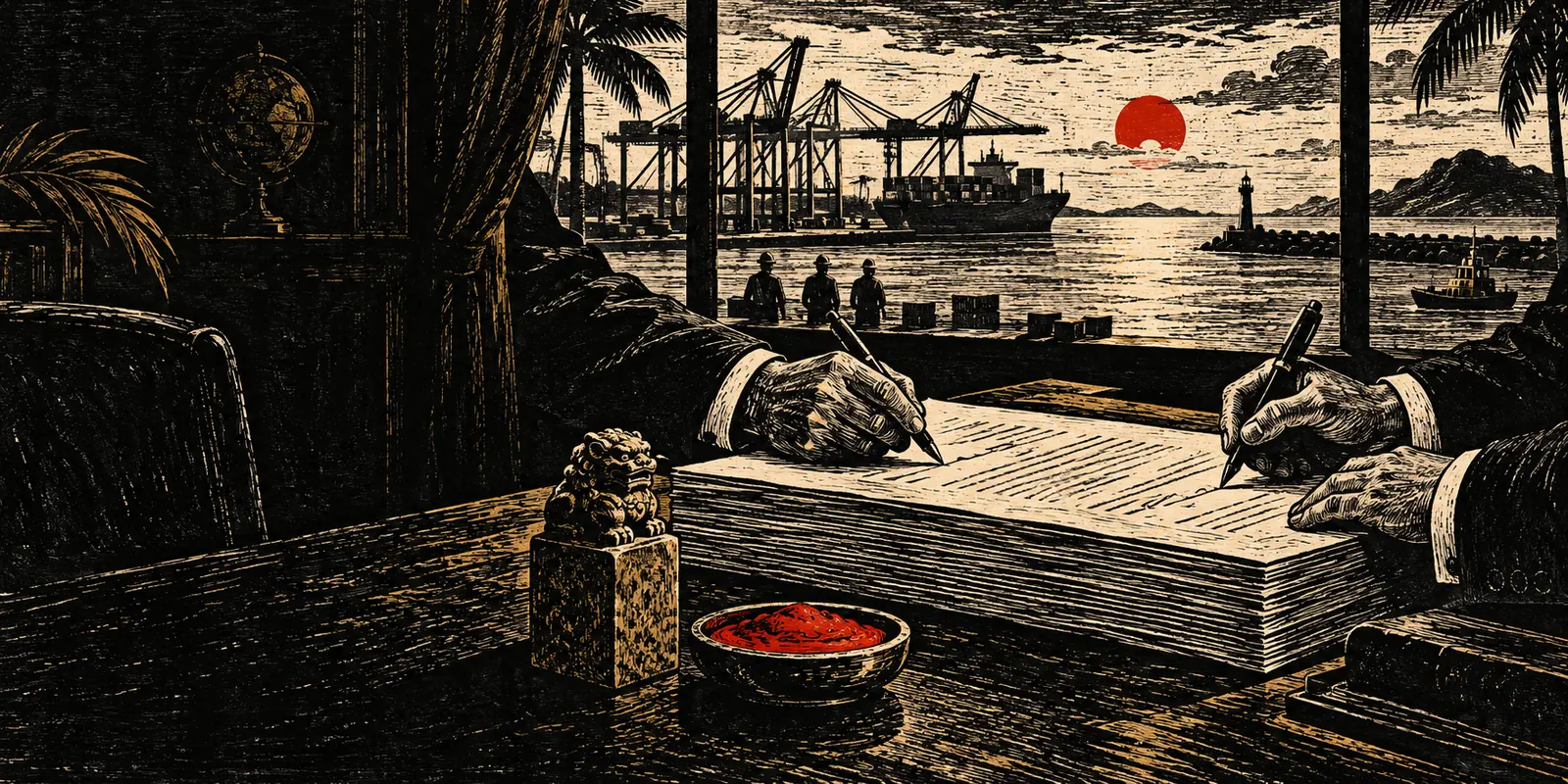
In December 2017 the government of Sri Lanka signed a 99-year lease that handed operational control of Hambantota port to China Merchants Port Holdings. Ninety-nine years was the length of Britain's lease on Hong Kong's New Territories. Within weeks the phrase debt-trap diplomacy filled Western media. The clean version said China had lent Sri Lanka money it could not repay, and when the bill came due Beijing took the port.
The chapter says the important particulars of that version are wrong.
Hambantota was not China's idea. It was a pet project of President Mahinda Rajapaksa, who wanted a major work in his home district in the rural south. China Exim Bank lent 306.7 million dollars for Phase 1 at 6.3 percent interest, roughly double or triple what the World Bank or the Asian Development Bank would have charged. The terms were bad by those standards. A sovereign government with its own political reasons accepted them. A WikiLeaks cable from the U.S. embassy in Colombo noted corruption worries from the earliest stages. A later New York Times investigation found that about 1.2 million dollars from a Phase 2 project account flowed into Rajapaksa's 2015 re-election fund.
The lease was not a seizure. China Merchants put in 1.12 billion dollars for a 70 percent stake. That money went to Sri Lanka's government. It did not retire the Chinese loans that had paid for construction. The Sri Lankan minister responsible for the deal said in public that his country should thank China for finding an investor willing to take on the port's losses. The debt that made the port unsustainable was owed to international sovereign bond markets, not to Beijing. At the time of the lease China held about 10 percent of Sri Lanka's external debt. The crisis was real. China was not its main architect.
The loan terms were still predatory next to multilateral rates. The corruption around the deal was enabled by talks that ran elite to elite and skipped scrutiny. And the number 99 was so strong an image that it changed how developing countries everywhere looked at Chinese infrastructure offers. The Belt and Road as a whole had put about 1.399 trillion dollars into more than 150 countries, and roughly 35 percent of projects had hit major implementation problems. One port in southern Sri Lanka became the parable for a 1.4 trillion dollar program.
After 2017 the same shape repeated. A government signed. The next government reopened or cancelled.
In Malaysia the cut was sharper. Former prime minister Najib Razak had signed a set of Belt and Road agreements, including the East Coast Rail Link, first priced at 65.5 billion ringgit. When Mahathir Mohamad beat Najib in the 2018 election, one of his first acts was to suspend the line and accuse the previous government of taking terms that served China at Malaysia's expense. He renegotiated it down to 44 billion ringgit, a 32.8 percent cut, and changed the ownership so Malaysians had a larger share. Beijing accepted. The railway was on Malaysian soil, the work was unfinished, and the new government had a democratic mandate to review the terms. Indonesia, Myanmar, Pakistan, and the Philippines all opened reviews of agreements signed by earlier administrations. Incoming leaders, often elected on skepticism of the projects, used that mandate to extract concessions. Once construction is done or far along, the country holds the asset. Once an election has happened, the new government holds the mandate. China's position weakens at the moment a signed deal becomes a physical thing.
Eighty percent of Chinese government loans went to nations already in serious debt trouble. One reading is that China was the lender of last resort, the only one still willing. The other is that the lending machine could not, or would not, check whether the borrower could pay, so the portfolio was built to produce crises. The chapter says both are partly right. The system was not one office with one strategy. It was the Export-Import Bank, the China Development Bank, provincial state-owned companies, and policy banks, each with its own incentives, its own taste for risk, and its own political friends. The portfolio looked like fragmentation more than like a plan.
Howard French, who has reported on China's work in Africa and the developing world for two decades, describes the structural miss. Beijing treats relationships in the Global South as extensions of a bilateral, leader-to-leader frame, in which a deal between leaders lasts because leaders control their politics. That is how the Chinese system works. When Xi Jinping signs, the signature holds, because no later Chinese leader will reopen it on democratic grounds. The assumption that the same model travels to countries with elections, opposition parties, a free press, and a memory of colonial rule is, in the chapter's terms, the theory-of-mind error at its root. China invests heavily in sitting presidents and prime ministers, and comparatively little in the systems that may replace them at the next vote.
In May 2022 the Pacific offered a cleaner test. Foreign Minister Wang Yi arrived for a ten-day tour of eight nations with a draft already written: the China-Pacific Island Countries Common Development Vision. It was a security and economic pact that would have given China policing cooperation, access on cybersecurity, and wider maritime rights across ten Pacific Island countries. The draft leaked before his meetings were finished.
David Panuelo, then president of the Federated States of Micronesia, wrote an eight-page letter to other Pacific leaders on May 20, 2022. He called the proposed pact the single most game-changing proposed agreement in the Pacific in any of our lifetimes. He also alleged that Chinese officials had tried to sway Pacific leaders with direct inducements, and he described envelopes filled with money after meals at the PRC embassy. The chapter is careful here. The bribery claims have not been confirmed on the record by other Pacific leaders. China's embassy denied them. The letter itself still became a political fact. Panuelo framed the pact as a threat to the foreign-policy independence of nations that had fought to get it. Not one of the ten targeted nations signed. Wang's ten days produced narrow bilateral deals. The comprehensive security pact, the point of the tour, was dead before he left the region.
The Pacific Islands Forum decides by consensus. Wang's approach was to lock in bilateral promises from individual heads of state and then present them as a group decision. That assumed leaders could commit their countries without legislatures or publics, and that bilateral deals could skip the consensus rule. The Forum's rule exists because most of these nations are small and exposed, and they built a safeguard against being picked off one by one. China walked into the mechanism built for exactly that approach.
Within days, on May 27, 2022, Fiji signed the Indo-Pacific Economic Framework, one day before the Common Development Vision officially died. Fiji had kept warmer ties with Beijing than many of its neighbors. It chose, in public, a U.S.-led economic frame at the moment China's pact was collapsing. By June 2022 the United States, Australia, New Zealand, Japan, and the United Kingdom announced Partners in the Blue Pacific, a counter-engagement that would have been politically hard to justify without China's overreach as the spark. The partners promised more infrastructure money, climate-resilience funding, and security cooperation, a direct answer to the development gap China had been filling.
AidData's project-level file shows China has restructured, forgiven, or written down more debt than it has seized assets. Eighty percent of the loans did go to countries already in distress, which fits a lender of last resort more than a plan to grab ports. The grain of truth in the trap story is also in the file. Rates were often above market. Checks on whether borrowers could pay were often weak. Corruption sat around multiple deals. The Belt and Road was partly driven by provincial officials looking for somewhere to put domestic industrial overcapacity, not by one grand strategy with clear risk numbers. About 35 percent of projects had major implementation problems, a rate no private lender or multilateral bank would call acceptable. Sovereign governments chose the terms, often for domestic political reasons that had nothing to do with a Chinese design. Years after detailed reporting took apart the specific Hambantota claims, debt-trap diplomacy was still the default frame.
The pattern split by the kind of partner. The China-Pakistan Economic Corridor continued through leadership changes because Pakistan's military kept continuity no matter which civilians were in office. Cambodia's Hun Sen could commit without real legislative oversight. Where elections, opposition, a free press, and a living memory of colonial extraction were present, the deals came apart. In countries that remember British, French, Dutch, or Japanese rule, a foreign power taking long control of sovereign ground through a loan triggers a sovereignty story the opposition can use. Chinese negotiators, whose own strategic psychology is shaped by the Century of Humiliation did not expect their model to switch that story on in reverse.
The costs the chapter counts are the narrative itself, now a tool politicians can swing at a Chinese deal whether or not the deal deserves it; Mahathir's price cut, which other countries copied; and the Pacific failure, which handed Washington and its partners a ready reason to step in. Project sizes shrank. Lending volumes fell from their 2016 peak. The small and beautiful rebranding at the third Belt and Road Forum came after the backlash had already cost something. The 1.399 trillion already spent cannot be pulled back.
The other ledger is the concrete. The Addis Ababa-Djibouti railway, the Mombasa-Nairobi Standard Gauge Railway, and the Karot hydropower project in Pakistan exist, they work, and they serve people who had no other funder. The criticism that Chinese rates were worse than multilateral rates assumes the multilateral money was on offer. Often it was not. By 2025 Hambantota's container volume had risen about eightfold, from 53,170 TEUs to 428,036. A TEU is the standard box, a twenty-foot container. The port was operating and growing in a part of Sri Lanka that had had none of that activity. The 1.12 billion arrived at a moment of severe fiscal distress. Mahathir did not kill the East Coast Rail Link. He got a lower price, and construction continued.
The five years between the 2017 lease and the 2022 collapse of the Pacific pact were long enough, the chapter says, for the lesson to have been learned. Wang Yi still arrived with a pre-drafted security agreement and a plan to collect signatures one capital at a time. Not one of the ten nations signed it. Fiji signed the American-led framework the day before the Chinese vision officially died.
Comments
Reader notes
Comments aren't live yet. Send notes to @slop_dealer.