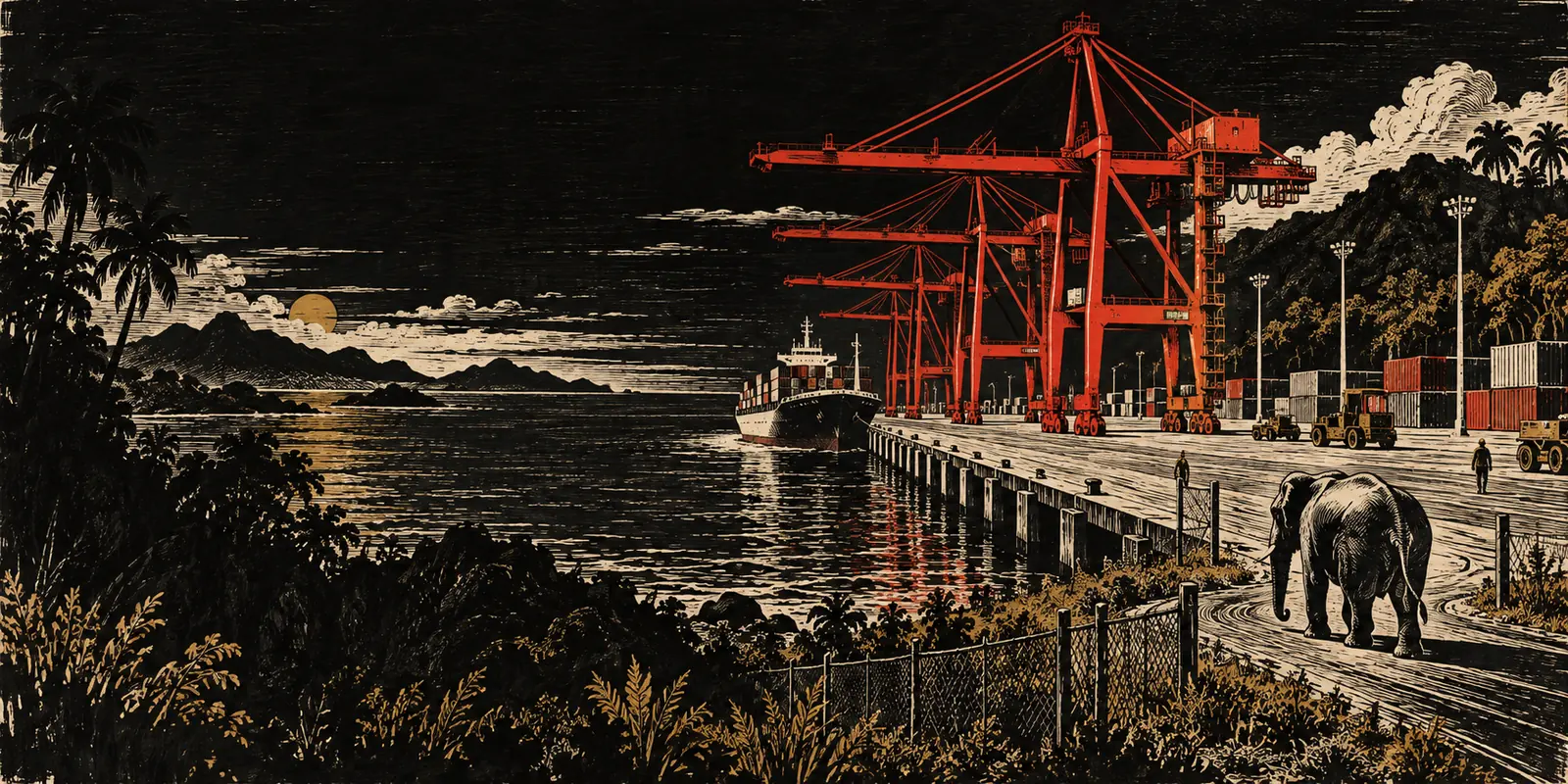
Between 2013 and 2026 China put about 1.399 trillion dollars into more than 150 countries under the Belt and Road Initiative, the program of overseas roads, ports, railways, power plants, and digital links announced in Xi Jinping's early years. AidData, the lab at William & Mary that built the most detailed project-by-project file of Chinese development finance, counted 13,427 projects worth 843 billion dollars. Loans outnumbered grants 31 to 1. The money paid for railways in East Africa, dams in South America, ports in South Asia, digital links across the Pacific, and highways through Central Asian passes that had not seen major building since the old Silk Road. In scope the chapter sets it above the Marshall Plan, above the World Bank's cumulative lending, and above every other bilateral development program.
The same file contains 7,648 cracks in an Ecuadorian dam, a debt in Laos above 100 percent of GDP, a Kenyan railway that lost 200 million dollars and runs below breakeven, and 385 billion dollars in hidden debt that does not show on government balance sheets. Thirty-five percent of Belt and Road infrastructure projects hit major implementation problems, against 21 percent for Chinese infrastructure projects outside the initiative. In Southeast Asia the average completion rate across the megaprojects studied was 33 percent.
The story most often told in the West is debt-trap diplomacy: China lends to countries it knows cannot pay, then takes a strategic asset when they default. The case everyone cites is Hambantota Port in Sri Lanka. The common version says China lent the money for a port that could never pay, Sri Lanka defaulted, and China seized the port on a 99-year concession. The chapter's history is messier.
Hambantota was not China's idea. It was proposed by the government of President Mahinda Rajapaksa, working with a Chinese state-owned company that had commercial reasons of its own. When the port did not earn what had been promised, China Merchants Port Holdings leased it for 99 years in exchange for 1.12 billion dollars. No debt was forgiven. No ownership was transferred. Sri Lanka used the 1.12 billion to pay Western creditors and to shore up foreign reserves, not to pay down the Chinese loans. It still owes the original Export-Import Bank loans, reported at 6.3 percent over 15 years. The Sri Lankan government negotiated the lease and kept sovereign authority over the facility. The port was not seized.
Chatham House, in research published in 2020, called deliberate debt entrapment a myth. It argued that economic factors, not a strategic plan written in advance, drove project choices, and that China's development-finance system was too split and too poorly coordinated to chase detailed strategic aims. A Princeton reading of Kyrgyzstan's Alternative North-South Road loan found contract language that could, in theory, allow an asset to be taken. There was no use of that language, and no active attempt by Chinese entities to use it.
Laos is the case that stops either comfort. As of 2023, Laos's public and publicly guaranteed external debt was above 100 percent of GDP. China held nearly half of the sovereign external debt. Scheduled payments to China alone were 1.7 billion dollars, about 90 percent of Laos's foreign-exchange reserves. The lending left the energy sector with more capacity than it could use, unsustainable losses, and, in the end, a Chinese state firm in control of the whole power grid. Laos has avoided default only because China has repeatedly deferred payments, case by case, not because a market cleared the debt. The Lowy Institute's line is direct: whether by design or by neglect, China created a debt trap in Laos. Growing out of it is unrealistic even with the Laos-China Railway, and even with realistic reforms to growth and revenue. The chapter separates intention from result. Chatham House's argument, that Beijing did not design a trap, can stand, and Laos can still be trapped.
Kenya's Standard Gauge Railway cost 3.6 billion dollars, financed by the China Export-Import Bank, from the port of Mombasa to Nairobi. The trains run. Passengers ride. Cargo moves between the main port and the capital. No other bilateral lender had been willing to pay for it. By 2020 the railway had lost 200 million dollars. It had not met the forecast that cargo and tickets would pay for it. The World Bank estimated it would need 20 to 55 million tons of freight a year to break even. It fell far short. The loan was at 5.6 percent over 15 years. Kenya has not repaid it, and is in default on other Chinese Export-Import Bank obligations. The chapter's point is that the railway can be a working asset and an unsustainable debt at the same time, and that it also served China's interest in port access and regional influence.
Ecuador's Coca Codo Sinclair dam was built by Sinohydro for 2.25 billion dollars, financed by 1.7 billion in Export-Import Bank loans at 7 percent over 15 years. It was supposed to be 1,500 megawatts and to change the country's power supply. In December 2018, inspectors found 7,648 large and small cracks in the generator hall and the equipment around it. The run-of-river design, which uses the river's flow rather than a giant reservoir, caused erosion downstream that destroyed San Rafael Falls in 2020. By 2024 a front of erosion eating backward up the river had come within 7 kilometers of the dam's own intake. In July 2024 sediment forced a temporary shutdown, and Ecuador had to import power from Colombia. In 2024 Ecuador agreed to give PowerChina operational control in exchange for 400 million dollars in compensation. Ecuador stayed liable for the original loan. It had put more than 3.2 billion dollars into a plant running at one-third capacity. China did not forgive the debt. It took more value out of the failure.
Indonesia's Jakarta-Bandung high-speed line sits at the other end of the building record. China Development Bank financed it. The total cost was 7.27 billion dollars, including 1.2 billion in overruns. The train, at 350 kilometers an hour, started commercial service in October 2023 and had carried more than 12 million passengers by September 2025. A trip of three and a half hours became 45 minutes. It was Southeast Asia's first working high-speed railway, using the model China had built at home. By October 2025 Indonesia's finance minister said the state would not use public revenue to cover the debt to China. Yearly operating income of about 60 million dollars did not cover yearly debt service of about 120 million. The trains run. The host country cannot afford them.
Malaysia's East Coast Rail Line shows a fourth ending: the deal gets rewritten. It was planned at 13.1 billion dollars. In 2018 Prime Minister Mahathir suspended it. He compared the loan terms to something only a drunkard would accept. The project was then renegotiated, and the cost fell by about 32.8 percent, roughly 5.7 billion dollars. It continued under changed terms through later governments. The chapter reads the suspension as a political act, driven by public anger about Chinese influence and debt that could not be sustained, and the rewrite as evidence that Chinese lenders, faced with a democracy's scrutiny, cut the scope rather than seize the asset.
AidData found the 35 percent problem rate was not a small miss. It was well above the 21 percent rate outside the initiative. Scale, speed, and incentives raised the failure rate by about two-thirds. The Lowy Institute's look at 24 major Southeast Asian megaprojects found eight projects worth 16 billion dollars completed, eight worth 35 billion on track though two were cut down sharply, five worth 21 billion cancelled, and three worth 5 billion unlikely to proceed. The gap between money promised and work delivered was more than 52 billion dollars in that region alone.
The hidden debt is about 385 billion dollars in loans that do not appear on government books but still carry an explicit or implicit promise that the host government is on the hook. Average yearly underreporting of what was owed to China jumped from 13 billion dollars before the Belt and Road to 40 billion a year during it. The former president of China's Export-Import Bank reportedly explained the philosophy this way: if the water is too clear, you don't catch any fish. By 2025 China was the largest bilateral creditor in 53 countries and among the top five in three-quarters of all developing countries. It held 26 percent of external bilateral debt in the developing world and more than half in the poorest and most vulnerable economies. Debt service from developing countries to China was projected at 35 billion dollars in 2025. No single bilateral creditor had taken that large a share of developing-country debt service in the previous 50 years. Public approval of China in recipient countries, the chapter notes later, fell from 56 percent to 40 percent.
Howard French, a former New York Times bureau chief, reported the Africa side in China's Second Continent. He found roads and railways that changed the economic map, and also labor exploitation, environmental disregard, and cultural misunderstanding that turned local people against the projects. His point, as the chapter uses it, is that host governments were not passive. Kenyan politicians wanted the railway, for development reasons and for reasons that were less clean. Parag Khanna's Connectography treats the rails, ports, grids, and cables as the tissue of the next century's power. On that measure a railway that loses money can still be a geopolitical asset. Kishore Mahbubani, in Has China Won?, argues that the West judges Chinese finance by standards Western institutions do not meet, and that for decades the alternative on offer to many of these countries was no finance at all. The IMF and the World Bank attached conditions many governments would not accept. Western bilateral lending shrank. China filled the gap. The chapter says that critique of a double standard is real, and that it does not make the cracks in the dam acceptable or the Laos debt payable.
Investigations in 2023 and 2024 into former rulers and ousted prime ministers who had backed the projects found what the Foundation for Defense of Democracies called a staggering amount of blatant bribery. Decentralized Chinese firms paired with corrupt officials in the borrowing countries. The projects looked impressive to voters in the short run and were often unneeded, badly planned, or defective. In November 2021 Xi called for a turn toward xiao er mei, small and beautiful projects, an explicit step away from the giant ones. Average deal size fell from over 500 million dollars in the early years to below 400 million by 2022. The 2023 Belt and Road Forum stressed green, high-quality, people-centered cooperation. Formal environmental and social standards arrived in 2020. A 2019 State Council directive launched the Clean Silk Road Initiative, an admission that the opacity had become a liability. China restructured or stretched payments for Zambia, Ethiopia, Kenya, Pakistan, and Sri Lanka. From 2022 through 2025 private Chinese firms, including CATL, Alibaba, and Zijin Mining, led investments that state-owned enterprises had dominated. Financing shifted toward equity, an ownership stake, rather than a sovereign guarantee that puts the whole government on the hook.
Green Finance and Development Center data say 2025 was the highest Belt and Road engagement on record: 128.4 billion dollars in construction contracts and 85.2 billion in investments. Energy engagement reached 93.9 billion, more than double the previous record. Oil and gas took 30 billion of the first half of 2025. Green energy projects totaled 9.7 billion. The small-and-beautiful language sat next to a return to resource megaprojects. Southeast Asian completion stayed at 33 percent.
The 1.12 billion dollars for Hambantota paid Western creditors, not the Chinese loans. The 7,648 cracks were still in the generator hall. In October 2025 Indonesia's finance minister said the high-speed line's income covered about half of what was owed.
Comments
Reader notes
Comments aren't live yet. Send notes to @slop_dealer.