Quick version
Reserve tables are not a count of everything inside Earth. They show the part people have proved can be mined now. A short reserve number can mean short proof, not an empty planet.
You have been told that tight reserve tables mean we are running out of the minerals modern industry needs. You have been lied to. A reserve table is not a census of the crust. It is the small, expensive slice somebody has drilled, modeled, financed, and can plausibly mine under current rules. That is a very different thing from asking what the Earth actually contains.
This mistake keeps coming back because the document looks authoritative. It has columns. It has categories. It has the smell of accounting. People see a reserve number and start talking as if they are looking at a fuel gauge on the whole planet. They are not. They are looking at a working inventory list for projects that have crossed enough technical and financial checkpoints to be booked as mineable. If the list looks short, that may mean the Earth is short. More often it means the proof is short.
That is the fallacy. Treat the short reach of the reserve book as if it were the edge of the map, then panic when the map ends exactly where the spending did.
The paying customer for a better map is not "civilization" in the abstract. It is the junior explorer trying to turn acreage into something financeable. It is the major miner trying to replace the ore its mill burns through every year. It is the refiner that would prefer a secure feedstock stream to a geopolitical migraine. It is the state that does not want to discover, at exactly the wrong political moment, that it outsourced the whole chain because nobody paid to look under the next layer of rock.
Here is the governing principle. Scarcity panic often confuses what has been mapped with what actually exists.
Once you see that, a lot of the drama around "running out" starts to look less like geology and more like bookkeeping with bad PR.
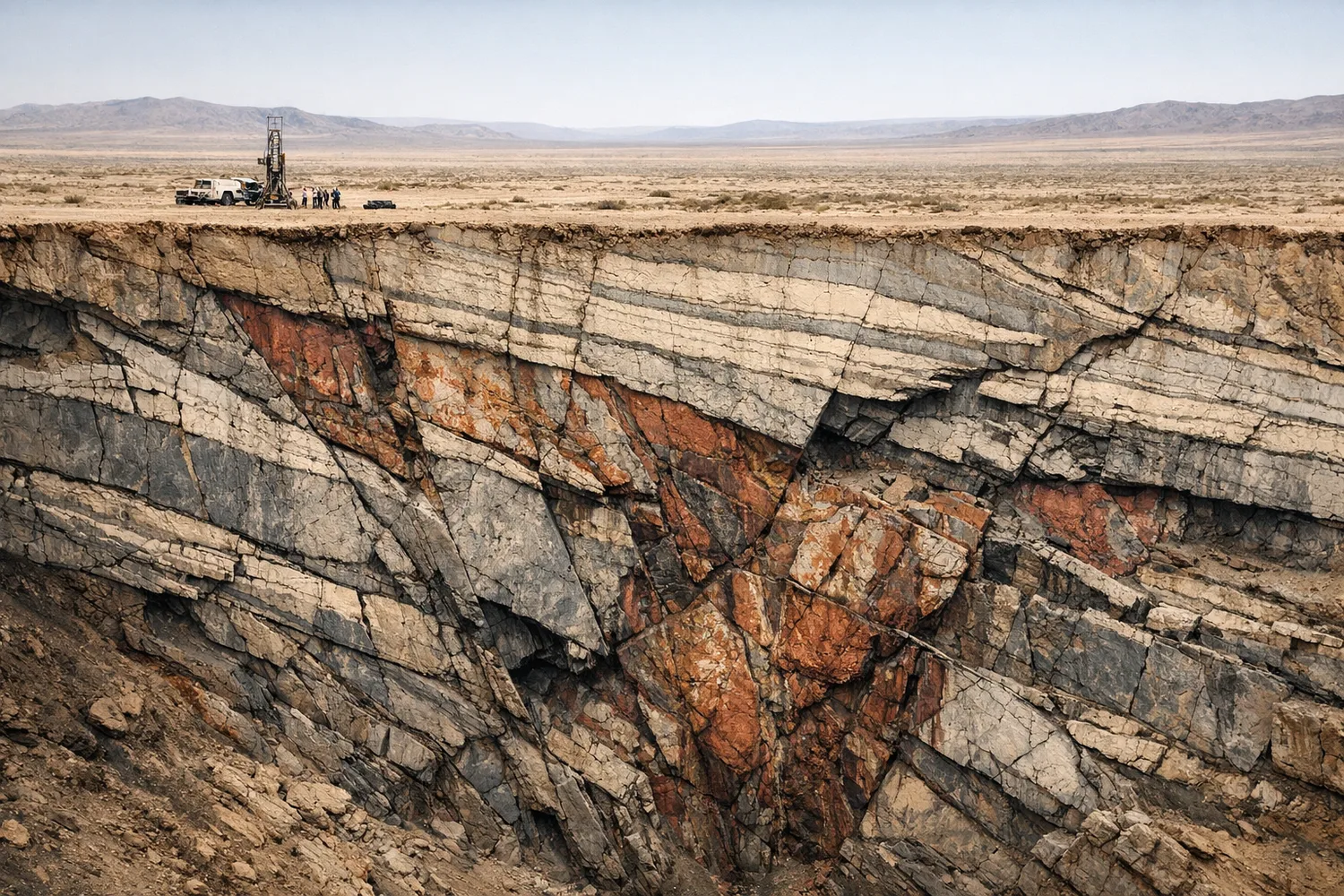
Reserve Books Are Not the Crust
Mining has three different boxes that public debate keeps mashing together.
The biggest box is endowment: what nature actually put there, whether we have found it or not. The middle box is resources: rock that has been identified well enough to say, with varying degrees of confidence, that there is probably something there worth talking about. The smallest box is reserves: material that has been drilled tightly enough, tested thoroughly enough, engineered cleanly enough, and de-risked enough that somebody is willing to treat it as economic inventory.
The public argument usually jumps straight from the smallest box to the biggest claim. Reserve book looks tight, therefore the planet is running dry. That logic is garbage.
A reserve statement is really a mine plan wearing a hard hat. It depends on drill spacing, because a few scattered holes are not enough to call rock predictable. It depends on metallurgy, because ore that exists in the ground is still useless if you cannot get the metal out cleanly enough. It depends on price, because a rock can be "too low grade" one year and perfectly serviceable the next. It depends on infrastructure, because a deposit with no road, power, water, or processing route is not reserve material just because it has nice chemistry. And it depends on permitting, because inaccessible ore is not reserve, it is scenery.
That is why reserve numbers move around so much. The movement is often treated like revelation. In reality it is usually the consequence of changing assumptions about what counts.
Take cutoff grade. That phrase sounds like it escaped from a consultant deck, but the meaning is simple. It is the line below which a company stops treating rock as worth hauling. If your processing plant gets better at recovery, that line can move downward. If power gets cheaper, it can move downward. If the commodity price jumps, it can move downward. If environmental compliance or labor cost rises, it can move upward. The deposit did not politely reconfigure itself to match your spreadsheet. Your accounting boundary moved.
This is why reserve exhaustion talk is so often sloppy. A deposit can operate for years while its reserve position stays stable or even grows, not because geology is doing magic tricks, but because more drilling tightens the model, more engineering improves the recovery, and more confidence turns "maybe" rock into inventory. The Earth did not refill. The operator got better information.
You can tell the same story in reverse. A project can look rich on paper and then get uglier once the hydrology turns nasty, the metallurgy underperforms, or the geotechnical model reveals that the pit walls or stopes behave like idiots. Reserves are not just a geology story. They are the point where geology and engineering survive each other.
That matters because the reserve book is supposed to be conservative. It is not designed to flatter the frontier. It is designed to protect the company from booking fantasy. Good. That is what it should do. The problem starts when people take a deliberately conservative business category and start using it as a metaphysical statement about what the crust has left.
Copper is the cleanest case because everyone thinks they already know the story. The International Copper Study Group noted in its 2020 Factbook that since 1960 the world has kept about 38 years of copper reserves on average. In the decade from 2009 to 2019, about 202 million tonnes were mined, and copper reserves still grew by 330 million tonnes. That is not what geological exhaustion looks like. It is what a moving inventory frontier looks like. The USGS has also estimated at least 3,500 million tonnes of undiscovered copper in just two deposit types that already account for most global supply. Again: reserve book is not crust.
Companies Do Not Prove Fifty Years of Ore Up Front
There is another reason reserve panic is so often embarrassing. Most companies have no incentive to prove out the whole geological dream at once.
That sounds counterintuitive until you remember what a mine actually is. It is not a museum exhibit built to demonstrate the full generosity of the Earth. It is a capital program with a sequence. The operator needs enough confidence in the next slices of ore to build, finance, permit, and run the project without kidding itself. It does not usually need to drill every distant possibility into submission on day one.
Why would it? Deep drilling is expensive. Detailed engineering is expensive. Metallurgical test work is expensive. Hydro work, geotech, scheduling, tailings planning, and all the rest are expensive. If a company can justify a mine with a decade or two of credible inventory and then keep extending the picture as operations advance, that is often the rational move. Spend all the money upfront proving every outer contour of the deposit and you tie up capital years before it earns a return.
Finance makes this bias stronger. Discounting hates distant tonnes. A tonne you expect to mine next decade matters far more to your present project economics than one you might mine thirty years from now if prices cooperate, permits stay stable, and the whole plan survives contact with politics. So the business naturally spends more effort proving the nearer material and less effort converting the far end of the dream into reserve today.
In plain language, reserve books are often short on purpose.
That does not mean they are fake. It means they are working documents optimized for current decision-making. The mine manager wants to know what can feed the plant with acceptable confidence. The lender wants enough proof to believe the debt gets serviced. The board wants enough visibility to approve the capital. None of those people are being paid to create a godlike census of the district if the next fifteen years of inventory already carry the project.
This is why the "years of reserves left" headline so often lands with more drama than insight. Many operations replace reserves as they mine them. They drill ahead. They extend pits. They tighten underground models. They improve recovery. They convert adjacent material. The reserve life can therefore remain stubbornly ordinary even while the operation itself keeps running for far longer than the panic chart implied.
The chart reader thinks the cupboard is nearly bare. The operator thinks, correctly, that there is no reason to pay today for every tonne that might matter in 2047.
This is not unique to mining, either. Warehouses do not stock a lifetime of demand if restocking works. Refineries do not build tanks for a century of throughput. Utilities do not order transformers for every speculative load that may appear two decades from now. Industrial systems run on managed inventory, not philosophical completeness. Mining gets treated differently because people keep mistaking reserve statements for geological confessionals.
It gets worse when public debate compares a reserve number with a giant demand forecast and pretends the gap is a physical sentence. Usually the comparison is mixing incompatible things. One side is a deliberately conservative inventory bucket built for near- to medium-term planning. The other side is a long-range scenario built from policy hopes, technology assumptions, and heroic deployment schedules. Even when both numbers are real, they are not doing the same job.
This is why experienced mining people are often much calmer about reserve headlines than everyone else in the room. They know that reserve life is not a final reading on the Earth's generosity. It is a reading on what has been proved tightly enough, close enough to the current business plan, to count right now.
That distinction is not a technical footnote. It is the hinge of the whole article.
If your model of scarcity ignores the fact that reserve books are intentionally partial, then you are not modeling depletion. You are modeling how much proof companies have chosen to buy so far.
Why the Map Looks So Small
Most exploration still behaves like a lamppost business. The industry looks where it can see, where old miners already proved the neighborhood, where roads exist, where outcrops tell some kind of story, and where the first few holes can be drilled without setting too much money on fire.
That is not because interesting geology stops beyond the shallow and obvious. It is because exploration money is finite and usually impatient.
By mining standards, a lot of the planet is still read shallow. A huge amount of practical decision-making still hugs the top few hundred meters, chases surface expression, and gives much more love to places with previous paperwork than to places that are genuinely blank. Under cover, meaning buried beneath younger sediment, basalt, weathered material, or whatever else hides the older structure, the picture gets harder and the invoice gets fatter.
Rock does not let you inspect it like a warehouse shelf. Signals blur. Weathering smears the chemistry near the surface. Faults offset what used to be continuous. Younger cover makes promising districts look boring from above. Every deeper hole costs more, takes longer, and creates more ways to lose money before the story is clear enough for the next financing round.
This is why "unexplored" is often the wrong word. The better phrase is badly read. The Earth is full of areas where we have hints, old surveys, scattered holes, partial geochemistry, maybe some magnetic work, maybe a previous operator who ran out of patience, and no coherent synthesis strong enough to justify the next serious drill program.
A lot of scarcity theater is built on mistaking that bad reading for absence.
The deeper irony is that the industry has trained people to think shallow equals real and hidden equals speculative. In many districts the opposite is closer to the truth. The obvious surface expression has already been chewed through. The buried continuation, feeder zone, parallel structure, or covered extension is where the future inventory is more likely to come from. The map looks small because the map is being drawn where finance tolerates uncertainty, not where geology stops being generous.
That distinction matters. A blank patch on the map may mean "no ore." It may also mean "nobody wanted to spend eight ugly seasons proving what lies under the cover." Those are not remotely the same statement.
The Lamppost Problem
This is why old districts keep coming back from the dead.
People love frontier stories about untouched virgin ground because they sound dramatic. Earth usually works through repetition instead. The same structures that fed mineralization near surface often continue at depth or under adjacent cover. The same intrusive systems that dropped metal into one zone often have cousins nearby. The same fault corridors that moved mineralizing fluids once rarely did it just one time and then retired with dignity.
Old miners did not stop where geology ended. They stopped where the tools, prices, processing routes, labor arrangements, or nerves of their era stopped.
That sentence should sit under every shortage chart in circulation.
An old camp can look finished because the rich easy ore near daylight is gone. That says almost nothing about whether deeper or nearby ore bodies exist. It says something about how far the previous generation could see and what it considered worth chasing. If drilling was expensive, data messy, metallurgy weak, or prices soft, a district could be treated as mature while leaving a ridiculous amount of material or extension in the ground.
There is also a brutal selection effect at work. Mines teach us about the districts that justified development, not about all the wrong turns and half-read structures around them. Once a mine exists, it creates roads, power, assay labs, operating experience, and a local mental map. That makes more drilling nearby cheaper and less scary. The district becomes legible. The result is that known camps keep attracting capital, which keeps generating more knowledge, which keeps making the next target easier to justify. Public debate then mistakes that concentrated attention for evidence that the rest of the crust has been somehow audited.
It has not.
The more honest view is that known districts are the lit islands in a much larger sea of partial information. Some of the next serious discoveries will happen far from those islands, but a lot will happen by extending or re-reading them. That is not a failure of imagination. It is how clustered geology works.
And it is why the phrase "we already looked there" often means less than people think. Many places were looked at under the wrong deposit model, the wrong commodity lens, or the wrong economic assumptions. A district explored for one metal in one price regime can look very different when recovery chemistry improves, power costs change, demand shifts, or a different style of mineralization becomes the target.
The Earth is not hiding from us out of spite. It is just not obliged to make the next ore body visible from a road cut.
Better Maps Change What Counts
The next move in the Earth story is not mystical. It is a better reading stack.
The old workflow was blunt. Find a surface clue. Run a survey. Punch a few holes. Hope the structure behaves. Miss by a little. Walk away and tell yourself the district is uninteresting. That worked often enough to build an industry, but it also left a lot of money buried under bad targeting.
The new stack is still imperfect, but it is much less stupid.
Magnetic surveys help because different rocks carry different magnetic signatures. Gravity surveys help because dense bodies tug the field differently than the country rock around them. Electrical and electromagnetic methods help because conductive fluids, sulfides, clays, and alteration halos do not all behave the same. None of these methods directly hands you a reserve statement. What they do is turn a big anonymous volume of crust into a more disciplined list of places where the next hole might actually teach you something.
That matters more than people outside the business appreciate. Exploration is not won by having cosmic insight. It is won by not wasting expensive holes on ground that never had a fighting chance.
Passive seismic is one of the least glamorous upgrades and one of the most useful. The trick is simple. The Earth is always humming. Ocean swell, distant weather, industrial activity, traffic, and microseismic noise keep sending weak signals through the ground. With enough sensors and enough patience, you can use that background rumble to sketch buried structure. Not ore grade. Structure. That is still valuable because ore follows structure much more often than it follows optimism.
What used to look like blank covered ground can start to resolve into faults, basin edges, intrusive plumbing, broken zones, and buried corridors worth drilling. That does not eliminate risk. It shrinks stupidity.
And that is usually enough.
The same thing is happening with reprocessing old geophysical datasets. Vast quantities of mineral and petroleum survey data were acquired for earlier targets, under earlier assumptions, then filed away once the first objective failed or the market mood changed. New processing methods can sharpen those datasets, remove noise more intelligently, and combine information streams that earlier teams never lined up properly. The result is not a miracle machine. It is a more coherent map.
Exploration people will sometimes oversell the sensor stack because it is easier to raise money around "new technology" than around "we finally cleaned up decades of ugly data." Fine. Strip away the pitch language and the underlying point still stands. Better interpretation expands the practical frontier even when the rocks themselves never changed.
None of this means declining ore grades are fake, or that physics stopped being rude. They are real. The IEA said in March 2026 that the average global grade of copper mines has fallen about 40 percent since 1991. That means more rock moved, more water managed, more tailings built, and less tolerance for lazy targeting. Good. That does not kill the thesis. It sharpens it. If grade is falling, then better metallurgy, better sorting, better process control, and better target selection become the whole game. Falling grade is a process tax. It is not proof the planet is empty.
AI Is Not a Prospector in a Cowboy Hat
The AI piece needs to be handled carefully because this subject attracts nonsense fast.
AI is not out there discovering new atoms. It is not replacing geology. It is not some digital shaman whispering copper coordinates into a hedge fund's ear. Most of the useful work is much more boring than that, which is precisely why it matters.
Mining and exploration data is a junkyard. Old drill logs in weird formats. Assays from different labs. Magnetic surveys flown decades apart with different quality standards. Surface mapping notes that only make sense if you can locate the geologist who wrote them and buy them a drink. Scanned reports. Lease data. Historical production records. Notes from programs that died when the treasury died. Even large companies often carry this information like a pile of incompatible rumors.
A decent machine-learning stack can chew through more of that mess than a human team can under deadline. It can standardize formats, line up data types that used to live in different silos, identify correlations the original team never tested, and flag targets that deserve a second look. That is not intelligence in the heroic sense. It is clerical stamina plus pattern recognition.
Used properly, it is still powerful.
Whole districts were written off under bad assumptions. Maybe the first team chased the wrong structure. Maybe they were looking for a shallow oxide story while the deeper sulfide story was better. Maybe they cared about nickel and missed the copper-cobalt geometry. Maybe the commodity price at the time killed interest in ground that now looks perfectly respectable. Maybe the drill spacing was too sparse to reveal continuity. AI is not the only way to revisit those mistakes, but it is a very good way to revisit them at scale.
It also helps with a more basic problem: humans are terrible at being consistently patient with ugly data. They get tired. They chase recent stories. They overvalue vivid drill hits and undervalue boring patterns. They let corporate memory decay every time a team turns over. A machine-learning system does not become inspired, but it also does not get bored halfway through reconciling thirty years of assay tables.
That said, there is a hard ceiling on the romance here. AI can improve target ranking. It cannot eliminate the need for physical proof. Anyone pitching AI as the end of drilling is either confused or fundraising.
Which brings us to the part the hype always tries to skip.
Core Boxes Still Rule
Geophysics suggests. AI filters. Drill rigs adjudicate.
Nothing in mining beats the authority of a tray of core and a lab result that repeats.
For a smart lay reader, drill core is exactly what it sounds like: cylinders of rock cut from underground and pulled up to the surface so people can finally stop guessing about what is down there. Those boxes of rock are where the rumor phase ends. You log the lithology. You test the chemistry. You study the structure. You learn where the fluids moved, where the sulfides sit, how continuous the mineralization is, how the rock breaks, whether water is going to be a menace, and whether your elegant district story survives contact with reality.
This is the expensive middle that shortage talk usually erases.
The first map is cheap relative to the rest. The real invoice starts when you try to turn a target into inventory. More holes. Tighter spacing. More assays. Metallurgical testing to see whether the metal actually comes out without a disaster. Geotechnical work to see whether the ground behaves. Hydro work to see whether the water system becomes an enemy. Then engineering to determine whether the whole thing can be mined without setting capital on fire.
That is why a geophysical anomaly is not a deposit and a deposit is not a reserve.
It is also why many frontier stories die in the gap between "interesting" and "provable." The exploration world is full of targets that are probably onto something but not onto it hard enough, fast enough, or cheaply enough to survive the proof phase. The Earth can be right while the project still dies.
That is not hypocrisy. It is normal. Nature is under no obligation to present ore in a way that matches a junior explorer's cash runway.
This also explains why reserves are such a bad proxy for ultimate availability. By the time material lands in the reserve bucket, it has survived a gauntlet that includes geology, drilling, engineering, economics, and administration. The reserve book therefore measures converted confidence, not the full endowment. It tells you what made it through the turnstile. It does not tell you how many people were still waiting outside.
One way to say it cleanly: we usually run short of converted knowledge before we run short of rock.
The Kill Shot Is Proof
That sentence leads straight to the real bottleneck.
The bottleneck is not that the Earth has suddenly become poor. The bottleneck is that proving hidden potential is slow, expensive, and easy to starve.
Follow-up drilling kills more supply stories than geology does. Permit delays kill more than people outside the industry seem willing to admit. Bad capital patience kills more than any conference panel on "future resources" will ever say out loud.
Junior explorers live this problem in the rawest way. Their business is not producing metal. Their business is surviving the stretch between "we found something interesting" and "someone larger believes us enough to pay for the next phase." That stretch can eat years. One bad season can wreck the story. One financing window missed because of market mood can turn a legitimate target into a zombie. One delayed permit can vaporize a field season. One ugly metallurgical result can send everyone looking for a cleaner fantasy.
The majors have more balance-sheet muscle, but they are not immune either. They have their own patience problem, just dressed in different clothes. Big firms are always triaging capital across existing operations, brownfield expansions, M and A, refining, downstream obligations, political risk, and shareholder demands for immediate neatness. A deeper, covered, slower-burn target may be exactly the right long-run move and still lose the internal capital argument to something uglier but nearer-term.
Permitting piles on top of all of this. Some of that friction is legitimate. Water matters. Communities matter. Tailings matter. Access and land use matter. None of that disappears because a geologist is excited. But it is also true that many jurisdictions run discovery-to-development like an obstacle course designed by people who are proud never to make a decision quickly. The result is the same either way: information decays while paperwork ages.
It is worth being explicit here, because this is where the replies usually get sloppy. Near-term pinch points can be real even when long-term endowment is abundant. The IEA currently sees the copper project pipeline falling about 30 percent short of 2035 needs, and it says new copper projects take around 17 years on average to move from discovery to production. You can be right about abundance and still get a shortage in the 2030s if the conversion chain runs too slowly. That is not a contradiction. That is the mechanism.
And the geopolitical part is not decorative either. The same IEA copper work shows the top three mining countries already account for just under half of supply, and more than half of copper mines sit in high water-stress areas. Some delays are the price of not building a tailings problem with a long fuse or draining an arid watershed to keep a schedule pretty. Good. The point is not that every permit fight is fake. The point is that real environmental constraints and bad administrative process get piled into the same bucket, then everybody argues past the actual bottleneck.
This is the part abundance rhetoric sometimes underrates. Better maps do not automatically become supply. Somebody has to pay the expensive proof bill. Somebody has to carry the project through the years where it is too geological for infrastructure capital and too infrastructural for venture-style impatience. Somebody has to keep drilling while the administrative clock keeps pretending time is free.
That is why resource panic is often aimed at the wrong villain. The Earth is rarely the binding constraint. The bottleneck is the conversion chain from hidden possibility to bankable inventory.
And that chain is fragile.
What the Next Decade Actually Looks Like
If you strip out the brochure language, the next five to fifteen years on Earth look less like a miraculous new era of discovery and more like a slow widening of the readable map.
You should expect more under-cover exploration, not because companies suddenly became adventurous philosophers, but because the shallow obvious ground has already absorbed too much attention. You should expect more brownfield wins, meaning extensions around or beneath known mines, because those districts already have infrastructure, operating memory, and a cheaper path from idea to proof. You should expect more reprocessing of old data and more fusion of survey methods, because a lot of yesterday's "dead ground" died under lousy interpretation rather than honest geological failure.
You should also expect more state interest.
That does not mean nationalization theater or some grand resource command economy. It means governments paying closer attention to feedstock security, mapping programs, strategic processing capacity, and the practical question of whether they are one bureaucratic delay away from discovering they outsourced the whole industrial base to whoever kept drilling while they held hearings. Strategic systems eventually learn to care about upstream geology.
The exploration sequence itself will stay ugly. Better district-scale reading. Better target ranking. More selective deep holes. More discipline around which targets deserve expensive follow-up. Then the same old fight between patient proof and impatient capital.
That also tells you where the practical alpha sits. Not in chanting "more mining" at the wall. It sits with the operators who can turn badly read ground into inventory cheaper than the next guy. Brownfield juniors around serious districts. Teams with a geophysics or data edge in covered terranes. Companies that can move from target to proof without lighting cash on fire. Majors will still pay up for de-risked inventory because replacing mill feed is a lot more urgent than pretending the reserve book is fate.
The signals are not mysterious either. Watch discovery quality relative to exploration spend. Watch reserve replacement that comes from deeper drilling or covered ground rather than from price sugar highs alone. Watch which jurisdictions manage to cut ten-year obstacle courses down to something sane without pretending water and tailings no longer matter. Quietly, that kind of permitting reform is one of the highest-return policy moves on the board.
None of this requires a new periodic table. It requires better information and a tolerance for boring work.
That is an important correction, because scarcity stories love theatrical explanations. The quieter truth is usually more useful. The terrestrial frontier moves outward when the cost of knowing falls faster than the cost of hiding. Cover stops being invisibility. Old districts stop being finished. Low-grade stops being junk. "Uneconomic" stops being eternal.
The Earth's gift is not that it keeps creating metal on demand. The Earth's gift is that our reading of it keeps improving, and the crust is much richer than the visible surface ever suggested.
Provided someone is willing to pay for the next hole.
The Dark Horses at the Edge of the Map
This is where the article can afford to get a little weird, because the main body has already done the real work.
Passive seismic deserves to be in this outer ring not because it is speculative, but because it changes how much of the crust counts as readable without requiring every program to light off a giant active survey campaign. If the Earth is always humming, and if that hum can be turned into a more usable picture of buried structure, then a lot of ground that used to be dismissed as blind becomes merely expensive instead of impossible. That sounds modest. It is not. Frontier economics often turn on whether uncertainty falls from absurd to manageable.
AI prospecting belongs here too, but only in its honest form. The strongest use case is not magic discovery. It is map cleaning at scale. Old geological work is full of almost-right calls buried under formatting chaos, fragmented ownership, and expired attention spans. A machine that can drag those hints into one room and tell you which ones are worth another round of real-world testing has industrial value even if it never produces a single sexy headline.
And then there is geologic hydrogen, which might be the cleanest illustration of the whole article.
Hydrogen in the crust is not the same story as hydrogen in a PowerPoint. The current field is a live demonstration of how new resource categories are born. First you get odd seeps, strange gas measurements, weird wells, bits of geology that did not fit the old playbook. Then you get people trying to figure out which rock settings actually matter. Then you get prospectivity maps, meaning maps of where the conditions look favorable enough to justify looking harder. Only much later, if things go well, do you get something that deserves to be called reserve.
That sequence matters more than the hydrogen hype itself.
There is still only one often-cited producing example people point to when they want to sound confident about natural hydrogen. That is the sober part of the story. The exciting part is that the search logic is improving fast. Geologists are getting better at identifying the rock-water reactions, structural traps, and migration pathways that matter. Survey teams are getting better at asking where to listen first instead of wandering around hoping for a miracle. The field is map-first before it is reserve-first.
That is exactly how terrestrial abundance tends to work. Not as a sudden bounty, but as a new category of legible ground.
The temptation, especially online, is to treat each of these dark horses as the big reveal. That would be a mistake. The point of AI prospecting, passive seismic, and geologic hydrogen is not that any one of them saves the world. The point is that they keep reinforcing the same underlying truth: the resource horizon keeps moving outward when our ability to read hidden systems improves.
The Earth is not done surprising people who mistake ignorance for depletion.
What the Panic Actually Gets Wrong
Now for the blunt version.
We are not running out in the way the public story implies. We are not standing at the edge of a geologically audited planet with the cupboards bare and the good stuff gone. What we have is a much narrower problem and a more manageable one.
We have reserve books that measure conservative, financeable inventory and then get misread as destiny.
We have an exploration business that still spends too much of its life under the lamppost because shallow, visible, and already-legible ground is easier to fund than buried, covered, or deeper systems.
We have sensing and interpretation tools that are finally getting good enough to widen the map in places that used to look dead.
And we have a conversion problem. Better maps do not become supply by applause. They become supply through more drilling, better metallurgy, more patient capital, and administrative systems willing to process reality on something faster than a geologic timescale.
That is the real correction to the scarcity sermon.
If the next decade disappoints, it will not be because the crust suddenly went empty while analysts stared nobly at their spreadsheets. It will be because too many promising targets died in the proof phase. Too many under-cover districts stayed under-read. Too many projects were asked to survive with venture-speed patience and infrastructure-length gestation. Too many permit clocks were allowed to eat the years in which the geology was finally becoming legible.
The Earth's resource frontier is not finished. It is buried, covered, half-read, and frequently starved before the evidence is tight enough for public confidence.
That is a very different problem from depletion.
And it leads to a very different conclusion.
The next resource horizon is not the point where the planet stops helping. It is the point where our map runs out, our patience runs out, or our institutions decide that proving the next layer is somebody else's problem.
We have not run out of planet.
We have run out of cheap proof, patient capital, and tolerance for the ugly middle.
Comments
Reader notes
Reader comments are not connected yet. For now, send notes to @slop_dealer.