Scale Wars essay

The Relay Layer Owns the Map

Before the Moon gets cities, it needs links, clocks, coordinates, and relays. The first durable utility may be the layer that keeps everyone from being blind.

Quick version

Before the Moon gets cities, it needs links, clocks, coordinates, and relays. The first durable utility may be the layer that tells every rover, lander, and astronaut where they are and gets their data home.

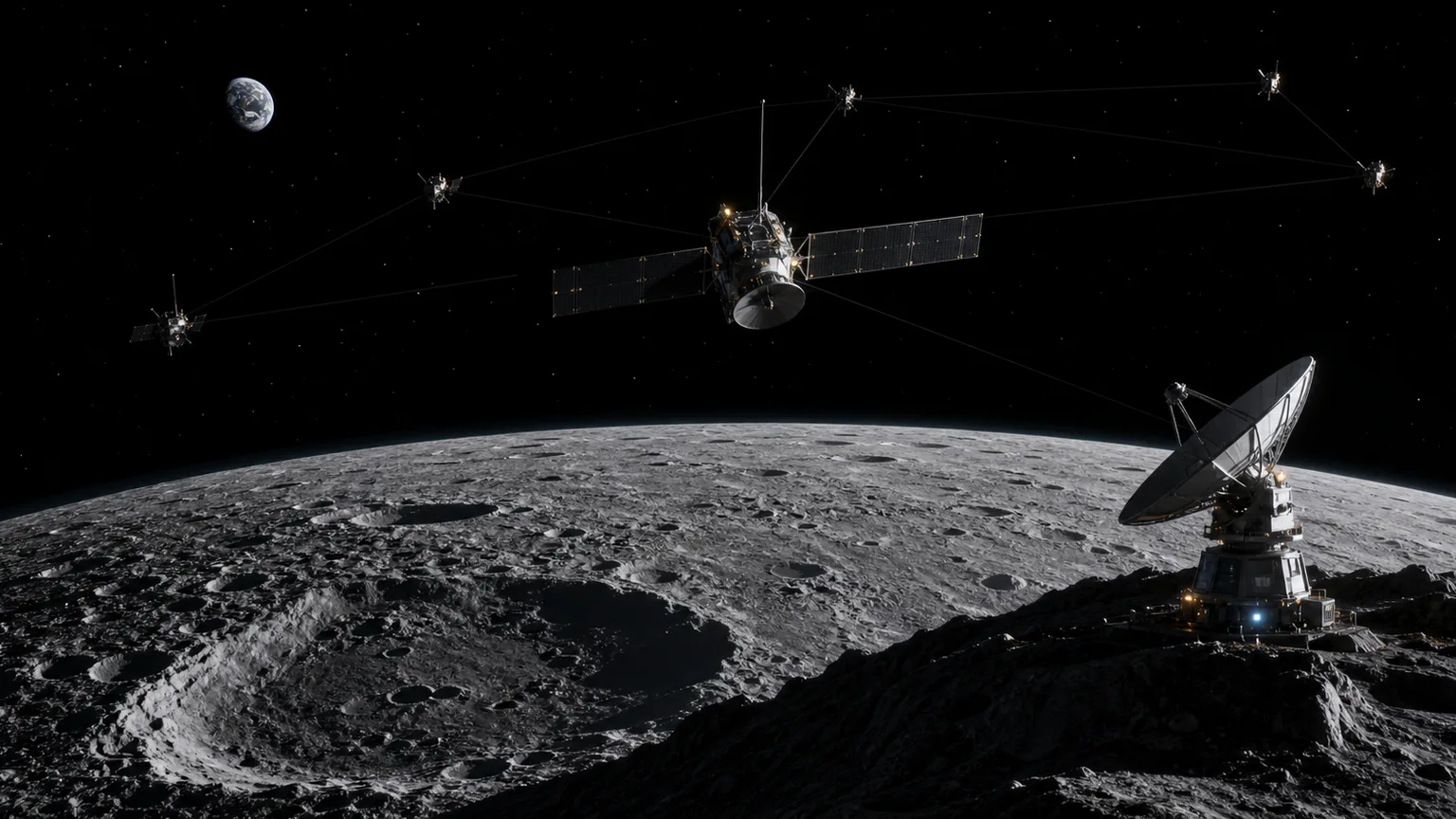
Lunar relay satellites and a ground antenna station above the Moon
The first lunar utility may be a bill for not being blind.

The first lunar utility probably will not look like a city utility. No pipes. No streetlights. No neat row of substations humming behind a fence. It may look like a handful of satellites, ground stations, user terminals, clocks, standards documents, and contracts. Boring equipment. Expensive boring equipment. The kind that gets ignored until nobody can land, drive, dock, point an antenna, timestamp a sensor, or send the data home.

That is the relay layer: communications, navigation, timing, and the standards that let one mission use more than one provider without rebuilding its whole nervous system. On Earth, this layer is invisible because it already won. GPS, mobile networks, internet routing, telecom backhaul, cloud regions, time sync. Most people only notice it when the map freezes or the payment terminal dies. On the Moon, the layer is still being laid down. That makes it one of the cleanest early scale wars in the whole lunar economy.

The simple thesis: before there are lunar cities, and before there is large surface industry, the first serious rent-collecting utility is likely to be the relay layer. Not because relay operators are glamorous. Because every other actor needs the layer before they can act at scale.

The Moon Gets a Meter Before It Gets a City

A city needs volume. Habitats, power, water handling, cargo cadence, maintenance crews, emergency response, roads or marked traverse routes, legal routines, and enough repeated human activity to make the word city more than costume jewelry. The Moon does not have that yet.

But it already has a thinner, meaner customer base: landers, orbiters, rovers, payloads, astronauts, human landing systems, lunar terrain vehicles, and science instruments. Those customers do not need cafes. They need contact. They need position. They need time. They need a map that is not a guess plus a prayer from a mission operations room on Earth.

NASA's LunaNet documents frame this as a network of cooperating networks, not one magic satellite. The point is interoperability. A mission should be able to receive communications and position, navigation, and timing services from compatible providers. NASA, ESA, and JAXA have been developing the LunaNet Interoperability Specification so that different government and commercial systems can speak the same operational language.

That matters because the first scarce lunar commodity is not regolith. It is usable certainty. Where am I? Where is my asset relative to the landing zone, the ridge, the crater, the shadow line, the other rover, the return vehicle? What time is this measurement? Can I send this packet now, or do I store it and forward it later? Is Earth visible, or is the terrain blocking me? Can another provider pick up the service if this link fails?

Whoever sells that certainty is not just selling bandwidth. They are selling permission to operate.

The Relay Business Arrives Before the Surface Business

A surface mine has to survive the surface. A relay service can start in orbit, connect to Earth, and serve many surface and orbital users as they arrive. That is why this layer comes early. It does not need a lunar city to be useful. It needs missions that hate being blind.

NASA's Lunar Communications Relay and Navigation Systems project says the gap plainly: some areas of the Moon, including the far side and the south pole, have limited or no direct visibility to Earth antennas. That is not a branding inconvenience. It changes landing opportunities, mission design, rover freedom, safety margins, and how much burden gets pushed onto each individual spacecraft.

Direct-to-Earth communication will still matter. Near-side missions can use it. Some missions will carry their own stronger radios. Some will buy only backup service. But the logic of a shared relay layer is brutal: every kilogram and watt spent on a private workaround is a tax on the mission. If a commercial relay can reduce that burden, even unevenly, it becomes part of the economic terrain.

NASA has already moved from concept to procurement. In 2024, it selected Intuitive Machines as the first commercial LCRNS service provider under the Near Space Network Services contract. NASA's contract release described a relay services contract vehicle with a maximum potential value of $4.82 billion. That figure is not guaranteed revenue, and it should not be waved around like proof of a finished market. It is still useful. It says the category is real enough for formal buying, validation, task orders, and operational integration.

ESA is building the same pattern from the European side with Moonlight. ESA describes Moonlight as a lunar communications and navigation service constellation: one high data rate communications satellite, four navigation satellites, and dedicated ground stations. Its coverage priority is the lunar south pole, where many future missions want to operate because of lighting conditions and permanently shadowed regions. ESA also describes Lunar Pathfinder as a precursor commercial data relay service, with Moonlight services planned to roll out after it.

This is not a moon-base poster. This is the plumbing of repeat operations.

Navigation Is the Toll Booth Hidden Inside the Map

People hear communications and picture video calls from astronauts. Fine. That is the retail version. The larger prize is navigation and timing.

LunaNet's PNT services are meant to help missions determine position, velocity, surface location, trajectories, maneuvers, and accurate time. That bundle is the map. Not a pretty map on a wall. The operational map that tells machines how to move and tells controllers whether the movement is real.

This is where the rent gets less obvious and more powerful. A bandwidth seller charges for a link. A navigation and timing layer becomes part of every action that needs confidence. Landing. Docking. Traversing. Returning samples. Coordinating multiple robots. Avoiding protected or contaminated sites. Finding a payload after dust, shadow, or slope hides it. Running science instruments whose readings only matter if the timestamp and location can be trusted.

The Moon is a harsh place to be vague. A rover that is somewhere near the crater rim is not an asset. It is a liability with wheels. A lander with poor timing and poor ranging does not become poetic. It becomes expensive debris.

The map owner does not need to own the land to collect. On Earth, the map layer learned this lesson early. Search, logistics, rideshare, delivery, advertising, emergency services, weather apps, field operations, and payment fraud systems all lean on position and timing. The toll is not always a direct fee for coordinates. Sometimes it is device dependency. Sometimes it is API access. Sometimes it is compliance. Sometimes it is the quiet fact that your operation was designed around someone else's reference system.

On the Moon, this will be less hidden at first. There are fewer users, fewer alternatives, and less room for consumer-grade pretending. Missions will know exactly which relay, which standard, which signal, which user terminal, and which service requirement they are depending on.

The Clock Is Not Decoration

The timing piece sounds small until it starts breaking the map. NASA is working on Coordinated Lunar Time after a White House policy directive. This is not a cute time zone for lunar wristwatches. It is an operational time standard for cislunar activity.

NASA says atomic clocks at the Moon will not tick exactly like clocks on Earth. The agency and its partners are studying how to establish a lunar time standard, with atomic clocks at the Moon likely involved. The White House policy memo is sharper: direct use of UTC at the Moon without correction can create ranging errors and can reduce the accuracy of mapping and inertial navigation products.

That is the part to underline. Timing is not paperwork. Timing is distance. Signals become measurements because clocks agree well enough. When the clock slips, the map slips. When the map slips, navigation, docking, landing, and science products inherit the error.

So the lunar utility stack is not just "can you call Earth?" It is: can you agree on time, locate yourself, exchange data, survive intermittent contact, and do all of that through standards that more than one provider can implement?

The Rent Is in the Interface

The obvious rent is service access. A mission buys relay, communications, navigation support, timing support, or some combination. The less obvious rent is interface gravity.

Once a user terminal, mission design, operations workflow, safety case, and procurement process are built around a service layer, switching becomes work. Standards like LunaNet are designed to reduce lock-in, and that is good. But even open standards do not remove the economic power of the layer. They move the fight from "who owns the only pipe?" to "who can provide the most trusted, validated, available, compatible service?"

That is still a scale war. It just wears a cleaner shirt.

  • More users make the network more useful.
  • More compatible providers make the standard harder to ignore.
  • More mission designs built around the layer make the layer harder to route around.
  • More operational history makes buyers prefer the proven provider.
  • More coverage makes surface ambitions less brittle.

Notice what is missing from that list: a city. The relay layer does not need a city first. It needs enough high-value machines and crews who cannot afford to be lost, silent, late, or mislocated.

What Can Break the Thesis

This is not a prophecy. The relay layer may become competitive enough that no single provider collects fat rent. Governments may keep core services public or treaty-shaped. Direct-to-Earth systems may remain good enough for many near-side missions. Lunar mission cadence may disappoint. Budgets may slip. Hardware may be late. Standards may fragment. A provider can win a contract and still fail to become the default terrain.

There is also a political limit. The Moon is not a private industrial park. Communications, navigation, timing, reference frames, spectrum, safety, rescue, scientific access, and international coordination all drag states into the room. The more important the relay layer becomes, the less likely it is to remain a pure toll road with no public obligations.

But none of that kills the core read. It refines it. The first rent-collecting utility may not be a monopoly company. It may be a utility layer with multiple providers, public standards, anchor government customers, commercial service contracts, and enough operational dependence that every serious lunar plan has to budget for it.

The Slop Dealer Read

The bad lunar economy pitch starts with cities, tourists, mines, and heroic renderings. It sells the surface as if the hard part is already solved. The sharper read starts with the boring layer: relays, clocks, coordinates, service validation, ground segments, user terminals, and standards.

That layer is not the whole Moon economy. It is the thing the rest of the economy keeps stepping on.

Before there is a lunar downtown, there will be a rover trying to get around a ridge. Before there is a factory, there will be a lander trying to prove exactly where it touched down. Before there is a hotel, there will be a crew vehicle needing a trusted navigation and timing service. Before there is a mining district, there will be machines that need to report, route, pause, resume, and come home.

The relay layer owns the map because the map is not just an image. It is the live agreement between motion, time, signal, and trust. Whoever helps maintain that agreement gets paid early, gets embedded early, and gets to define what normal operations mean before the big surface dreams arrive.

That is why the first lunar utility is probably not glamorous. It is a bill for not being blind.

Source Notes

Comments

Reader notes

Reader comments are not connected yet. For now, send notes to @slop_dealer.