Scale Wars essay

The Gradient Is the Business

The Moon matters less as a future town and more as a cheaper place to make and move oxygen. The first useful business is tanks, pipes, depots, and transport.

Quick version

The Moon matters less as a future town and more as a cheaper place to make and move oxygen. The first useful business is tanks, pipes, depots, and transport.

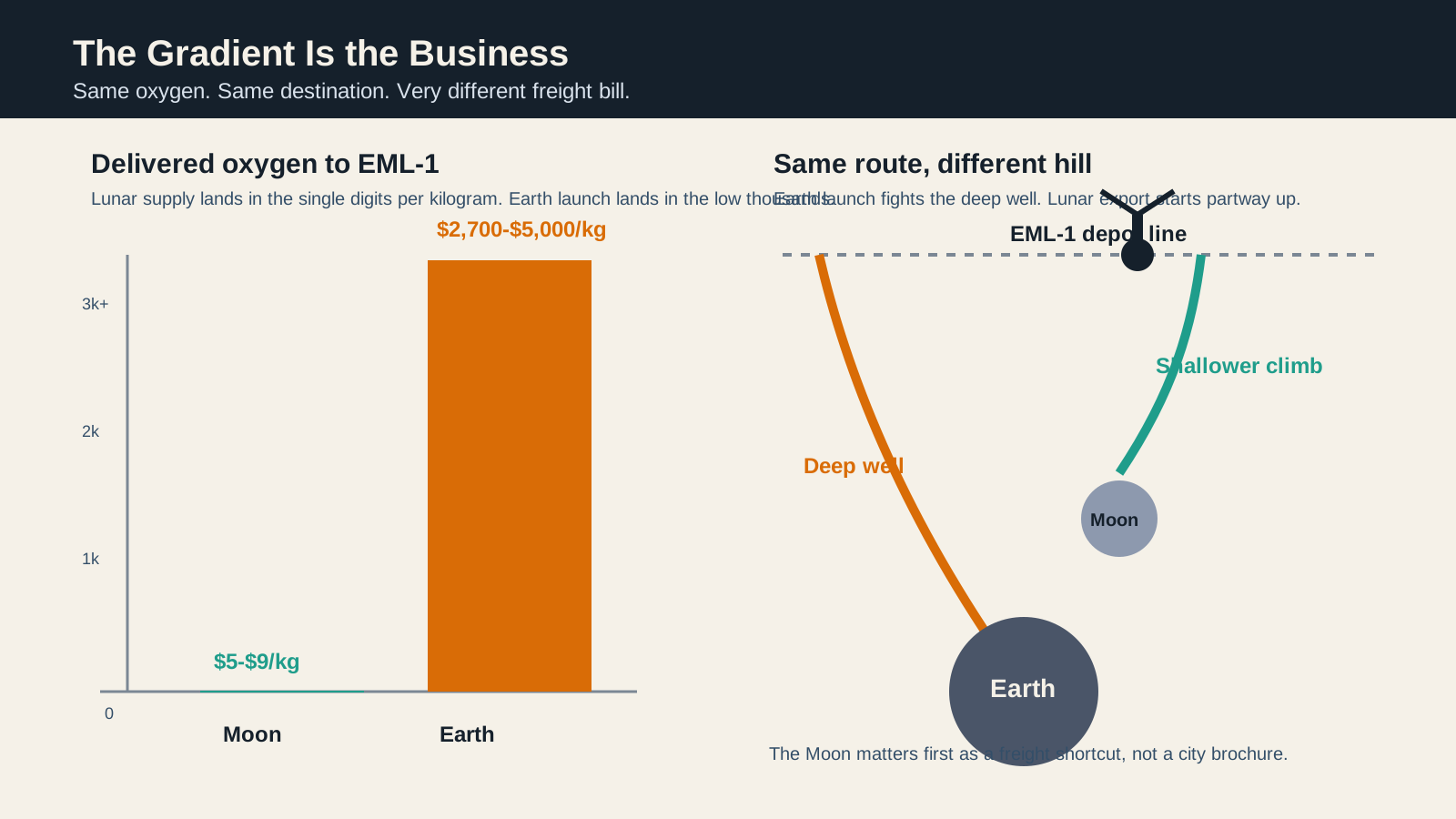
You were told the Moon matters because people will live there. That story is wrong. The interesting lunar object is not a dome or a flag or a brochure rendering of a glassy habitat. It is a cryogenic oxygen transfer line on a depot parked at EML-1, the Earth-Moon Lagrange Point 1, a parking spot between Earth and Moon where vehicles can stage cargo and propellant. Fill that line from Earth, and you pay Earth's full gravity tax on every kilogram. Fill it from the Moon, and the climb to the same neighborhood is roughly one-fifth as hard. Same oxygen. Same depot. Completely different bill.

Chart comparing Moon-sourced oxygen and Earth-sourced oxygen delivered to EML-1
Same oxygen, same destination, different transport bill.

That is the governing principle. The Moon matters first as a transport gradient and a shallow gravity well, not as a settlement fantasy. It is a gas station and a rock quarry before it is anything like a town. The customer is not a future homeowner under a plastic dome. The customer is in cislunar space, the working volume between low Earth orbit and the Moon where landers, transfer vehicles, servicing craft, depots, and high-value satellites have to move, wait, dock, and refuel.

If that sounds abstract, strip it down to plumbing. Cislunar space is not empty blackness. It is a warehouse district with no air and a nasty freight problem. EML-1 is useful because traffic can pass through it in several directions. A vehicle coming up from Earth can stage there. A vehicle coming off the Moon can stage there. Cargo headed deeper into lunar space or outward beyond the Earth-Moon system can stage there. Put tanks, valves, docking ports, and guidance software at that node, and you have the beginning of an economy. Not a sexy economy. A real one.

Cislunar logistics scene showing an orbital staging point between Earth and the Moon
EML-1 is a useful stop near the top of the hill, not a magic place.

Oxygen is the first serious lunar commodity because chemistry is rude and mass is expensive. In common chemical propulsion, oxygen is the heavy side of the propellant load. Hydrogen gets the poetry because it is hard to store. Methane gets the startup slides because it sounds modern. Oxygen does the heavy lifting on mass. If you can source oxygen off Earth, you chop a large recurring burden out of the logistics stack. You are not solving every problem, but you are attacking the fat middle of the shipping bill instead of admiring the mission patch.

The Moon can supply that oxygen in two ugly, useful ways. One is water ice, especially in cold polar regions where sunlight is awkward but volatiles may be available. Split the water and you get oxygen and hydrogen. The other is lunar rock itself. Lunar regolith is full of oxygen chemically bound into oxides. That does not mean you scoop up breathable air with a bucket. It means you take a shovel bite of dirt, run it through hot and power-hungry processing, and pry the oxygen loose with industrial chemistry. Neither path is elegant. Both are more plausible as businesses than pretending the first profitable lunar export is lifestyle real estate.

Rugged lunar oxygen processing plant with radiators, tanks, excavation hardware, and dust-covered service lanes
The first oxygen plant is ugly because the useful parts are tanks, heat, power, and repairs.

This is where the gradient does the real work. Earth makes you lift propellant to lift propellant to lift propellant. That compounding penalty is the rocket equation in plain English. Every kilogram you want at EML-1 has to survive the trip out of Earth's deep gravity hole, which means a lot of the hardware below it exists only to throw other hardware upward. The Moon is much less punishing. From the lunar surface to EML-1, the climb is far smaller. That does not make it free. It makes it tractable. Smaller vehicles can do useful transport work. Tankers do not have to spend so much of their own mass budget feeding themselves.

That difference is why the lunar business starts with spreads, not settlements. If a kilogram of oxygen delivered from the Moon to EML-1 undercuts a kilogram hauled there from Earth, a market can form around the gap. Not a giant market on day one. A narrow one. But narrow is how real infrastructure businesses start. Somebody owns the extraction plant. Somebody owns the tanker. Somebody owns the depot slot, the transfer hardware, the boiloff control, and the insurance logic. The industrial metabolism splits cleanly: dig and crack material on the Moon, then store, sort, and resell it in cislunar depots where traffic actually needs it.

That is why the first important lunar geography is depot geography. People hear "Moon economy" and picture buildings on the surface. The more important map may be a set of tank farms in useful orbital parking spots. A depot is not mystical. It is tanks, insulation, thermal control, transfer lines, docking rules, sensors that can tell a clean coupling from a leaking one, and operations software that keeps expensive hardware from kissing at the wrong speed. If it works, it looks boring. Good. Boring is what customers trust.

Orbital propellant depot with tanks, docking ports, transfer lines, and spacecraft arriving in cislunar space
The depot is the shop counter: tanks, transfer lines, docking, inventory, and uptime.

The likely early customers are also boring in the best way. Start with landers that should not be disposable. Add transfer tugs moving cargo from Earth orbit into lunar space. Add government missions that would like to stop launching every sortie as a bespoke stunt. Over time, the same network can support servicing craft and relocation vehicles for high-value satellites on the Earth side of cislunar space. The paying customer is the operator with hardware already in motion, already on a schedule, and already losing money when mass has to be dragged up from Earth one mission at a time.

Simple cislunar logistics map linking low Earth orbit, Earth-Moon L1, and low lunar orbit
A few useful stops beat a thousand decorative ones.

This is the correction most lunar salesmanship tries to dodge. The Moon does not become economically important because people are brave or because exploration is noble. It becomes important if it removes recurring mass from expensive routes. A reusable lander is not just a cool machine. It is a customer for depot oxygen. A depot is not just a clever orbital object. It is a utility that makes reuse worthwhile. A quarry on the Moon is not interesting because rocks are romantic. It is interesting because rocks are oxygen feedstock and oxygen is freight.

The likely trajectory over the next several years, if this frontier matures at all, is not cinematic. First comes proving that extraction equipment can survive dust, cold, long duty cycles, and miserable maintenance conditions. Then comes proving that you can liquefy and store oxygen without watching your inventory boil away. Then comes transfer: couplers that seal, pumps that behave, guidance that can dock repeatably, and enough thermal control that a hot valve or a cracked radiator does not turn margin into vapor. Only after that do you get something that deserves the name market.

The bottleneck is not lunar romance. It is demand sequencing. The scarcity panic missed the actual bottleneck. You can sketch extraction plants, tankers, and depots all day. If cislunar customers stay thin or show up in the wrong order, the whole thing turns into demo theater. A depot with no traffic is a very expensive sculpture. A mine with no dependable offtake is a science project with invoices. Build a base before you build the logistics spine, and you have built the hotel before the road.

That sequence error matters because surface bases mostly consume. Depots and transport links can compound. A surface habitat is a customer, which is fine, but it is rarely the first customer you want if you are trying to bootstrap throughput. A depot that serves multiple landers and tugs improves every mission that passes through it. A relay network improves every robot and every crater operation under it. A timing system improves every docking event. Those are utilities. Utilities collect rent from traffic. Outposts mostly ask for more cargo.

So the second lunar business, right behind oxygen, is hidden utility work. Power is one piece. If your extraction plant sits near a polar region for access to ice or steady light, its power design is not a side note. It is the plant. Thermal management is another. Cryogenic storage is a war against heat leak. Sunshades, insulation, radiators, tank placement, and boiloff handling decide whether your depot is a business or a slow-motion leak. Nobody will make a stirring speech about heat rejection. It will still decide who stays solvent.

Lunar landing pad and service area built from local surface material with blast protection and work vehicles
The boring ground work matters because rockets punish loose dirt every time they land.

Communication coverage is the same kind of hidden plumbing. The relay blind spot will decide which craters get developed long before some grand theory of lunar urbanism matters. A robot miner working in permanent shadow is not heroic when it drops off the network. It is dead capital. Constant or near-constant relay coverage means teleoperation when you need it, autonomy with supervision when you do not, and fewer dumb losses when a haul vehicle disappears behind terrain. Own the relay layer and you do not own glamour. You own permission.

Lunar timekeeping lands in the same bucket. It sounds like a nerdy standards fight until vehicles have to dock, transfer propellant, and coordinate navigation without a human babysittering every move. Shared time is part of shared position. If the depot, the tanker, the lander, and the relay network do not agree closely enough on the clock, guidance gets sloppier, synchronization gets harder, and routine operations stop being routine. Once traffic thickens, a lunar timing standard stops being a curiosity and becomes another piece of industrial plumbing.

Then there is the cold sink, which belongs out on the weird outer ring but still fits the same logic. Permanently shadowed lunar regions are naturally cold enough to matter for industry. The first obvious use is not science fiction. It is refrigeration. If you can store volatile propellants in colder conditions with less boiloff, that is money. More speculative uses may follow: sensitive instruments, exotic materials handling, maybe even hardware that benefits from a giant natural freezer. Fine. But the near-term value is still ugly and practical. Cold saves propellant.

That is the pattern across the whole frontier. The Moon is not valuable because it is pretty, sacred, or waiting to become a suburb. It is valuable because it sits at the top of a shallower hill and offers feedstock, staging, and utility nodes for machines already trying to move through cislunar space. Once you see that, the priority list changes fast. You stop asking when the first large settlement appears. You ask who can deliver oxygen to EML-1 without burning the margin away, who can keep a tank farm cold, who can cover the relay dead zones, and who can make the docking clocks agree.

The open question is not whether the gradient exists. Physics settled that a long time ago. The open question is whether enough customers show up in the right order to turn that gradient into rent. If they do, the first real lunar fortunes will not come from selling condos in a crater. They will come from owning the uphill haul route: the regolith shovel, the extraction plant, the tanker, the relay layer, the depot slot, and the utility stack that makes the whole route dependable. That is a much less glamorous story than a moon city. It is also the one that has a chance of being true.

Comments

Reader notes

Reader comments are not connected yet. For now, send notes to @slop_dealer.