Scale Wars essay

The Furnace Below

Geothermal power is simple to explain: Earth is already hot. The hard part is drilling deep enough, keeping the pipe alive, and selling steady heat or power to real customers.

Quick version

Geothermal power is simple to explain: Earth is already hot. The hard part is drilling deep enough, keeping the pipe alive, and selling steady heat or power to real customers.

The furnace is already running. The business is the pipe.

The furnace is already running. The business is the pipe.

The strange thing about geothermal is that the planet has been quietly doing the hard part forever.

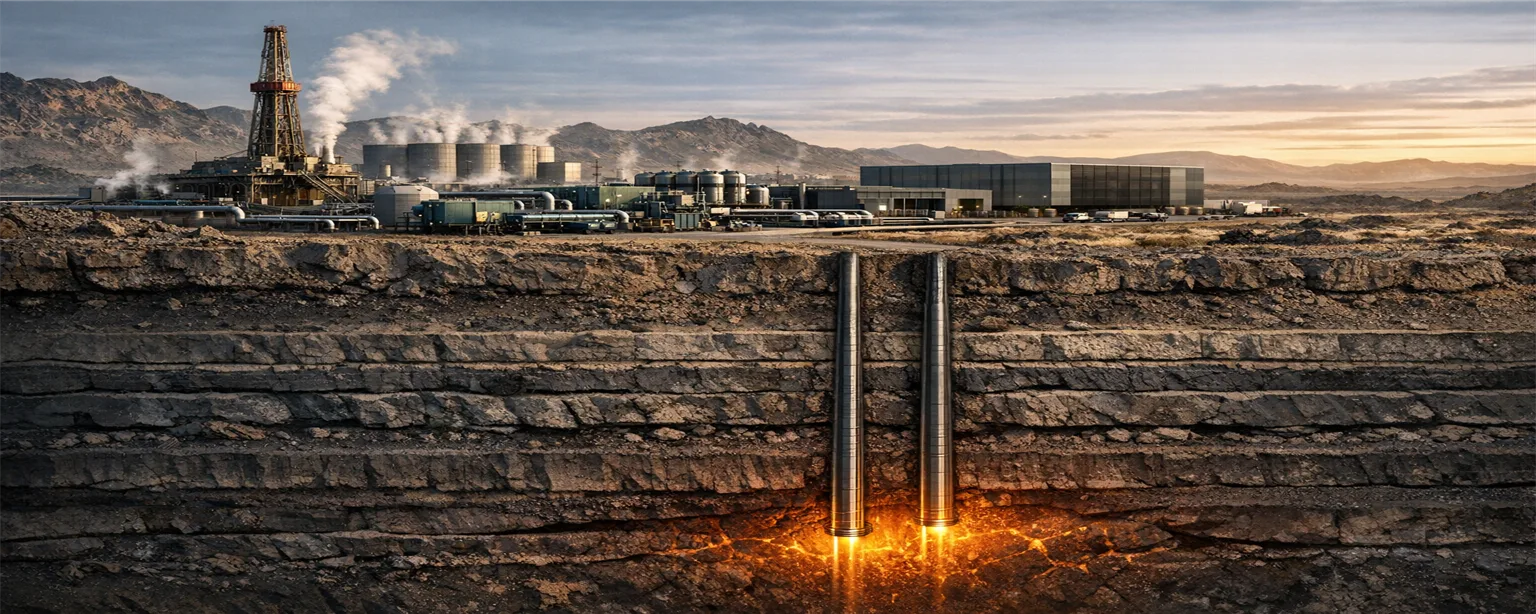
Heat is already moving upward through the crust. It is slow, stubborn, continuous, and completely uninterested in fuel markets. No one has to invent the furnace. No one has to ship it. No one has to persuade the mantle to show up for work. The invoice starts when we try to reach it, hold the well open, move fluid through hostile rock, keep the chemistry from eating the pipe, and turn a deep thermal gradient into something customers can buy.

Geothermal needs a different frame. It is not just a niche electricity trick for volcanic regions and lucky steam fields. It is one of the most underpriced energy frontiers on Earth because it turns geology into firm industrial heat and power.

The basic rule is simple: the deeper and hotter the rock, the more the wellhead behaves like infrastructure instead of a fuel source.

The customer is not an energy theorist admiring a resource map. The customer is a grid operator that needs firm capacity after sunset. It is a data center that wants power without weather drama. It is a district heating system trying to stop burning gas. It is a refinery, fertilizer plant, desalination site, lithium processor, greenhouse, or factory that needs heat as much as electrons. It is the industrial buyer who does not care whether the electrons feel fashionable. They care whether the site stays on.

Geothermal's real product is uptime from below.

That product has been easy to underestimate because conventional geothermal has looked small for so long. The old map taught the wrong lesson: find hot water near the surface, drill where volcanoes have done you a favor, build in Iceland, Kenya, New Zealand, Indonesia, Italy, the western United States, or another geological sweet spot, and shrug everywhere else.

It was a drilling and reservoir problem wearing a geography costume.

The next phase is not "geothermal, but with better vibes." It is engineered geothermal systems, closed-loop heat exchangers, superhot rock, better drilling, better downhole materials, better reservoir modeling, and industrial campuses designed around firm heat. The frontier is not a new fuel. It is a new way of treating the crust as infrastructure.

The result will not arrive as one miracle machine. It will arrive as a staircase. First, enhanced geothermal systems use oil-and-gas drilling habits to make hot dry rock behave like a reservoir. Then closed-loop systems test whether heat can be harvested without trusting natural permeability or injecting large pressure pulses into faulted rock. Then superhot rock tests whether the industry can survive the 400-degree-C-plus regime where water becomes a far more aggressive energy carrier. Then the best sites stop being mere power plants and become local industrial machines: heat, power, cooling, storage, brines, and mineral recovery arranged around one very expensive hole in the ground.

Not geothermal as a procurement checkbox.

Geothermal as the furnace below the factory.

Geothermal Was Supposed To Stay Weird

The lazy version of the story says geothermal is limited by luck.

You need the right volcano, the right rift, the right hydrothermal system, the right permeability, the right hot water, and the right regulator. If the crust has not already done enough free plumbing for you, the project dies. That view made sense for conventional geothermal. It also made the whole category feel permanently local, useful in the right zip codes and irrelevant everywhere else.

There is some truth in that.

Conventional geothermal does depend on generous geology. A normal hydrothermal field is not simply hot rock. It is heat, water, permeability, pressure, and surface access all showing up together in a commercially tolerable way. It is a lot to ask from one patch of crust. Plenty of places have heat but no flow. Plenty have rock that is hot enough only if you drill too deep. Plenty have fluid chemistry that turns every valve into a chemistry argument. Plenty have a resource that looks good in a paper and terrible in a financing meeting.

So yes, the old geothermal industry stayed geographically constrained for a reason.

But the important thing about a constraint is whether it is fundamental.

The heat is not rare. Earth's crust is not cold. The rare thing is easy access to heat through natural fluid systems. Once drilling, stimulation, closed-loop circulation, and downhole materials improve, the map changes. The market stops asking, "Where did nature already build a perfect hydrothermal asset?" and starts asking, "Where can we create enough reservoir, transfer enough heat, and sell the output to someone who values firmness?"

It also puts geothermal in a category with other frontier industries that begin as local accidents and become engineered platforms. Oil did not stay a seepage business. Natural gas did not stay a shallow-reservoir business. Mining did not stay a business of picking rich rocks off the surface. Each frontier looked limited until the toolchain learned how to move the boundary.

Enhanced geothermal systems, usually shortened to EGS, are the most legible version. Instead of waiting for nature to provide a perfect hot-water reservoir, operators drill into hot dry rock, create or improve fractures, inject water, and recover heated fluid. The reservoir is not simply found. It is partly manufactured. That brings all the familiar problems: induced seismicity, water management, drilling cost, stimulation design, flow uncertainty, and the risk that the rock refuses to behave like the model.

But it also brings the familiar industrial advantage: once a process becomes repeatable, costs can fall.

Closed-loop geothermal attacks a different part of the problem. Instead of forcing fluid through the formation, it circulates working fluid inside sealed wellbores. The rock becomes a heat source rather than a fluid pathway. That reduces or avoids some seismic and contamination risks. It also means the operator must solve a different problem: how to move enough heat through the pipe wall and wellbore geometry to make the economics work.

Superhot rock is the highest-ceiling branch. If water reaches temperatures above roughly 374 degrees C at sufficient pressure, it crosses into the supercritical regime. The distinction between liquid and gas gets weird, the energy density rises, and one well can, in principle, do the work of many conventional wells. The unpleasant part is that the same regime tries to destroy the well.

Geothermal deserves more serious attention because it is not one technology. It is a family of approaches converging on the same prize: firm heat from rock.

And firm heat is a much bigger market than people who only think in electrons tend to notice.

Electricity is the cleanest public story, but industrial heat is the larger industrial prize. A lot of the economy does not merely need power. It needs temperature. It needs steam, drying, process heat, chemical loops, hot water, cooling cascades, and thermal stability. A zero-carbon power plant is useful. A zero-carbon heat spine that can anchor an industrial site is the bigger prize.

The right model is a wellhead trying to become a campus.

The Hole That Changed the Math

The cleanest geothermal parable is still Krafla.

In 2009, the Iceland Deep Drilling Project was trying to push deeper into the Krafla volcanic system. The target was not a normal shallow geothermal well. The project wanted hotter, denser, more powerful fluids. It wanted to test whether supercritical geothermal could turn a deep well into something much more productive than the standard hydrothermal asset.

Then the drill hit magma at about 2.1 kilometers.

The first proof arrived as a drilling problem.

The first proof arrived as a drilling problem.

In ordinary drilling logic, this is the part where everyone gets very quiet and starts discussing how to kill the well. A drill bit is not supposed to casually shake hands with molten rock. Magma contact is not an operational convenience. It is a warning from the planet written in heat.

But the team did something useful with the accident. They stabilized the well and flowed it. The result was not a clean commercial victory. It was a field assay of a much larger idea.

Krafla Magma Testbed describes IDDP-1 as delivering more than 100 megawatts of thermal output for ten months after the surprise magma encounter. Technical IDDP reviews give the sharper wellhead picture: superheated steam at about 452 degrees C and 142 bar, with roughly 30 to 40 megawatts electric equivalent from one borehole. Nearby conventional wells were more in the few-megawatt class. Different analyses frame the multiplier differently, but the shape of the fact is hard to miss: the hotter regime can turn one well into the equivalent of several.

It is not merely that the Earth has a lot of heat. Everyone knows that in the abstract, and abstract abundance is cheap. The useful point is that at high enough temperature, the productivity of each expensive penetration can change dramatically. A well is not just a straw. It is the capital unit of the whole business. If one well can carry many times more output, the economics change because drilling is the bill that decides whether the project feels like infrastructure or punishment.

The prize is not a new kind of environmental virtue. It is higher output per hole.

A normal wellfield needs many penetrations, each with its own risk, casing, cement, surface tie-in, maintenance burden, and reservoir uncertainty. A superhot well that delivers five, seven, or ten times the output changes the surface footprint, the capital intensity, the maintenance equation, and the number of geological bets an operator must make. The plant can become smaller per megawatt. The field can become denser. The industrial site can sit closer to the customer.

Now for the part that keeps it honest: the well never became a durable commercial asset.

IDDP-1 proved the resource and then exposed the engineering. Corrosion, scaling, thermal stress, casing integrity, and extreme chemistry moved from footnotes to center stage. IDDP-2 at Reykjanes added another data point: the well reached supercritical conditions around 4.5 kilometers, with a measured bottom-hole temperature of 426 degrees C and fluid pressure of 34 MPa after heating. But later IDDP summaries also put the same hard lesson back on the table: casing failure left the production section inaccessible and prevented the kind of long-term flow test the business case needs.

The superhot case is neither fantasy nor solved business. The heat was real. The output was real. The failure modes were also real.

The strongest technologies are often born in exactly that gap: the physical prize is proven, but the operating envelope is not yet wide enough for ordinary capital. That is where engineering either earns its keep or burns money with excellent diagrams.

Krafla's lesson is not "magma power is ready." It is sharper than that.

The lesson is that the Earth's high-temperature geothermal regime is not a myth. The resource exists at drillable depths in the right places. A single well can carry an absurd amount of energy. But the machinery that touches that regime has to survive a chemical and thermal environment that laughs at normal oilfield comfort.

The bottleneck is not whether the planet has heat.

The bottleneck is whether we can keep the furnace connected to the factory without the pipe becoming the sacrifice.

The Pipe Is the Business

Every frontier has a glamorous noun and a boring noun.

In geothermal, the glamorous noun is heat.

The boring noun is casing.

The boring noun wins.

The heat is abundant. The wellbore is scarce.

The heat is abundant. The wellbore is scarce.

The wellbore is the business because everything valuable has to pass through it. Heat, pressure, fluid, chemistry, data, maintenance, and capital all converge inside a steel-and-cement argument several kilometers underground. If the well cannot survive, the resource might as well be on another planet.

Here the easy geothermal optimism gets disciplined.

Hot rock is not automatically cheap power. A reservoir is not automatically durable. A drilled hole is not automatically an asset. A successful flow test is not automatically a bankable project. A map with hot colors is not a power plant. The industry has learned all of this the expensive way.

Start with drilling cost. Deep holes are machines, labor, mud, bits, motors, directional systems, casing strings, cement jobs, rigs, trucks, crews, waiting time, lost tools, and bad days. Hard rock eats bits. High temperature damages electronics. Pressure changes the behavior of the whole system. Every extra kilometer adds cost and uncertainty. If drilling stays too expensive, geothermal remains a niche even if the heat is everywhere.

Then well integrity. Steel loses strength as temperature rises. Thermal cycling expands and contracts materials that would prefer not to be tortured. Supercritical fluids can carry corrosive chemistry. Magmatic volatiles can turn the inside of a well into a chemistry lab with invoices. Cement has to hold. Couplings have to move without failing. The casing has to survive not just the first heroic test but decades of operation.

Then scaling. Geothermal fluids carry dissolved minerals. As pressure and temperature change on the way to the surface, those minerals can precipitate. Silica is especially annoying because it can form hard deposits that narrow flow paths and choke equipment. The hotter and more chemically aggressive the system, the less comforting old field experience becomes. You cannot simply assume a conventional inhibitor package will behave in a superhot well because the brochure feels confident.

Reservoir life is the next gate. People talk about geothermal like it is infinite because the planet's heat is enormous. The local reservoir is not infinite on a project finance schedule. If you extract heat faster than it conducts or convects back into the swept rock volume, the production temperature falls. In EGS, bad well spacing or poor fracture control can send cooled water back to the production well too quickly. That cold breakthrough turns a beautiful model into a falling revenue line.

Induced seismicity is the permission gate. Enhanced geothermal systems create or activate permeability. That means pressure changes underground. Most projects can manage this with monitoring, traffic-light protocols, careful site selection, and conservative operations. But "most" is not a business plan when a single bad project can destroy local permission for a decade. Basel and Pohang still haunt the category because earthquakes are not a public-relations detail. They are a permission cliff.

A firm clean megawatt is valuable, but it still has to reach someone who pays. Transmission queues can kill good projects. Permitting can kill good projects. Interconnection delays can turn a technically successful asset into a stranded asset. Industrial heat buyers may want reliability but hate being first. Data centers may love firm power and still demand contract structures that squeeze the developer. The physics can be right and the project can still lose to market plumbing.

Those are the counters. They should not be hidden in the replies.

Geothermal's bear case is not that the Earth lacks heat. It is that the surface industry fails to turn a hostile subsurface into a repeatable, financeable machine. That risk is narrower than "geothermal is niche," and much more useful. The category is gated by drilling, materials, reservoir design, chemistry, permitting, and offtake. Those are hard problems, but they are problems industrial systems can attack directly.

This is why the pipe is the business.

If the wellbore becomes reliable, everything else gets more interesting.

The Commercial Path Is Less Dramatic

Superhot rock gets the best opening scene because magma is memorable.

The commercial path may be less dramatic.

That is how industries usually grow. The highest-ceiling branch proves the size of the prize. The lower-risk branch builds the market, supply chain, workforce, and capital habit.

For geothermal, that lower-risk branch is already visible in enhanced geothermal systems and closed-loop systems.

Fervo is the obvious example because it makes geothermal look less like a bespoke science project and more like an oilfield learning curve pointed at heat. The company has adapted horizontal drilling, multi-stage completions, and subsurface habits from shale into hot dry rock. The toolchain already knows how to drill complex wells. The new target is heat.

Project Red showed the early commercial version: an engineered geothermal reservoir producing sustained flow and power for a real buyer. Cape Station in Utah is the larger test of whether that approach can scale from proof to infrastructure: 100 megawatts targeted first, another 400 megawatts by 2028, and a 500-megawatt project frame if the phases land. It sits near DOE's Utah FORGE research site and the Blundell geothermal plant, which is not an accident. The best early projects will cluster where the data, workforce, transmission, and heat all help each other.

The commercial path looks more like field development than breakthrough theater.

The commercial path looks more like field development than breakthrough theater.

A frontier becomes serious when it turns into a location strategy.

Utah FORGE matters in the background because it is doing the unglamorous work of de-risking EGS: stimulation, circulation, flow paths, seismic monitoring, thermal decline, fracture behavior, and public data. Its 2024 one-month circulation test produced about 9 barrels per minute, roughly 378 gallons per minute, with about 90% recovery and a wellhead temperature around 385 degrees F. Not a viral energy miracle. Part of the operating manual being written in public.

The geothermal industry needs that manual more than it needs another concept rendering.

The reason Fervo is important is not simply that one company is clever. It is that the boundary between oil-and-gas competence and geothermal deployment is thinner than people thought. A lot of the labor already exists. The rigs exist. The directional drilling knowledge exists. The habit of learning across wells exists. The financing language around reserves, decline curves, and field development exists. Geothermal does not have to invent every industrial muscle from scratch.

It also changes the politics. A clean-energy technology that tells oilfield workers they are obsolete invites one kind of fight. A clean-energy technology that hires them to drill the next resource invites a different fight. The difference is not sentimental. It is deployment math. Workforces matter. Supply chains matter. Local legitimacy matters. The fastest energy transitions are the ones that reuse existing competence instead of insisting everyone attend a seminar on moral rebirth.

Then there is the closed-loop path.

Eavor is the cleanest visible closed-loop example. Its Geretsried project in Germany matters because the site had already disappointed conventional geothermal hopes. The old problem was not enough natural hot-water productivity. Since December 2025, Eavor says the project has been sending power to the German grid. The larger claim is still being tested: a large closed-loop system can circulate fluid through sealed laterals and turn the subsurface into a repeatable heat exchanger without relying on the same kind of hydrothermal generosity.

Closed loop is attractive because it avoids some of the ugliest EGS objections. No large-scale injection into the formation in the same way. Less induced seismicity risk. Less fluid chemistry surprise because the working fluid stays inside the pipe. More control. More repeatability if the drilling and heat-transfer math works.

But closed loop has its own burden. Heat transfer is hard. Long wells are expensive. The contact area has to be large enough. Drilling precision matters. The temperature has to justify the capital. The system must prove that it can move enough heat for long enough without becoming a beautiful underperforming radiator buried in rock.

Every serious branch has a bottleneck.

EGS has stimulation, seismicity, flow, and thermal drawdown.

Closed loop has heat-transfer density and drilling cost.

Superhot rock has materials, scaling, and well integrity.

The geothermal thesis does not require any one branch to solve everything immediately. It requires enough branches to mature that the market stops treating geothermal as a geological lottery ticket and starts treating it as a portfolio of firm heat technologies.

The question now is not whether geothermal can produce power. It can.

The question is whether the next-generation stack can become repeatable enough that customers stop buying pilots and start buying capacity.

The Wellhead Wants Tenants

The mistake in a lot of geothermal writing is that it stops at electricity.

Electricity is important. It is also only the first invoice.

A geothermal site is a heat machine. That means it can sell power, direct heat, low-grade heat, cooling support, storage, and sometimes chemistry. The more of those products one site can sell, the more resilient the project becomes.

Here the wellhead starts wanting tenants.

A lonely geothermal plant connected to a distant grid has one main customer and one main price exposure. A geothermal campus has several. It can sell firm electricity to a data center, heat to a district network, process steam to an industrial customer, cooling support through thermal loops, and maybe mineral recovery from brine. The same drilled asset begins supporting multiple contracts.

The wellhead gets stronger as the tenant stack gets denser.

The wellhead gets stronger as the tenant stack gets denser.

If lithium prices fall, the power contract still matters. If grid prices soften, the heat customer still matters. If one tenant leaves, the reservoir is not automatically worthless. The site becomes less like a single-product mine and more like an industrial district organized around a stable thermal spine.

Industrial civilization wastes an enormous amount of value by treating heat as a side effect. Hot things become too hot, then get cooled. Cold things need chilling, then dump heat somewhere else. A factory needs one temperature band. A greenhouse needs another. A district heating loop needs another. A data center needs reliable power and cooling. A mineral train needs steady flow and chemistry. A desalination or water-treatment site may need both energy and heat.

Put those loads near one another and the economics become more interesting.

The geothermal well does not have to be magic. It has to be central.

A wellhead that supplies firm power can pull in compute. Compute can anchor the revenue. Waste heat can feed lower-temperature uses if the layout makes sense. Brines can be processed if their chemistry is favorable. Cooling loops can be designed as part of the campus instead of as afterthoughts. The operator can monetize temperature bands rather than only kilowatt-hours.

This is why "geothermal plus data centers" is not just a tech-sector headline. It is a clue about the customer. Compute will pay for uptime. It will pay for power quality. It is location-flexible within limits. It can move toward a good energy site if fiber, water, permitting, and latency allow. That makes it one of the first large customers that might value geothermal's firmness enough to sign serious contracts.

But compute is not the whole story.

Industrial heat is the deeper one.

A lot of clean-energy discussion gets trapped in grid electricity because grids are visible and easy to argue about. Process heat is messier. It comes in many temperatures, with many site-specific demands, and the existing fossil systems are often embedded deep inside factory operations. That makes it harder to decarbonize and more valuable when someone can offer reliable heat without fuel-price chaos.

Geothermal's unfair advantage is that it begins as heat.

Electricity is the conversion product.

The best projects may not maximize electricity first. They may maximize site value. Sometimes that means power. Sometimes direct heat. Sometimes heat plus power. Sometimes power plus lithium. Sometimes heat storage plus peaking services. Sometimes a local industrial park built around a resource that never needed a pipeline.

The more the site can do, the more the project finance changes.

The practical alpha is not only who drills the hottest hole. It is who assembles the best customer stack around a hot hole.

The winners will not necessarily be the operators with the sexiest temperature claim. They may be the ones with the best siting discipline: heat, transmission, water, permits, workforce, customers, and subsurface data all stacked in one place.

Boring, in this case, is how infrastructure becomes expensive.

Reservoirs Are Not Magic Batteries

There is a tempting phrase people use around geothermal: Earth's battery.

It is useful if it reminds us that the crust stores enormous heat. It is dangerous if it makes the reservoir sound effortless. A geothermal reservoir is not a lithium-ion pack with rocks around it. It is a complex thermal system with heat flow, fractures, fluids, pressure, chemistry, stress, and time. You can overdraw it locally. You can short-circuit injection and production. You can create flow paths that look productive in year one and disappointing in year five.

The best operators will be reservoir managers, not just drillers. They will care about spacing, fracture geometry, flow rate, reinjection temperature, pressure support, tracer tests, seismic behavior, chemical change, and thermal decline. Geological battery concepts are still important, but they need that discipline. Heat leaks. Conversion efficiency matters. Round-trip economics matter. Drilling still costs money.

A reservoir is a balance sheet with heat on one side and mistakes on the other.

A reservoir is a balance sheet with heat on one side and mistakes on the other.

The strongest near-term geothermal case is not that every well becomes a perfect storage asset. It is that firm heat and firm power become more valuable as the rest of the grid fills with weather-dependent generation and electricity demand rises from compute, electrification, and industrial reshoring.

Geothermal does not need to beat solar at solar's job. It needs to do what solar cannot do alone.

Stay on.

Firm clean capacity is not the same product as cheap midday electrons. A grid can have an abundance of low-cost energy in some hours and scarcity in others. It can have enormous renewable nameplate capacity and still need resources that run through nights, cold snaps, heat waves, smoke events, wind droughts, and transmission congestion. Geothermal's value rises when the market stops pretending that all megawatt-hours are identical.

Where the Thesis Breaks

The strongest objection to geothermal is not environmentalist resistance, fossil inertia, or lack of imagination.

The strongest objection is execution density.

Too many hard things have to work in the same project.

The drilling has to be cheap enough. The reservoir has to flow. The seismic risk has to stay inside permission. The wellbore has to survive. The customer has to pay for firmness. The interconnection has to arrive. The project has to avoid spending five years inside a permitting maze while its cost of capital quietly chews through the upside.

Any one of those can kill the project.

Geothermal will not spread evenly. It will cluster where the stack is unusually kind. The first big winners will probably not be in random places where a map says the rock is hot. They will be in places where the whole system lines up: hot rock, drillable geology, manageable seismic risk, existing transmission or large behind-the-meter load, permissive local politics, water strategy, service companies, and customers that understand firm power.

The 63-terawatt style resource number should be handled carefully. It is useful as a scale correction. It reminds us that geothermal is not small in principle. It does not mean 63 terawatts are investable this decade. Most of the resource is behind cost, depth, materials, location, or customer problems. Resource size is not the same thing as market size. The article that forgets that becomes propaganda with better charts.

The better claim is more disciplined: even if only a small fraction of the deep heat resource clears commercial filters in the next decade, it can still matter enormously because the first customers are high-value and power-hungry. The market does not need universal geothermal tomorrow. It needs enough repeatable projects to turn next-generation geothermal from a strange procurement choice into a normal tool in the firm-power stack.

Normal.

Normal means lenders know how to underwrite it. Normal means drillers know what failure modes to expect. Normal means regulators have templates. Normal means utilities can compare it against gas, nuclear, batteries, transmission, and demand response without treating it as an exotic science project. Normal means data center buyers can sign contracts without feeling like they are secretly funding research. Normal means a failed well is bad, not category-defining.

Geothermal does not need to become easy.

It needs to become legible.

The current wave matters because it makes the subsurface more legible. Fervo makes EGS more legible. Eavor makes closed-loop more legible. Utah FORGE makes reservoir behavior more legible. Krafla and IDDP make the superhot prize and its materials problem more legible. Krafla Magma Testbed, if it delivers, may make the magma interface less like a terrifying accident and more like an instrumented frontier.

The more legible the subsurface becomes, the more capital can price it.

And once capital can price a frontier, the frontier changes.

Where the Upside Actually Sits

The asymmetric upside is not in announcing that geothermal can power the world.

The upside sits in smaller, sharper transitions.

The first is the oilfield learning curve applied to heat. If geothermal wells become more repeatable, drilling times fall, completion designs standardize, and field development starts looking more like manufacturing than exploration, the cost curve can move quickly. Not magically. Quickly.

The second is customer stacking. A project that sells only electrons is weaker than a project that sells firm power, heat, cooling, and maybe chemistry. The operator who builds the customer stack around the reservoir has more ways to survive commodity shifts and grid weirdness.

The third is subsurface data compounding. Every well teaches. Every stimulation teaches. Every tracer test, thermal decline curve, fiber-optic measurement, microseismic event, and chemistry change improves the next model. The firms that learn fastest across wells may matter more than the ones with the boldest resource claims.

The fourth is workforce transfer. Geothermal can absorb pieces of the oil-and-gas machine without pretending those skills are embarrassing. The world has spent a century building an army of people who know how to drill, service, log, complete, and manage subsurface assets. A serious geothermal industry gives that army a new target.

The fifth is industrial siting. The biggest wins may come from places where firm heat unlocks something else: compute corridors, lithium brine processing, desalination-mining complexes, district heating, greenhouses, hydrogen, ammonia, or high-temperature manufacturing. The well is the anchor, not the whole district.

The winners will be allergic to single-factor thinking. They will not say "we have hot rock" and stop. They will ask whether the rock is drillable, whether the fault regime is manageable, whether the power can reach load, whether the brine chemistry helps or hurts, whether the town wants the project, whether the customer values uptime, whether the heat cascade has tenants, whether the reservoir model can survive contact with year-seven data.

They will be less interested in the resource as a slogan and more interested in the site as a machine.

Watch drilling time per well. Watch nonproductive time. Watch casing and cement failures. Watch induced seismicity envelopes. Watch actual thermal decline after sustained circulation. Watch how much output is contracted before construction. Watch whether data centers, industrial heat buyers, and district systems sign contracts that survive financing diligence. Watch whether closed-loop projects produce enough heat per drilled meter to justify their elegance. Watch whether superhot testbeds solve well integrity or merely rediscover that the Earth's deep chemistry is mean.

Insurance. Standard contracts. Permitting templates. Data rooms. Reserve reports. Heat offtake agreements. Traffic-light protocols. Drilling service packages. These are not glamorous. They are how a category becomes bankable.

If geothermal is going to move from underpriced frontier to normal infrastructure, the real proof will appear there.

Not in the loudest temperature claim. In the paperwork getting duller.

The Outer Ring Belongs At The End

Now we can talk about the stranger stuff.

The outer ring matters, but it should not carry the main argument. The main geothermal thesis does not need magma power, geological batteries, or metal-as-energy loops to be true. It needs repeatable firm heat and power. The weird extensions are upside options that become more plausible if the boring machine works.

Start with magma interfaces.

The outer ring is a testbed before it is a utility.

The outer ring is a testbed before it is a utility.

Krafla turned magma contact from a drilling accident into a research program. The Krafla Magma Testbed wants to create direct access to a magma-adjacent environment, instrument it, sample it, and learn how to work near one of the most extreme energy boundaries humans can reach from the surface. It is not a near-term utility business. It is a testbed for the edge of the possible.

A magma interface is a place where the thermal gradient stops being subtle. The energy density is absurd. The science is valuable even before the power business exists. Better instruments, better high-temperature materials, better corrosion data, and better drilling methods all spill back into the less extreme geothermal industry.

Treat it as a frontier lab with a very bright furnace, not as the base case.

The second outer-ring idea is the geological battery.

If operators can use subsurface systems to store surplus electricity as heat and return useful energy later, geothermal becomes part of the storage stack as well as the generation stack. This could matter enormously in grids with lots of variable renewables. Chemical batteries are excellent for some jobs and expensive for others. A thermal store in rock might be ugly, durable, and cheap enough for long-duration applications if the losses and conversion chain work.

Round-trip efficiency, drilling cost, site geology, and operating complexity decide whether this is infrastructure or theater. The phrase "geological battery" will attract hype because it sounds like a solved metaphor. It is not solved. But it is worth watching because the need for long-duration storage is real and because geothermal operators already live at the intersection of heat, rock, and flow.

The third outer-ring idea is stranded-energy metallurgy.

Firm power in the wrong place can become a product in the right supply chain.

Firm power in the wrong place can become a product in the right supply chain.

Some of the best geothermal resources may sit far from the best electrical loads. If transmission is weak or slow to permit, the energy can be stranded. One way to solve stranded energy is to move electrons. Another is to move energy-intensive products. Aluminum, hydrogen, ammonia, synthetic fuels, and other industrial carriers enter the conversation here.

The most interesting version is not vague "green industry." It is specific arbitrage. Use firm geothermal power and heat at the source to make something dense, tradable, and valuable. Ship the product instead of fighting the transmission queue. In certain places, that could turn remote geothermal into a metals or chemicals platform.

This is not free money.

Smelters are expensive. Feedstock logistics matter. Commodity cycles are brutal. A remote geothermal field does not automatically become an aluminum kingdom because someone drew an arrow from heat to metal. But the direction is important. Firm power in the wrong place can become industrial output in the right supply chain.

That is the outer ring: magma labs, rock batteries, and stranded-energy metallurgy. Keep it weird. Keep it subordinate.

The Furnace Is Not the Factory

The furnace below us is enormous.

That does not mean the factory is built.

Heat in the crust is not an energy transition. A high-temperature map is not a business. A successful test well is not a fleet. A giant resource estimate is not a contract. The work is everything between the thermal gradient and the customer.

But that "everything" is starting to look less like fantasy and more like industry.

The old geothermal story was too small. It treated the resource as a local gift for lucky volcanic regions. The new story is more interesting and more demanding. Drill better. Model better. Complete wells better. Manage reservoirs better. Sell firmness to customers who understand its value. Stack heat and power with industrial uses. Let oilfield skills migrate into a cleaner subsurface business. Treat the site as a machine, not a miracle.

Not by promising infinite energy from below.

By becoming the most useful kind of boring: firm, local, industrial, and hard to replace.

The best version of the next decade is not a sudden geothermal takeover. It is a sequence of projects that make the category less strange. An EGS project that drills faster than the last one. A closed-loop plant that proves its heat-transfer economics over time. A superhot testbed that answers a materials question instead of merely producing a hotter press release. A data center that contracts for geothermal power because uptime beats fashion. A district heating system that stops burning gas. A brine plant that turns a waste stream into a co-product. A regulator that learns how to permit the second project faster because the first one did not lie.

Progress looks like the subsurface becoming legible.

The Moon has its gravity gradient. The ocean floor has ready-made ore. The crust has something less cinematic but more immediately useful: a furnace already running beneath every industrial economy on Earth.

The question is not whether the heat is there.

The question is whether we can build the pipes, contracts, reservoirs, campuses, and operating habits that let the heat matter.

If we can, geothermal stops being a niche on the energy map and becomes a deeper kind of infrastructure.

Not fuel.

Not weather.

The furnace below.

Comments

Reader notes

Reader comments are not connected yet. For now, send notes to @slop_dealer.