Quick version
The gas comes out at better than 95 percent hydrogen, at about 50,000 cubic feet a day, and runs a small turbine for 1,500 villagers. One report dates production to 2012 and another to 2011. This page does not pick one.
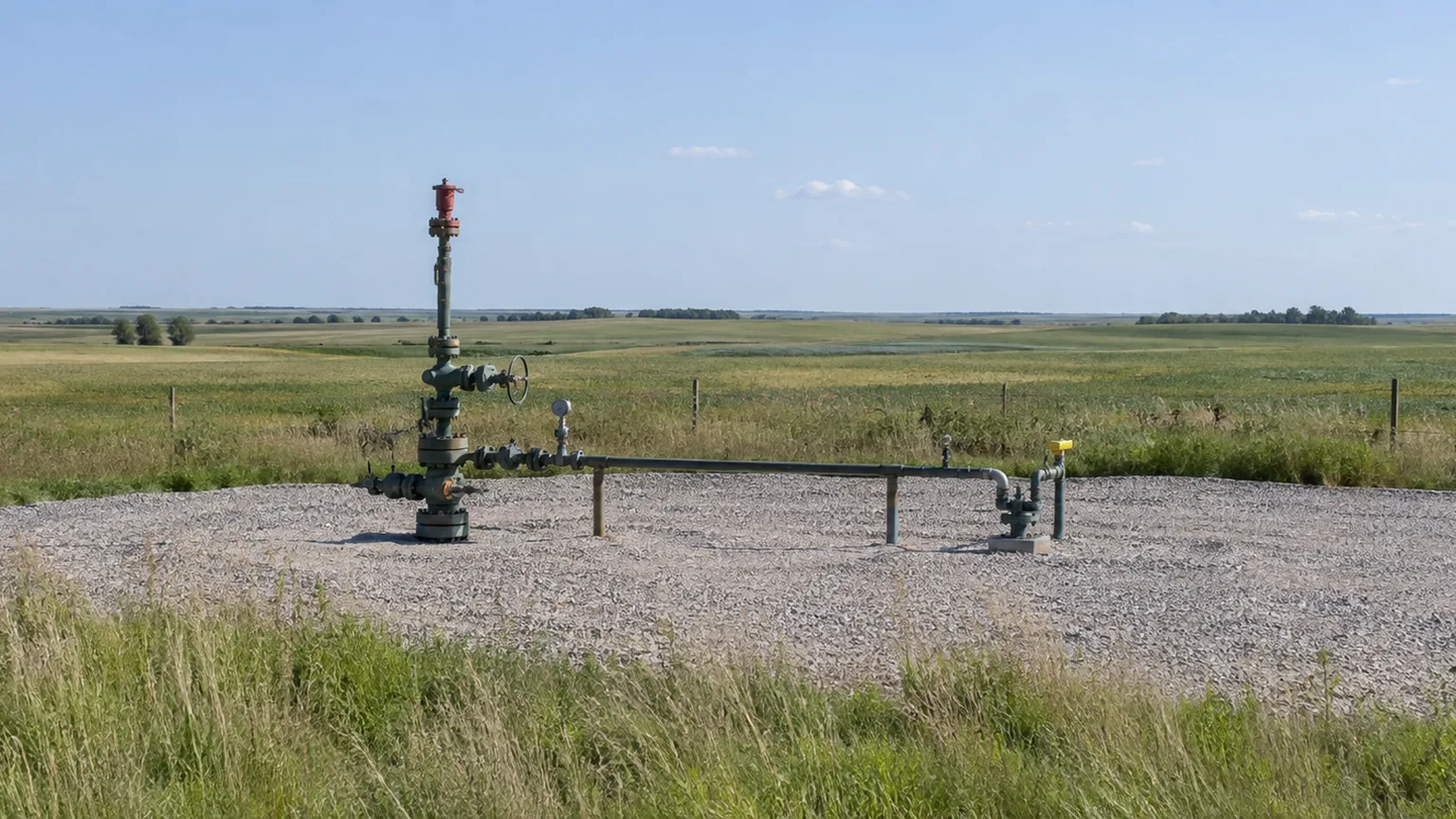
The Deep Harvest, Chapter 4: Natural Hydrogen: The One-Well Problem
In 1987 a water well at Bourakebougou, in Mali, caught fire. Nobody had been looking for fuel. That fire was how the hydrogen at Bourakebougou was found, in a shallow reservoir about 110 meters down.
The field later went into commercial production. One of the reports behind this chapter dates that to 2012. Another says the field has produced high-purity hydrogen since 2011. The record here does not settle which. The gas comes out of the wellhead at better than 95 percent hydrogen, at about 50,000 cubic feet a day. It runs a small turbine that makes electricity for 1,500 villagers. Twenty-four more wells have been drilled across the surrounding area.
Geologists still do not agree on what the well is tapping. A 2024 peer-reviewed analysis in the International Journal of Hydrogen Energy went back to the well logs. It found no clear gas-water contact, the flat boundary where a trapped pocket of gas sits on the water beneath it. The pressures matched the water zone, and the readings from instruments lowered into the well on a cable looked more like rock pores full of water. The authors suggested a seepage system, hydrogen carried in water with small, scattered gas pockets, rather than a large trapped body of free gas.
What the rock is doing
Deep underground, water meets rock rich in iron and magnesium, minerals such as olivine and pyroxene, at 200 to 300 degrees Celsius. The rock takes up the water and oxidizes, and hydrogen comes off. Geologists call this serpentinization, and the research estimates it makes about 80 percent of the world's natural hydrogen. Radiolysis, natural radiation splitting water, makes roughly 20 percent. The other sources named are gas rising from the deep mantle, rock grinding along faults (cataclasis), and microbes.
The rock keeps making it. One report estimates total generation from all geological sources at 15 to 31 million tonnes a year. Another puts the flux from serpentinization alone at about 23 million tonnes a year, give or take 8 million tonnes. That second report adds that these are rates of generation, not of collection: most of the hydrogen vents away instead of pooling where a well could reach it.
Some of what stays gets eaten. In Oman's Samail Ophiolite, in strongly alkaline water inside rock that has been through serpentinization, single-celled organisms called methanogenic archaea consume hydrogen and turn it toward methane. The chapter calls this the methanogen tax: hydrogen lost to microbes before anyone drills for it. Hydrogen held in a trap lasts on the order of 1.4 million years before microbes consume it or it leaks away. When methane comes up with the hydrogen, leaks above 1 to 2 percent bring a climate risk of their own.
One well
By the research's count, as of early 2026 there was one producing natural hydrogen well in the world. Its output is 5 to 50 tonnes a year, less than one millionth of global hydrogen consumption. No natural hydrogen project has published an engineering feasibility study showing production at commercial scale.
Two readings of Bourakebougou
Two tests would help decide what Bourakebougou is, and neither has been publicly released. One is a full pressure transient analysis, which watches how pressure in a well changes as flow starts and stops. The other is a material balance, which compares how much gas has come out with how far the pressure has fallen.
Without them there are two different fields on the table. If it is a trapped accumulation, the job is to find out how big the pocket is and drain it. If it is seepage with small pockets, the job is to learn how fast hydrogen reaches the wells through the water, and that rate sets how many wells the field needs and how hard each can be produced. One of the reports attributes the field's production to replenishment from the cratonic basement, the ancient rock under the continent. The pressure data that would test that are not public.
Either way, what a builder needs is a flow rate certain enough to design a plant around, and the public record does not yet give one.
Where else it shows up
Hydrogen has turned up well beyond Mali: Tanzania, Oman's Samail Ophiolite, the Lorraine region of France, Albania, Brazil's Sao Francisco Basin, Colombia's Llanos Basin, Australia's Yorke Peninsula and Kangaroo Island, and Kansas, Nebraska, and Idaho along the Midcontinent Rift System. In January 2025 the USGS published a geologic hydrogen prospectivity map that rates the Midcontinent Rift System, the Appalachian Basin, and the northern Great Plains as medium-to-high.
The Lorraine find, announced in 2023, is estimated at 46 to 260 million tonnes. Drilling on the PTH-2 test well began in December 2025. Francaise de l'Energie is drilling in Lorraine with 8.8 million euros in project funding. In the United States, HyTerra holds over 80,000 acres above the Midcontinent Rift System, where historic wells recorded up to 92 percent hydrogen, and Natural Hydrogen Energy has exploratory wells in Kansas and Nebraska. Koloma, based in Denver, has raised over $400 million from Breakthrough Energy Ventures, Khosla Ventures, Mitsubishi Heavy Industries, and Amazon's Climate Pledge Fund, and was preparing to drill its first test well in Notus, Idaho, at depths beyond 3,600 meters. Across the sector, exploration has drawn over $1 billion. Exploration permits exist in over a dozen countries, Australia is advancing a National Natural Hydrogen Strategy, and several European countries are amending their mining codes to allow hydrogen exploration.
Australia also has an older story. In 2020, archived documents from the 1930s came back to light, with geologist Luke Titus's name on the rediscovery. They showed oil prospectors on Kangaroo Island reporting "vast amounts of high-purity hydrogen" and dismissing it. A South Australian exploration rush followed.
Steel and a buyer
Suppose a well flows. The hydrogen still has to go somewhere. Hydrogen molecules are small enough to make standard steel pipelines brittle, so moving the gas needs specialized infrastructure that does not yet exist at scale. Each well costs $4 million to $14 million to drill, and nobody yet knows how many will come up dry.
Every cost number here is a projection. The research projects wellhead costs of $0.50 to $1.00 a kilogram for shallow, high-purity deposits and $2 to $4 a kilogram at typical depths of 1,500 to 3,500 meters, with a separate summary projection of $1 to $3. Against that, it lists green hydrogen, made from water with renewable electricity, at $10 to $15 a kilogram now, with a 2030 target of $4 to $6. Grey hydrogen, made from fossil fuels, runs $1 to $2 in the U.S. and $5 to $6 in Europe and Australia. Blue hydrogen, the fossil route with the carbon captured, runs $5 to $11. The U.S. Inflation Reduction Act offers up to $3 a kilogram in production tax credits for qualifying clean hydrogen. Preliminary estimates put natural hydrogen's energy return, the energy delivered for each unit of energy spent getting it, at 10 to 20. The same research warns that the $1-to-$3 projections lack validation from any commercial-scale operation, that commercial cost claims lean on company material, and that no peer-reviewed commercial-scale techno-economic assessment has been published.
One well, a flow rate, and a pipe
The rock makes hydrogen. Estimates of what sits in place run to 5 to 10 trillion tonnes, but only a small fraction of that is economically recoverable with current technology. All the geological sources together are estimated to generate 15 to 31 million tonnes a year, against a projected 2050 world demand of 530 million tonnes a year. France's CNRS cautions that natural hydrogen should not be classed as renewable, because it forms far too slowly for the energy the world needs. And as of early 2026 the whole industry rests on one producing well putting out 5 to 50 tonnes a year.
What turns the gas into a resource is a flow rate certain enough to build around, and pipe and plant that can carry it. The Deep Harvest takes this up in Chapter 4, Natural Hydrogen: The One-Well Problem. If a burning water well in Mali is the part that caught you, start there.
Source notes for the claims check:
- 2011 production date and replenishment from the cratonic basement: S-046, "Hydrogen Accumulation in Natural Deposits." One report dates production to 2011 and another to 2012; this draft does not pick one.
- 23 +/- 8 Mt/yr and generation-versus-accumulation: S-046, "Global Hydrogen Flux from Serpentinization." Methanogenic archaea: S-046, "Serpentinization-Associated Methane and Microbial Activity." "Methanogen tax": book-outline-v2.md, Chapter 4.
- Binding constraint (flow-rate certainty and infrastructure compatibility): book-outline-v2.md, "Chapter 4: Natural Hydrogen: The One-Well Problem."
Comments
Reader notes
Comments aren't live yet. Send notes to @slop_dealer.