Quick version
On October 9, 2009, the LCROSS impact hit the floor of Cabeus crater, at 89.7 degrees south, and dug out about 350 metric tonnes of material. At the impact site, that material measured 5.6 ± 2.9 percent water by weight. An instrument called LEND, which maps hydrogen, reads the ground around the crater at 0.3 to 0.5 percent water-equivalent hydrogen. The research behind this chapter reads the gap plainly: the impact landed in a rich pocket, not in typical shadowed ground. The detection work uses one temperature to mark the ground where ice is likely: places whose warmest moment of the year stays below 110 kelvin. Kelvin counts up from absolute zero, the coldest any temperature can be.
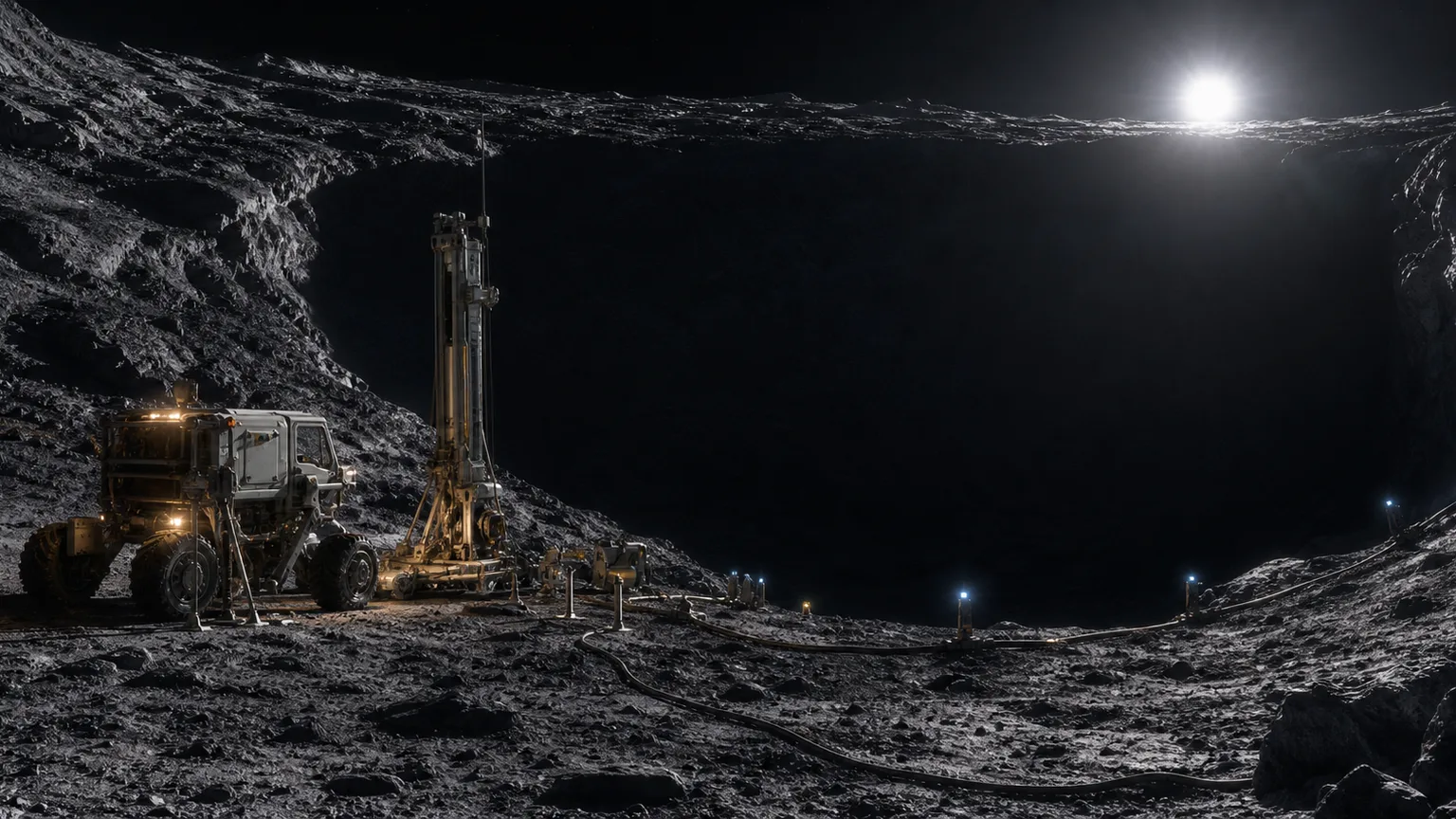
The High Ground, Chapter 3: The Cold Trap Is the Mine
On October 9, 2009, the LCROSS impact hit the floor of Cabeus crater, at 89.7 degrees south, and dug out about 350 metric tonnes of material. At the impact site, that material measured 5.6 ± 2.9 percent water by weight. An instrument called LEND, which maps hydrogen, reads the ground around the crater at 0.3 to 0.5 percent water-equivalent hydrogen. The research behind this chapter reads the gap plainly: the impact landed in a rich pocket, not in typical shadowed ground. The detection work uses one temperature to mark the ground where ice is likely: places whose warmest moment of the year stays below 110 kelvin. Kelvin counts up from absolute zero, the coldest any temperature can be.
The Moon's axis is tilted only 1.54 degrees. Near the poles the Sun never climbs high, and the floors of deep craters never get direct light. Those floors are called permanently shadowed regions. Because they never warm up, they work as cold traps: water vapor or another volatile, meaning a substance that turns to gas easily when warmed, drifts in, freezes to the ground, and stays. The research says ice in these places can last for billions of years.
How much ground is that cold depends on who measured it. Earth-based radar put the large shadowed regions at 1,030 to 2,550 square kilometers. Later modeling put them at about 14,000. Micro cold traps, much smaller patches of permanent shadow, add about 40,000 square kilometers more, and about 60 percent of that lies in the southern hemisphere.
The case for ice there rests on instruments that agree with each other. LEND sees hydrogen. Another instrument, M3, looks for the infrared light that ice absorbs, at 1.1, 1.3, 1.5, and 2.0 micrometers. Of M3's ice detections, 93.2 percent are backed by readings from three more instruments, LOLA, Lyman Alpha, and Diviner, in ground whose yearly peak temperature stays below 110 kelvin. The south polar detections cluster in Haworth, Shoemaker, Sverdrup, and Shackleton craters. By reflectance, up to 22 percent of the surface in Shackleton is covered in ice.
None of that agreement adds up to one number for the ice. One report behind this chapter estimates about 600 megatonnes of ice in the top meter of these deposits, spread unevenly and concentrated in Cabeus, Shackleton, and Haworth. The same report warns that models of how old the shadowed regions are may force that figure down. A second report gives up to 300 million tons at a depth of about 40 centimeters, with local south polar concentrations above 5 percent by weight and 0.5 to 4 percent more common. The two reports do not agree, and nothing in the research settles which one is right.
The age warning matters because a younger trap has had less time to collect ice. The first report says shadowed regions began forming about 4.1 billion years ago, and that Cabeus may have become one less than a billion years ago. A third report, on the other frozen volatiles, says most shadowed regions formed in the last 1 to 2 billion years, puts Cabeus at about 0.9 billion years, and cites accumulation of roughly 1 tonne of water per million years in each shadowed region.
Not all lunar water is ice that a machine can collect, either. A shared report on lunar carbon says the Moon's water comes in different forms, and only discrete ice mixed into polar regolith, the loose broken soil on the surface, is readily harvestable.
The LCROSS material held more than water. The report on volatiles lists carbon monoxide, hydrogen sulfide, ammonia, sulfur dioxide, methane, formaldehyde, carbon dioxide, mercury, and silver. The cold sorts them. Water ice is stable below about 110 kelvin; ammonia, methane, and hydrogen sulfide in the band from about 70 to 90 kelvin; and carbon dioxide only where the yearly maximum stays below 55 kelvin.
That same report flags its own doubt. The impact itself may have skewed the mix, inflating the carbon-bearing organic compounds relative to the water, so the LCROSS mix may not be the mix in the ground.
To show what a multi-product trap might look like, the report works an example grade: 5 percent water, 0.3 percent ammonia, 0.15 percent methane, 0.1 percent carbon dioxide, and 0.1 percent hydrogen sulfide. That is the report's example, not a measured average for Cabeus. It puts water-only extraction at 10 to 20 kilowatt-hours per kilogram, and says separating the other products adds about 10 to 30 percent to the energy and capital cost. Most of those separation systems stand at technology readiness levels 4 to 6, on the scale engineers use to rate how close a technology is to working hardware. The report raises a possible 30 to 50 percent energy penalty if performance degrades, and it presents that as a possibility, not a measurement.
The book's outline for this chapter says the poles are not just deposits; they are cryogenic infrastructure. The chapter brief goes further: the polar cold chain, meaning the work of keeping cold things cold from where they are made to where they are used, is itself an economic utility. In a shadowed crater floor, the cold is already there before any machine arrives.
The extraction numbers in the research start from that cold. Microwave sublimation, which heats the ice until it turns straight to vapor, takes about 0.58 kilowatt-hours per kilogram of water from regolith at 40 kelvin holding 5 percent ice. A heated auger, a drill screw that warms the soil as it turns, takes about 2,800 kilojoules per kilogram. The job is to heat the ice and catch the vapor while the ground around the plant stays at those temperatures.
The same cold is a hazard. The first report says temperatures of 40 to 100 kelvin in the shadowed regions are a reliability problem for machines with no analog anywhere on Earth.
The reason to pay that price is the cost of shipping propellant. The first report puts lunar-made propellant at about $500 per kilogram on the surface and about $1,100 per kilogram at Earth-Moon L1, a balance point in space between the two bodies. Propellant launched from Earth to the lunar surface costs about $35,000 per kilogram. The report calls that a 30-to-70-fold difference.
Carbon decides which propellant the trap can supply. Samples returned from the Moon hold 50 to 200 parts per million of carbon in total. Carbon dioxide is about 10 to 30 percent of that, and the shared carbon report puts carbon dioxide in surface soil at roughly 5 to 60 parts per million, implanted by the solar wind.
That trace sets up a fork. A rocket burning liquid oxygen and liquid hydrogen needs no carbon, and it ties the operation to the water ice at the poles. A rocket burning methane needs carbon, and that carbon has to be dug out of the soil, imported, or made. The methane route runs through the Sabatier reaction, which combines carbon dioxide with hydrogen to make methane. The NASA baseline in that report is oxygen-only from the Moon, with the hydrogen coming either from Earth or from polar ice.
The report runs a scenario to show the size of the carbon gap. Making 100 kilograms of methane a day takes 275 kilograms of carbon dioxide a day, and at 30 parts per million in the soil that carbon dioxide has to come out of tonnes of regolith every day. The report adds that no large-scale study has measured the energy it takes to pull carbon dioxide out of bulk regolith.
The second report records that extraction hardware, named there as PRIME-1 and the TRIDENT drill, has operated on the Moon. That is a drill turning in lunar soil, not a mine. The meter-scale grade is still unmeasured. The VIPER mission was cancelled in July 2024, then restored for late 2027 on Blue Origin's Blue Moon Mark 1, carrying the TRIDENT drill to a depth of 1 meter. That delivery has not happened in the research.
It is tempting to ask the cold to do more. A shared report studies whether temperature differences inside shadowed regions could separate isotopes, the slightly heavier and lighter versions of the same element, and it marks that feasibility as unknown.
The cold trap holds the ice, sorts the volatiles by temperature, and keeps them frozen. The one LCROSS reading that found a rich pocket sits beside surrounding ground at 0.3 to 0.5 percent, the two inventory estimates disagree, and the carbon needed for methane is measured in parts per million. A company that plans on liquid oxygen and liquid hydrogen stays at the poles; one that plans on methane needs carbon from soil where nobody has yet measured the energy cost of getting it out. What happens to that propellant once it exists, how it is stored and kept cold on its way to a rocket, is the subject of The High Ground, Chapter 6: The Propellant Architecture.
Comments
Reader notes
Comments aren't live yet. Send notes to @slop_dealer.