Quick version
The Moon's loose surface dirt is already useful. It can become oxygen, shielding, pads, glass, and repair material, if the machines can survive the dust.
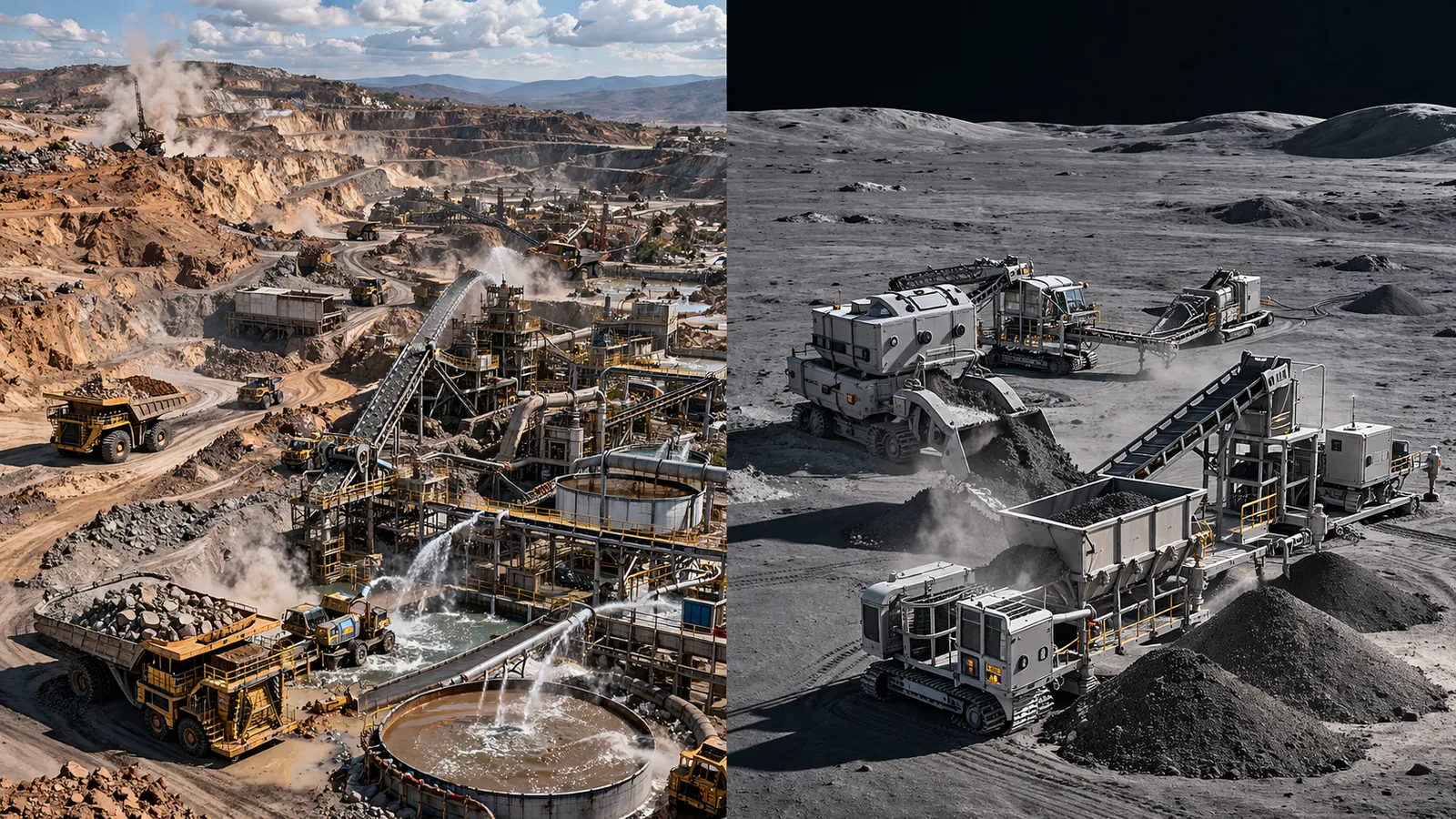
People keep talking about lunar mining like somebody has to find a lucky vein. Wrong. The Moon's best ore body is the dirt under your boots. On Earth, the front half of mining is expensive punishment: drill, blast, crush, grind, dry, sort, then pray the chemistry is still worth the trouble. On the Moon, micrometeorites have been running that first half of the plant for free for billions of years.
That is the real correction. The Moon's edge is not that the soil is magically rich. It is that the surface is already broken down, already dry, and much easier to read than a weathered Earth system. Lunar industry does not begin with prospectors hunting one heroic strike. It begins with accepting that the working surface itself already behaves like feedstock.
The first paying customer is not a collector of exotic metals. It is the operator trying to turn bare ground into a working site. It is the surface outpost that needs oxygen, pads, berms, shielding, glass, ceramic mass, and repair stock more than it needs settlement poetry. Before the Moon sells much to orbit, it has a chance to stop importing a long list of bulky, dumb, local-use materials for its own operations.
That is why regolith matters. Not because it is romantic. Because it is already halfway processed.
On Earth, the First Bill Is Usually for Breaking Rock
A lot of people who talk about mining never seem to think about how dumb the first part of the business really is.
Before you get metal, you usually spend a fortune making rock smaller. Crushing and grinding are not decorative steps. They are often the tax collector at the gate. On Earth, comminution can eat a quarter to half of the total energy in mineral processing, depending on the ore and the plant. That means massive machinery, steel wear parts, dust handling, water management, and endless maintenance just to turn "there is mineral in this rock" into "this material is fine enough to separate."
The Moon starts much further along the line. The surface has already been pounded into granular feed by billions of years of impacts. That does not make it nice. Lunar regolith is abrasive, sharp, clingy, and generally rude. But from a process point of view, a lot of the material is already where terrestrial mining spends serious money trying to get.
That matters more than the usual grade argument admits. On Earth, a high-grade ore body is partly valuable because you do not have to move and process as much worthless material to get what you want. On the Moon, one of the biggest advantages is not grade but preparation. The material is already on the surface. It is already fragmented. A lot of it is already in a particle-size range where separation work can begin without importing an entire Earth-style grinding circuit.
That is not a minor convenience. It is a structural advantage.
If every kilogram of machinery has to be landed, protected, powered, and kept alive in vacuum, then deleting a whole class of front-end equipment is not just good engineering. It is survival logic.
The Moon Already Paid the Grinding Bill
This is where the lunar case usually gets flattened by bad metaphors.
People hear "dust" and think nuisance. Engineers should hear "somebody already did the size reduction." Again, not for free in the full system sense, because you still pay for excavation, handling, wear, and separation. But the Moon has still done something incredibly useful. It has converted a lot of its surface into a distributed granular inventory.
Lunar regolith is not uniform powder sprinkled evenly across the Moon like flour on a countertop. It has rocks, clasts, glassy fragments, compacted layers, weird local behavior, and all the other complications geology likes to hand you. But it still arrives much closer to process-ready feed than terrestrial hard rock.
That changes what the early industrial system looks like.
On Earth, a mine often begins with violence. Drill pattern. Blast. Haul. Primary crusher. Secondary crusher. Mill. Pump. Filter. On the Moon, the sequence gets shorter and stranger. The front end looks more like excavation, screening, sorting, and beneficiation than a classic explosion-to-mill routine. You still have a materials-handling problem, but it is a materials-handling problem with less brute-force rock breaking in the loop.
The practical effect is easy to miss if you think only in chemistry. The Moon has handed future operators lower mechanical complexity on the front end of the process chain. Less crushing means less imported steel, less wear, less power draw, less maintenance, fewer moving parts, and fewer opportunities for the entire system to become a monument to replacement parts.
That is one reason the Moon should be described as a preprocessing advantage, not just a resource base.
Dry Matters More Than Most People Realize
The second advantage is almost as important as the first.
The Moon is dry in the way engineers like and everything biological hates. No rain. No roots. No groundwater. No mud. No clay-rich weathering profile trying to confuse your signals. No ecosystem dressing the rock up in chemistry that was not there originally. No surface water spending millions of years smearing, oxidizing, transporting, and hiding the thing you are trying to understand.
Earth makes geology hard to read. Weather and life keep editing the top of the page.
The Moon is rude, but it is honest.
When people say lunar regolith is easy to read, they do not mean simple. They mean the signal is less blurred. Mineralogy and chemistry are still varied by terrain, but they are not hidden under the same kind of weathering theater that dominates terrestrial exploration. Orbital spectroscopy has been unusually useful on the Moon for exactly this reason. The surface says more directly what it is.
That matters because industrial site selection begins with target quality. A slightly better read of the feed means better separation strategy, better process choice, better power sizing, and less fantasy in the plant design. On Earth, a lot of exploration and early process work is spent undoing the lies weather told. On the Moon, more of the effort can go straight into deciding what kind of plant the feed actually wants.
This is a big part of why the Moon should not be framed as a worse version of Earth mining. In some ways it is much worse: dust, vacuum, thermal extremes, maintenance, and logistics are all vicious. In other ways it is cleaner. The feed is dry. The surface chemistry is more legible. The ground has not spent geological time being rewritten by water.
That is not enough to make a business by itself. But it is enough to move the entire industrial conversation out of the fantasy lane and into the process-design lane.
Not All Dirt Is Equal
This is the part where the space-brochure version usually falls apart.
"Regolith" is not one universal industrial soup. The Moon has districts. Those districts have personalities, and the early economy will care about them a lot.
The dark maria are the obvious workhorse territories. These basalt plains are richer in iron and titanium than the bright highlands, which makes them the best starting points for oxygen extraction routes tied to ilmenite and related oxide-rich feed. If you want a cleaner oxygen-and-iron story, you care about mare regolith first.
The highlands are different. More aluminum. More calcium-rich feldspar. Less friendly to the simplest oxygen-and-iron pitch, but potentially excellent for aluminosilicate materials, glass formulations, ceramic routes, and later-stage construction chemistry. They are not the wrong dirt. They are different dirt.
Then there are the weird provinces, the trace-element-rich and geochemically odd zones that make researchers excited and industrial planners cautious. Those may matter later. They are not the first chapter.
The point is simple: the Moon does not offer one giant homogeneous mine. It offers giant geological provinces whose value changes depending on what your plant is built to make.
That is actually good news. It means lunar industry is not waiting on a lucky discovery. It is waiting on increasingly disciplined site selection.
It also means the early industrial map is probably split between hot dirt and cold dirt. The maria want furnaces, separators, oxygen lines, glass, and metals work. The polar cold traps want volatile handling, cryogenic storage, and chemistry. Expect zones, not one perfect master site.
The first serious operator is not going to ask, "Where should we put the first real Moon base?" That is brochure language. The better question is, "Which site gives us the best compromise between feed quality, power access, terrain sanity, downstream use, and transport pain?"
That is how real frontiers get opened. Not with a slogan. With a location problem.
Oxygen Is the Cleanest Proof the Dirt Is Real Feedstock
If regolith is the deposit, oxygen is the cleanest way to prove the deposit is real.
This is not because oxygen is the whole business. It is because oxygen is the easiest place to show that lunar dirt is chemically worth processing at all. Regolith is full of oxygen bound into oxides. Roughly speaking, the Moon is not short on oxygen atoms. It is short on easy ways to liberate them.
That is a much better kind of problem than not having the resource. If you can make oxygen cleanly enough, you have proved something much larger than one product line. You have proved the dirt can survive being treated like industrial feed.
You can go after that oxygen in several ways. Hydrogen reduction of ilmenite is one of the cleaner early routes because it is chemically straightforward and ties neatly into mare feedstock. Carbothermal reduction pushes hotter and can unlock more of the oxygen tied up deeper in the mineral matrix. Molten regolith electrolysis is the most brutal and maybe the most industrially interesting, because it treats the dirt itself like the working medium and spits out oxygen while also handing you metal streams.
Each route comes with its own headaches. Hydrogen loops have to close. Hot reactors have to stay sane. Electrodes wear out. Temperatures get stupid. Power budgets matter. Thermal rejection matters. Materials compatibility matters. None of this is "just scoop dirt and print rockets."
Good. It should not be.
The useful point is that the main uncertainty is process, not resource presence. That means the learning curve is more plausibly driven by engineering repetition than by geological luck. Operators are not waiting to discover whether oxygen exists. They are waiting to discover which systems survive long enough to extract it economically.
That is how an industry gets born. First the resource story gets demoted from mystery to given. Then the real fight moves to throughput, uptime, and system design. Oxygen is the cleanest laboratory for that transition, not the only thing the Moon is allowed to sell.
The Leftovers Are Not Leftovers
This is the part that makes the lunar regolith story much stronger than a lot of single-product models admit.
If you process regolith for oxygen, you do not just end up with one useful output and a pile of disappointment. You end up with streams.
Reduce ilmenite and you get iron as a co-product. Not symbolic iron. Useful iron. Titanium dioxide shows up too. Run hotter processes and other metal streams enter the picture. Melt or partially melt material and you are already halfway into glass and ceramic territory. Even when one product is paying the first bills, the mass flowing through the plant wants to become several kinds of industrial feedstock.
That matters because frontier economics get badly distorted when people model only the first saleable molecule and treat the rest as waste. A regolith plant is not best understood as a mine chasing one commodity. It is better understood as a refinery attached to a quarry.
The moment you think that way, the value stack changes.
Oxygen still matters first because it has obvious local demand. But oxygen is no longer the whole story. The same plant can generate structural iron, glassy material, ceramic mass, and input for pads, shields, slabs, fibers, or crude fabricated stock. One excavation system feeds multiple downstream uses. One separation line can improve multiple outputs. One ugly thermal system pays rent across several products instead of just one.
That does not magically make the economics easy. It makes them more honest.
A real lunar regolith business is not a one-product export story. It is the first layer of a local materials economy.
That is a much bigger idea and a much harder one for Earth-centric intuition to dismiss.
Vacuum Turns Sorting from an Annoyance into an Asset
There is another advantage here that sounds small until you think like a process engineer.
On Earth, fine-particle handling is often a fight against moisture, clumping, oxidation products, and all the other low-level annoyances that make clean separation harder than the textbooks imply. Tiny particles misbehave. Surface conditions matter. Atmospheric humidity gets into everything. Plenty of effort goes into making the feed act like feed instead of gossip.
The Moon is awful in many ways, but it is excellent at being dry.
That helps beneficiation. Magnetic separation, electrostatic sorting, and other pre-concentration steps all become more interesting when the material is already dry and vacuum behavior is not fighting the same moisture-driven nonsense terrestrial plants deal with. If you can enrich the useful fraction before you pay the high-temperature bill, everything downstream gets less stupid.
This is where the Moon's preprocessing advantage becomes an energy advantage.
The hot steps are expensive. Regolith heating dominates a lot of the oxygen-production energy budget. So the more intelligently you sort before you heat, the more you reduce the whole system's appetite for power and hardware. That is why beneficiation is not an optional flourish. It is the hinge between "interesting lab chemistry" and "something that might actually survive contact with industrial economics."
This also means site selection is not just a geology question. It is a feed-conditioning question. A slightly better material that sorts more cleanly may beat a nominally richer material that forces uglier process behavior.
That is not romantic. It is what real operators think about when they are trying not to go broke.
This Is a Refinery in a Quarry, Not a Gold Rush
Most bad intuition about lunar mining comes from imagining it as treasure hunting.
Wrong movie.
Nobody serious should be going to the Moon looking for one sexy rock. The lunar case is much closer to building a quarry, a separator, a kiln, a foundry, and a glass works into one linked system. The feed is common. The value comes from how many useful streams you can reliably turn it into.
That is why the Moon makes more sense as a mass industry than a luxury-export story.
Glass is a perfect example. On Earth it is so common that nobody respects it. On the Moon that is exactly why it matters. If the local dirt can be turned into windows, protective covers, insulation forms, slabs, glass-ceramics, and eventually fiber, then a huge category of imported mass stops being sacred cargo. You are no longer flying up every stupid flat piece of material from Earth like it is a holy relic.
The same logic applies to pads, berms, shielding blocks, road surfaces, and rough structural stock. None of these are glamorous. Good. Glamour is usually a sign you are still in pitch-deck land. The first real off-world materials economy is going to be built out of products so boring that most people will stop reading right when the business gets interesting.
That is a good filter.
The Moon does not have to beat Earth at everything. It does not have to make the finest alloy, the best electronics, or the cleanest micro-machined parts any time soon. It only has to win at the categories where local mass matters more than imported precision.
That makes the regolith story narrower than "the Moon will do all industry," but much stronger than "the Moon might have some useful resources." It is the beginning of a real division of labor.
The First Market Is Sitework, Not Export
The cleanest way to think about the early market is to stay brutally local.
The first market for regolith processing is probably not export. It is sitework. It is the business of turning bare ground into a functioning industrial lot.
A surface program hates importing things that are too cheap to respect but too heavy to waste launch on: pads, berms, blast walls, shielding blocks, trench liners, road surface, sacrificial covers, crude stock, and oxygen for local breathing and process use. That is quarry logic, not orbital romance. A local materials line does not have to conquer cislunar trade on day one. It only has to make the site less stupid to operate.
That is a real threshold. Once a landing zone has a proper surface, dust damage drops. Once habitats and machines get local shielding, landed high-value hardware goes further. Once glass, ceramic mass, and crude structural material exist on site, expansion stops beginning from empty dirt every time a new cargo ship shows up.
This is why regolith should be thought of less like a future export miracle and more like the Moon's first construction and utilities business. The first victory is not selling something glamorous to orbit. It is deleting stupid imports from the local manifest.
Exports may come later. Sitework comes first.
The Bottleneck Is Not Finding Feed. It Is Keeping the Line Running.
This is where the story stops sounding like generic lunar-industry rhetoric and starts sounding like a real plant problem.
The risk here is not that the Moon runs out of dirt. That would be an absurd problem to have. The risk is that you build a clever process line that works beautifully in a lab and then starts acting feral once it has to run for months on actual feed in actual lunar conditions.
That is the real bottleneck: continuity.
Can you excavate, screen, sort, heat, separate, and route outputs without the whole operation slowing into a maintenance ceremony? Can seals survive? Can hot parts stay hot where they should and not where they should not? Can dust stay out of places where dust turns engineering into slapstick? Can the plant run long enough, often enough, to teach you something useful?
That is why the operational questions matter more than the treasure-hunt questions. The Moon is not short on regolith. It may be short on hardware that can keep digesting regolith without constant babysitting.
Power is the next constraint. Feed is everywhere. Useful process heat is not. Oxygen extraction, glass production, sintering, melting, metals work, and thermal stabilization all want real energy, and they want it with enough rhythm that the plant does not spend half its life in restart mode. A slightly weaker site with cleaner power logic may beat a chemically better site whose energy architecture is a permanent hostage situation.
Then there is dust. The narrow point matters most here: the same fine grain size that makes regolith attractive as feed also makes it the plant's main abrasive hazard. The feedstock and the contaminant are the same material. That is not poetic. That is the job.
And finally there is the simulant gap. A lot of good work has been done on Earth with lunar simulants. Necessary work. Serious work. Still not the same as running a plant on the actual Moon for long periods under real duty cycles. Simulants can get you to engineering confidence. They cannot give you operational truth.
So the kill shot for the thesis is not "what if there is no regolith?" The kill shot is "what if the plant never becomes continuous enough to matter?"
That is the right question, and it is much sharper than the lazy "Moon mining is sci-fi" dismissal.
The Near-Term Path Is a Throughput Story
If this works at all over the next five to fifteen years, it will not look like a lunar mining boom. It will look like a throughput discipline slowly getting less stupid.
First you prove material handling. Not one photogenic scoop. Not a ceremonial bucket. Actual repeatable excavation and feed movement with believable wear rates and believable dust behavior.
Then you prove pre-sorting. Show that beneficiation is not just a nice paper result but a real energy-saving move that survives rough handling and bad days.
Then you prove one hot line well enough to matter. Oxygen is still the cleanest first answer because it plugs into obvious demand and because the chemistry is already mapped well enough to justify serious effort. But the bigger win is proving that coproducts can be routed into useful material streams instead of treated as conference-slide garnish.
Then you widen the surface market. Local pads reduce dust plumes. Local shielding reduces import mass. Local glass and ceramic mass reduce the need to fly up every dumb panel and crude part. Local oxygen reduces the pain of every system that needs it. Each small win cuts the import bill for bulky material and makes the next unit of local production easier to justify.
That is the compounding logic. Not "one giant breakthrough," but a chain of increasingly boring substitutions.
This is how frontiers become real. They stop asking for permission in the language of destiny and start deleting line items from the import manifest.
The Real Counters Are Process Counters
There are three serious objections here, and none of them are "maybe the Moon has no dirt."
First: yes, regolith is low-grade in the way Earth people instinctively mean it. You are not digging concentrated terrestrial-style ore. Fine. That is true. It matters less when the resource is surface-wide, already fragmented, and useful across several product streams, but it is still real. The Moon is trading concentration for preprocessing.
Second: yes, the sexy multi-product story can be oversold. Oxygen, iron, glass, ceramics, and later exotic by-products may all come from the same broad feedstock base, but that does not mean one perfect machine spits out finished products like a vending machine. Temperature windows differ. Impurity tolerances differ. Finishing steps differ. A refinery logic is still stronger than a single-product logic, but it may also be messier and more equipment-hungry than advocates like to admit.
Third: yes, the best hot-dirt sites and the best cold-volatile sites are probably not the same places. Mare districts want heat, separation, oxygen, glass, and metals work. Polar traps want volatile handling, cold chemistry, and storage. The Moon may open as two linked industrial geographies rather than one neat master site. That makes the first decade clumsier.
And over all of it sits the same ugly truth: continuity still decides everything. If the line cannot keep running, none of the elegant chemistry matters.
Those objections do not kill the thesis. They narrow it from "one giant lunar economy" to "a staged materials economy with awkward geography and very real process pain."
The Real Asymmetric Upside Sits in the Boring Choke Points
If you are trying to think clearly about where the actual upside lives, do not default to "the company that mines the Moon."
That label is too vague to be useful.
The real asymmetric upside probably sits in the chokepoints that make continuity possible. Beneficiation systems that work in vacuum with low mass and low fuss. Reactor designs that tolerate ugly feed. Dust mitigation that survives long cycles instead of just demos. High-temperature materials that stop making maintenance everyone's full-time religion. Thermal management that does not turn the plant into a radiator cult. Surface handling gear that can survive abrasive fines without becoming disposable.
The high-status fantasy is always the mine. The money often lives with the dull parts that keep the mine from embarrassing itself.
Watch operator behavior. The serious teams will choose slightly less sexy chemistry in exchange for better uptime. They will talk a lot about throughput, maintenance intervals, contamination control, heat balance, and feed consistency. They will sound more like bulk-process engineers than frontier evangelists.
Watch three signals.
First, integrated run duration. Anyone can make a subsystem work. The important number is how long the full loop keeps working before the Moon starts collecting rent.
Second, coproduct discipline. If an oxygen program still talks like the rest of the output is an afterthought, it is leaving industrial leverage on the table. The strongest players will design around streams, not a single trophy product.
Third, local substitution rate. The more categories of imported bulk mass a site can replace with local material, the more believable the staircase becomes. That is the industrial metric that matters, not the number of cinematic renders.
The Moon will reward the least theatrical people in the room.
The Dark Horses Start When the Dirt Stops Being Just Dirt
Once you stop treating regolith as a single-product mining story, the outer ring gets much more interesting.
Start with the leftovers. If a regolith line is already running for oxygen, metals, glass, or shielding mass, then some ideas that sound ridiculous in isolation stop sounding ridiculous at the margins. Helium-3 is the classic example people usually ruin by sprinting straight to fusion speeches. That is still the wrong pitch. The more honest version is smaller and more useful: if industrial-scale regolith handling already exists for other reasons, trace-value isotopes and oddball by-products become worth skimming long before they become civilization-defining fuel.
The same is true for material branches that sound boring on Earth and quietly become exotic on the Moon. Glass. Ceramics. Fused crusts. Fibers. Porous thermal mass. Dirty local structures that are good enough for a place where hauling dumb bulk material is the real tax.
Push one step farther and the materials story gets stranger. A surface already predisposed to glass and ceramic outputs may eventually support products Earth does not make very gracefully: large brittle structures in vacuum, fiber systems that benefit from no hydrolytic weakening, or optics whose manufacturing routes are cleaner in a dry off-world environment than they are on a wet planet. That is not the first business. It is what the first business starts making legible.
The point of the outer ring is not to stack moon-flavored curiosities. It is to show what happens when one materials platform begins to branch.
Glass May Beat Metal to the Weird Stuff
Metal gets the headlines because people can picture it. Beams. Tanks. Frames. Girders. Something that looks expensive in a concept render.
But if you are thinking like an operator instead of a keynote addict, glass may be one of the Moon's weirder and earlier wins.
That sounds backwards until you remember what regolith already is. A lot of lunar dirt is basically silicate material waiting for heat and process control. Glass is also far more forgiving than the average futuristic pitch deck likes to admit. You do not need to refine your way into jewel-grade perfection before it becomes useful. You need to melt, cast, draw, foam, or fuse it into things that solve bulk problems.
That immediately opens a branch Earth people underestimate because Earth is drowning in cheap, ordinary glass products. On the Moon, ordinary is exactly what makes them powerful. Cover panels. Abrasion-tolerant shields. Windows for machines before windows for people. Fiber reinforcement. Ceramic-glass hybrids. Insulating forms. Dust-resistant covers. Hard sacrificial skins over equipment that would otherwise spend its life getting sandblasted by the local environment.
Then it gets stranger.
Earth is a wet, oxidizing, gravity-heavy place that is oddly hostile to some of the brittle things advanced materials people would love to use more often. The Moon is dry, hard vacuum, and brutally honest. That is bad for plenty of systems. It may be quietly useful for others. A place that is already good at giving you glassy feedstock may become good at making oversized brittle components, rough optical blanks, long fiber runs, or gradient materials that would be annoying, fragile, or contaminated too easily in terrestrial factory conditions.
This does not mean the Moon becomes an optics superpower next Tuesday. It means the first crude glass output could be the top of a surprisingly tall ladder. Once you are already making bulk glass for shields, panes, insulation, and reinforcement, the jump to weirder products stops looking like science fiction and starts looking like process refinement.
That is the pattern to watch. Not "can the Moon immediately export elegant high-end products?" Wrong question. The right question is whether a dirty local glass industry can start with brutally practical junk and then climb.
If it can, the Moon's material future gets much less metallic and much more interesting.
The Best Brick Might Be a Bad Brick
A lot of off-world construction talk still sounds like someone took suburban housing brochures, crossed out the word "suburban," and replaced it with "lunar."
That is not how this starts.
The first useful construction material on the Moon may not be a beautiful block, a perfect 3D-printed wall, or a habitat shell that looks good in a magazine. It may be an ugly, partly fused, maybe porous slab that does one extremely important job: it keeps the site from wrecking itself.
That matters because early lunar construction is not really about architecture. It is about damage control.
Landing pads that stop exhaust from turning the whole neighborhood into a shotgun blast of dust and gravel. Berms that catch debris. Road surfaces that keep vehicles from churning every trip into a fresh abrasion event. Blast aprons. Equipment stands. Thermal shields. Crude barriers between hot hardware and the surrounding mess. The first big win is not elegance. It is stopping the surface from acting like a vandal.
That is why the best early "brick" may be a bad brick.
Maximum strength is not the only thing you care about. Sometimes it is not even near the top of the list. A graded material with ugly internal structure may handle thermal differences better than a pristine brittle one. A porous fused panel may be useful as sacrificial mass, thermal buffer, or impact-tolerant surface even if no architect would brag about it. A rough sintered crust may be vastly more valuable than a prettier imported component simply because it is local, repairable, and easy to replace.
This is another place where Earth intuition can mislead you. On Earth, material quality often gets judged by polish, uniformity, and whether it would pass a familiar code book. On the Moon, the first question is much more primitive: does it keep dust, ejecta, heat, and abrasion from turning every operation into a stupid fight?
If yes, it has value.
That is why I suspect the first really important regolith structures will look industrial in the least glamorous sense possible. Not cathedrals. Not homes. Not sexy additive-manufacturing demos. Crusts, pads, barriers, surfaces, and sacrificial components that make everything else last longer.
The Moon may start building itself out of materials that look half-finished to Earth eyes because half-finished is enough when the alternative is importing dead weight from six figures of transport chain.
And if that sounds underwhelming, good. Underwhelming is often what a real industrial breakthrough looks like right before it quietly becomes indispensable.
The Weirdest Lunar Factory May Use Fields More Than Teeth
Most people picture mining as a mechanical argument with the ground. Teeth. Drums. Crushers. Mills. Conveyors. Shakers. A whole lot of wear parts slowly dying in public.
Some of that will happen on the Moon too. But the really interesting processing advantage may come from something stranger: lunar dirt is dry, fine, electrically obnoxious, and often magnetically legible.
That creates a different kind of factory logic.
On Earth, one of the reasons ore processing gets ugly and expensive is that water, mud, sticky fines, oxidation, and contamination keep forcing you back into heavy, messy separation systems. The Moon strips a lot of that away. Suddenly electrostatic sorting, magnetic pickoff, triboelectric behavior, and field-driven separation stop being lab curiosities and start looking like serious plant architecture.
In plain English: some lunar processing lines may end up moving value with tuned fields and careful feed handling more than with giant grinding circuits.
That matters because moving parts are where maintenance goes to get ugly. A process that can upgrade feed with fewer crushing stages, fewer wet steps, and fewer mechanically violent separations is not just clever. It is operational mercy.
This is still speculative in the sense that nobody has yet run a full industrial lunar plant long enough to prove what the dominant separation stack will be. But the directional advantage is obvious. The same electrostatic nastiness that makes dust a headache may also make material sorting cheaper if engineers learn how to weaponize it.
That opens a genuinely weird possibility: the Moon's first great processing innovations may look less like a bigger excavator and more like a physics teacher getting revenge on mechanical engineering.
Picture lean beneficiation trains built around charge, magnetism, size control, and careful thermal conditioning. Picture feed moving through a refinery that is part quarry, part foundry, part electrostatic trap. Picture a surface where the nuisance properties of the dirt become part of the process toolkit.
That would be a very lunar kind of industrialism.
It also leads to a useful inversion. On Earth, dust is mostly the thing you try to get rid of after it causes trouble. On the Moon, dust may become one of the things you sort, fuse, charge, and route on purpose. Not because it is pleasant. Because it is there, it is dry, and its bad manners may turn out to be process leverage.
The smartest lunar factories may not defeat the dirt so much as learn its personality and start using it.
The Dirt May Eventually Grow a Power Skin
Here is one of the strangest branches in the whole lunar materials story: a regolith economy may eventually start making some of its own power hardware.
Not elegant hardware. Not beautiful high-efficiency terrestrial-style panels rolled out of a spotless fab. Something much rougher and much more lunar than that.
The reason this idea keeps surviving serious scrutiny is simple. The Moon does not necessarily need the best solar cells. It may need the least embarrassing local ones.
That is a huge difference.
On Earth, land, labor, weather, cleaning, and balance-of-system costs can make mediocre solar a bad joke. On the Moon, the relevant comparison is often uglier: should you launch yet another shipment of bulky energy hardware, or should you accept a lower-efficiency local panel if the substrate, cover material, support structure, and a chunk of the process chain can all come from the surface itself?
Once you frame it that way, a dirt-to-power loop stops sounding insane and starts sounding like exactly the kind of ugly industrial hack frontiers love.
There is already enough lab and concept work to take the branch seriously. Not as a near-term certainty. As a plausible ladder. Regolith can be pushed toward glass, ceramic, and silicon-adjacent pathways. Some researchers have shown that low-efficiency devices built on lunar-derived substrates could still be worth it because the Moon has one thing cheap solar systems love: area. If local mass is cheap and imported mass is expensive, then "worse but local" can beat "better but launched."
That leads to a version of solar build-out Earth almost never uses. Instead of chasing exquisite panels, the Moon may accept thick, ugly, rugged power skins. Surfaces that collect enough energy to matter. Surfaces that can be replaced locally. Surfaces whose job is not to win a performance trophy but to feed heaters, sorters, pumps, electrostatic systems, and all the other greedy little machines a regolith line depends on.
In that world the distinction between structure and power starts to blur. Berm caps, equipment covers, rigid sheets, thermal shades, even some kinds of road-adjacent or pad-adjacent surfaces could become candidates for crude local energy collection if the materials stack matures far enough. Not because every surface turns smart. Because on the Moon, dead weight is the enemy and multifunction beats purity.
This is exactly the kind of idea that belongs in the outer ring. It depends on far too much to anchor the near-term thesis: reliable processing, repeatable materials quality, durable electrical performance, survivable dust management, and enough maintenance discipline that the power layer does not degrade into expensive litter.
But if the branch works at all, it changes the feel of the whole industrial system.
A regolith plant would no longer just be consuming dirt. It would be using dirt to make some of the surfaces that help process more dirt. Not full self-replication. Nothing that dramatic. Just a primitive and extremely important industrial reflex: the site learning how to extend its own skin.
That is when the Moon stops looking like a mine with accessories and starts looking like a place where materials, power, and surface infrastructure begin to fold into each other.
The Poles Are Not Just Ice Wells
This is where the dark horses stop being merely "interesting" and start becoming genuinely strategic.
People talk about permanently shadowed regions as if the whole story is water. Water is the obvious first headline, but it is not the whole industrial story. The more interesting long-term possibility is that the poles become the Moon's first cold chemical districts.
LCROSS and related work made the basic point years ago: permanently shadowed regions are not just hiding water. They are holding a messier volatile inventory that includes carbon-bearing compounds, ammonia, sulfur species, and other ingredients that matter a lot once you are trying to do more than drink, breathe, and burn.
That changes the logic.
If regolith processing is the way the Moon builds its bulk-material economy, polar volatile handling is how the Moon starts building chemistry. Water matters for life support and propellant. Ammonia matters because nitrogen is a chronic nuisance off-world. Carbon-bearing volatiles matter because carbon is scarce exactly where useful chemistry wants it. Sulfur species matter because process chemistry always wants more tools. Once those are in play, the poles stop looking like wells and start looking like feedstock parks.
This is still outer-ring material because it depends on a lot of other things going right first: access, power, handling, cold-capable hardware, dust control in ugly terrain, and enough industrial maturity to care about more than oxygen. But it belongs here because it is a direct extension of the main thesis. Once you treat local material as feedstock instead of scenery, the Moon's strangest districts stop looking decorative and start looking economic.
Permanently Shadowed Regions May Become Cold Industry
The farther-out version is even better.
Permanently shadowed regions are miserable places for humans. That does not make them bad industrial sites. It may make them specialized ones.
A place that is a nightmare for ordinary operations can be useful if your business likes permanent cold. Cryogenic storage is the obvious early case. Volatile warehousing, boiloff control, and cold-chain handling all get more interesting in an environment that gives you low temperatures as a site feature rather than a constant engineering fight.
Then there is fractionation. If different volatile species stabilize at different temperature bands, then the polar environment is not just hiding resources. It is sorting them. That raises the possibility of cold chemistry zones where the environment itself is part of the process design.
Push one step past that and you get the real beyond-the-frontier material. Ultra-cold sensor infrastructure. Long-duration cryogenic experiments. Possibly quantum-adjacent hardware if the rest of the industrial stack ever becomes mature enough to support delicate systems in otherwise hostile places. None of that is tomorrow's business plan. It should not be written like one. But it is exactly the kind of second-order opportunity that becomes plausible once a materials-and-volatile economy exists.
There is also a nastier and more useful way to say it: some places on the Moon may eventually sell temperature the way other places sell ore.
That sounds ridiculous until you remember how much industrial effort on Earth goes into fighting heat, preserving cold, suppressing boiloff, and keeping fragile equipment inside narrow operating windows. If a lunar site can offer persistent cold as an environmental feature, then "location" stops meaning just access to molecules. It starts meaning lower refrigeration burden, lower storage losses, slower chemical degradation, and maybe entirely new kinds of staging for cryogenic materials or delicate hardware.
Again, not a near-term business pitch. A later-stage branch. But it is a real branch.
The cold traps may end up mattering less as places people want to stand around in, and more as places industry wants to use.
That is a much better framing.
Natural Voids Turn Dirt Into Fit-Out
Lava tubes are one of those topics that usually gets dragged straight into settlement fan fiction. Giant underground caverns. Moon cities. Glass domes in every concept artist's portfolio. Fine. Ignore all of that.
The more useful industrial version is much less romantic.
If large natural voids or sheltered cavities are real and accessible, then regolith-derived materials do not need to become elegant standalone buildings on day one. They can become fit-out.
That is a very different job.
Floors. Liners. Dust-stable walking and driving surfaces. Internal berms. Equipment bays. Thermal partitions. Radiation-thickened zones. Cable runs protected from the surface. Storage volume with crude local finishing instead of imported shell structure. The Moon may not need to build every cubic meter from scratch if geology already donated some roof.
That changes the material question from "can regolith become a complete habitat?" to "how much ugly local material can turn a natural void into usable industrial volume?"
That is a much easier question, and a much more interesting one.
Once you think this way, a lot of speculative lunar construction talk gets less stupid. You stop imagining pristine printed mansions in the dust. You start imagining layered industrial interiors where imported precision gear lives inside spaces that are mostly made usable by local mass. Earth ships the brains, seals, controls, bearings, pumps, and finicky stuff. The Moon supplies the dumb volume, the shielding, the liners, the rough surfaces, and the things that would be economically insane to launch in bulk.
That is still speculative because access, mapping, stability, dust behavior, and operational reality all matter. A void is not useful just because it exists. It has to be reachable, characterizable, and worth the trouble. But if even a small subset of these structures are workable, regolith stops being just quarry feed and starts becoming interior industrial material.
And that matters for a simple reason: protected volume is expensive. If geology gives you any for free, even imperfectly, the value of local surface-derived material goes up immediately because it no longer has to solve every structural problem at once.
This is the broader lesson of the whole article. Regolith gets more powerful every time you stop asking it to be a miracle.
It does not need to be a miracle ore.
It does not need to become a perfect habitat wall.
It does not need to produce elegant export products before it earns its keep.
It just has to be useful across enough ugly jobs that the local material bill starts collapsing.
That is a lower bar than the futurists sell, and a much more dangerous one.
The Moon Stops Looking Empty Once the Material Logic Clicks
Most people see the Moon and see emptiness. That is because they are still using the wrong industrial filter.
If you go looking for forests, rivers, soft climate, and easy biology, yes, the Moon looks hostile and dumb. If you go looking for pre-broken dry feed, destination-side oxygen, bulk shielding mass, glass and ceramic potential, vacuum-enabled processing, and weird cold chemistry, it stops looking empty very fast.
That is the mental shift the Moon keeps demanding.
The lunar case is not "there might be useful minerals on the Moon." That is far too weak. The stronger and more accurate claim is that the surface itself already behaves like the front half of a plant, and that this changes the economics of what kind of industry can appear there first.
On Earth, mining spends enormous effort making the feed legible and processable. On the Moon, much of that punishment has already happened. The remaining fight is not discovery romance. It is engineering discipline: excavation, sorting, heat, dust control, throughput, and uptime.
That is why regolith is the deposit.
Not because it is rare.
Because it is already halfway processed.
If that sounds less glamorous than the standard space pitch, good. Glamour is usually what people reach for when the actual mechanism is not strong enough.
The Moon's mechanism is strong enough.
The first real lunar mine may not look like a mine at all. It may look like the moment someone stops asking the Moon for a miraculous ore body and starts using the landscape itself like a materials plant.
Comments
Reader notes
Reader comments are not connected yet. For now, send notes to @slop_dealer.