Quick version
Some useful metals are already sitting loose on the deep ocean floor. The hard part is not finding the rocks. It is lifting them, processing them, and deciding who is allowed to do it.
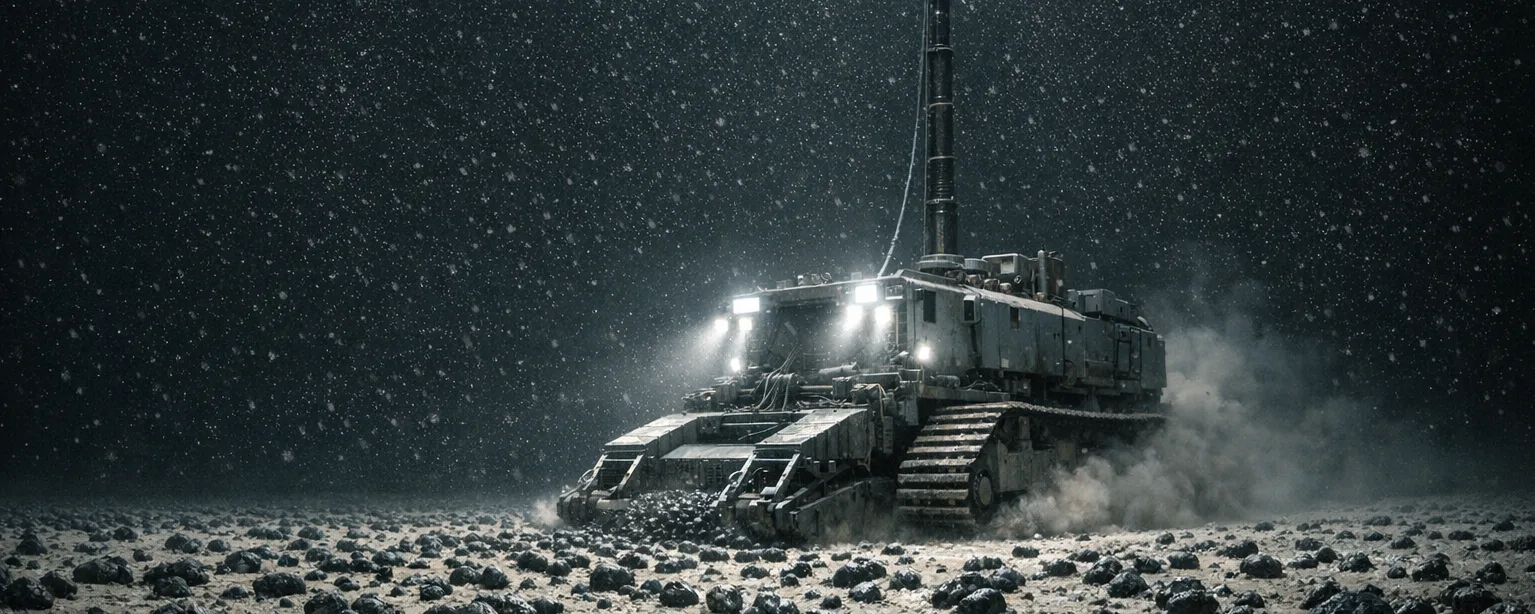
Four kilometers down in the Pacific, a mining machine does not go looking for a vein. It crawls across a warehouse floor someone else stocked. Polymetallic nodules sit loose on abyssal mud like somebody spilled a planet's battery metals and forgot to pick them up. No blasting. No overburden campaign. No waste-rock mountain. The ocean already did the stupid part.
That is the correction this article is trying to force. Earth still hides absurdly rich frontiers in places the political economy treats as untouchable or premature. The seafloor case matters because it shows, in almost insulting fashion, that grade and accessibility are not the same thing as regulatory viability. A deposit can be physically ridiculous and still commercially frozen if the chemistry is ugly, the governance is unfinished, and nobody agrees who is allowed to touch it.
The first real customer is not a futurist. It is the refiner with a nickel problem, the battery chain that would like less geopolitical migraine in its cobalt line, the automaker that wants a cleaner metals story, and the state buyer that does not enjoy discovering its supply chain depends on a handful of hostile chokepoints. If you use the right customer, the whole seafloor story gets a lot less mystical and a lot more industrial.
The Ocean Already Paid the Stripping Ratio
Most terrestrial mining begins with punishment.
You move dirt that does not pay. You strip away barren rock. You drill. You blast. You haul. You crush. You grind. Then, if the gods of metallurgy are in a tolerable mood, you start earning the right to talk about actual metal. A lot of the mine plan is just a very expensive argument with material that was never the product in the first place.
Nodules invert that sequence. The ore is not buried under a mountain of insult. It is sitting there on the floor already separated from the host rock. That does not make seafloor mining easy. It makes the starting point much cleaner than people instinctively expect.
This is the part most casual debate misses. The deep-sea case is not exciting because there are metals under the ocean. There are metals everywhere. The deep-sea case is exciting because a large part of the mechanical ugliness that defines surface mining has already been outsourced to geological time. The concentration happened slowly. The sorting happened slowly. But it happened. A lot of the stripping ratio got replaced by patience measured in millions of years.
That is why the phrase ready-made ore is not hype. It is a process description.
The Clarion-Clipperton Zone alone is usually cited at around 21 billion tonnes of polymetallic nodules. The numbers matter less than the shape of the thing: an absurdly large mineral inventory spread across a giant, flat abyssal plain, sitting loose instead of trapped inside an overburden story. Average grades around 1.3 percent nickel, 0.2 percent cobalt, 1.1 percent copper, and nearly 29 percent manganese do not sound like science fiction until you remember what is missing. No stripping ratio. No waste rock. No giant pit wall. No village to relocate off the ore body. No truck fleet climbing switchbacks with dead mass all day.
That last point is doing more work than the grade itself.
And the CCZ is not the whole map. The Peru Basin, the Central Indian Ocean Basin, and the Cook Islands' Penrhyn Basin all point the same way: this is not one freak district. It is a global abyssal portfolio with different metal personalities. The CCZ is simply the biggest insult to the standard scarcity story.
The Grade Is Real, But the Preparation Is the Trick
If you only compare grades, the argument gets sloppier than it should.
Yes, the nodule chemistry is strong enough to make terrestrial operators pay attention. Yes, the multi-metal package is unusually attractive. Yes, the amount of contained nickel and cobalt implied by the big abyssal fields is rude enough to embarrass a lot of reserve panic. But the better argument is not that the seafloor has miracle grade. The better argument is that the seafloor has prepared feed.
That is a different kind of advantage.
A terrestrial laterite may carry useful nickel and cobalt, but the system around it is often hateful. Strip the top. Move huge tonnages. Manage water. Build roads. Manage tailings. Fight weather. Then drag the ore through a refinery sequence that wants acid, heat, patience, and a very high tolerance for disappointment. Nodules do not remove the refinery problem. They remove a surprising amount of the front-end stupidity.
That matters because mining economics are not a geology contest. They are a full-stack cost contest.
A tonne of ore that arrives with less excavation pain, less beneficiation pain, and a cleaner multi-metal mix is not just a slightly better deposit. It is a different industrial posture. The ocean floor is telling you something blunt: abundance is not only a matter of how much metal exists. It is also a matter of how much nonsense you must fight before the metal starts behaving like inventory.
This is also why the customer needs to be named early. The customer is not buying a romantic story about unexplored frontiers. The customer is buying a metal stream that might let them diversify away from increasingly ugly land-side constraints. A refiner cares about throughput, recovery, reagent burden, and political reliability. A state buyer cares about concentration risk. An automaker cares about whether the supply survives the next price spike or export restriction. Nodules matter because they seem to answer those buyers with an annoying sentence: the planet already laid out a lot of this feedstock on the floor.
If that sentence makes terrestrial mining people defensive, good. It should.
The Customer Is Really Buying Upstream Simplicity
The deep-sea story is often framed as if the prize were some abstract stockpile of battery metals. That is too vague.
The real sale is upstream simplicity.
A serious nodule field is not one commodity wearing a clever disguise. It is nickel, cobalt, copper, and manganese arriving in one awkward but potentially powerful package. That means the operator is not just selling one metal into one bottleneck. They are potentially feeding several stressed lines at once. In a world where the clean-energy buildout keeps rediscovering that every mineral chain has its own political weak spots, that bundled supply is not a trivial feature.
And because the nodules sit loose on the seafloor, the pitch is not "let us go build another heroic land war with geology." The pitch is "let us go collect an already exposed feedstock and then see whether the rest of the chain can be made sane." That is a much narrower proposition and a much stronger one.
It is also one reason I do not buy the lazy dismissal that says deep-sea mining is just another speculative commodity scheme. It might become one. Plenty of bad operators can ruin any good deposit. But the physical asymmetry is real. An exposed, multi-metal ore body already lying on the abyssal plain is not the same thing as a brochure for a hypothetical district that still needs a decade of drilling before anybody can tell whether the grades hold together.
The ocean has already answered the geology question with unusual generosity.
Everything after that is engineering, chemistry, law, and nerve.
Collection Is No Longer the Main Excuse
There was a time when the easiest way to dismiss nodule mining was to pretend the collection system was pure fantasy.
That excuse is aging badly.
Pilot campaigns have already dragged thousands of tonnes of nodules up riser systems several kilometers long. The point is not that commercial-scale collection is solved forever. The point is that the argument has crossed a threshold. We are no longer debating whether a machine can crawl the abyssal plain, lift loose nodules, and get them to a ship. We are debating uptime, wear, sediment handling, fleet economics, and the usual unglamorous things that show up after "can this even work?" stops being the central question.
That is progress, even if it is ugly progress.
Recent pilot work in the Clarion-Clipperton Zone has shown exactly the kind of thing skeptics used to say would remain hypothetical: a tracked collector moving across the abyssal floor, a riser lifting recovered nodules to a production vessel, and assay results broadly matching the geological expectations built from earlier sampling. One trial pushed well past three thousand tonnes recovered and hit collection rates strong enough to make the commercial case feel like an engineering problem rather than a fairy tale.
That distinction matters a lot.
It also gives you a cleaner benchmark than most of the public argument bothers using. Nobody serious thinks the early pilots are already the finished business. The target is still commercial steady-state collection closer to two hundred tonnes an hour, not a good-looking demo number. But that is exactly why the recent runs matter: they moved the debate from "can anything be collected?" to "how far are we from a system that can stay up long enough to count?"
In frontier industries, there is a huge gap between invention risk and optimization risk. Invention risk says the whole thing may be nonsense. Optimization risk says the thing works, but maybe not cheaply enough, reliably enough, or soon enough for the balance sheet. Seafloor nodules now look much more like the second category.
That does not make the business safe. It makes the conversation more honest.
And one other correction matters here because the environmental fight keeps blurring it. The monitored plumes in the better recent trials behaved more like dirty, bottom-hugging currents than the water-column apocalypse critics like to post. That does not make them harmless. It does make them observable in a more disciplined way than the cartoon versions imply, which is exactly what a real tradeoff argument needs.
It also makes the next question unavoidable: what happens when the ore reaches the surface?
The Ship Is Part of the Mine
This is one of the quiet ways people misread the frontier. They picture a collector on the seafloor and a refinery on land, then imagine the middle as a boring transport gap.
It is not a boring gap. It is half the business.
The riser, the surface vessel, the dewatering systems, the handling equipment, the storage choreography, the maintenance rhythm, the weather windows, and the brutal fact that your mine gate is floating in open water are not support details. They are the operating reality that determines whether the nice geological asymmetry survives contact with an actual production schedule.
On land, a mine can have terrible roads and still muddle through. On the abyssal plain, one fouled lift system, one ugly wear pattern in the riser, one bad patch of sea state, or one shipboard handling bottleneck can turn a beautiful resource story into idle capital very quickly. The ocean floor may have done the stripping ratio for you, but it does not give you a free pass on offshore operations. It makes you earn the business in a different language.
That language is uptime.
This is why the seafloor case should be thought of as offshore logistics first and extractive romance second. The collector is only useful if the vertical lift stays stable. The vertical lift is only useful if the surface vessel can process, stage, and hand off material without turning into a queueing problem. And the whole floating system is only useful if it can keep doing that often enough, in bad enough conditions, that customers stop treating the supply as ceremonial.
There is a useful inversion here. The nodules simplify the geology and complicate the choreography. You save on overburden, blasting, and front-end ore violence. In exchange, you inherit a moving mine gate tied to marine systems, vessel contracts, corrosion, fatigue, storms, and a schedule that the sea gets a vote on.
That does not make the case weaker than land mining by definition. It makes the case different. You are not replacing one cost stack with no cost stack. You are swapping one family of headaches for another.
That is why I think the riser and ship should be treated almost like process equipment, not logistics afterthoughts. They are closer to a floating concentrator and mine gate than to a dumb freight link. The operator who gets this wrong does not merely pay a higher shipping bill. They discover that their entire supposedly simple collection story was hiding a marine-integration business they never properly underwrote.
This is also why the first commercial beachheads will probably look more like disciplined offshore-industrial systems than like planetary-scale mining empires. The hard thing is not proving there are rocks on the bottom. The hard thing is proving that a collector, a riser, a vessel, a dewatering stack, a maintenance regime, and a handoff to processing can behave like one chain rather than six different excuses.
The Real Fight Starts in the Refinery
This is where the brochure usually gets quiet.
Collectors are cinematic. Riser pipes look like frontier engineering. The public imagination likes machines on the seafloor. It likes giant maps of the Pacific. It likes the phrase battery metals on the ocean floor.
But the business does not live there.
The business lives in the refining chain.
Nodules may be easier to collect than a lot of land ores are to expose, but the metal still has to be separated, concentrated, purified, and pushed into saleable form. That means chemistry. That means heat. That means ugly process reality. And that is where the seafloor story stops being a victory lap and starts becoming a refinery problem with a very long tail.
High-pressure acid leaching is the obvious villain here because it is both proven and rude. It works. It is also the kind of process line that reminds you industrial civilization is held together by autoclaves, corrosion allowance, and somebody's willingness to keep buying reagents nobody writes poems about.
The key fact is brutal enough to stand almost by itself: a serious HPAL route can want something like 350 to 500 kilograms of sulfuric acid for every tonne of ore processed. That is not a footnote. That is a regime. It means the economic center of gravity can shift away from the miraculous ore body on the seafloor and onto the very terrestrial question of whether you can source enough acid, enough heat, enough limestone, enough waste handling, and enough process discipline to keep the circuit from becoming a self-important fire.
This is the main thing seafloor hype gets wrong. It imagines the ocean solved the problem. No. The ocean solved one problem very elegantly and left the rest of the invoice sitting on the refinery desk.
That does not kill the thesis. It sharpens it.
Because once you see the refinery burden clearly, the article's governing principle gets even stronger: terrestrial abundance is often blocked by process and governance, not by ore quality. The nodules prove the geology can be absurdly generous while the real system still chokes on reagents, permitting, and downstream buildout.
Sulfur Sneaks In and Tries to Run the Whole Story
The acid problem is really a sulfur problem wearing a chemical-engineering badge.
That matters because sulfur has one of those supply-chain personalities nobody notices until it starts strangling something expensive. A huge share of global sulfur supply comes from desulfurization in oil and gas systems. In other words, a lot of the sulfur that modern hydrometallurgy leans on is effectively a byproduct of the hydrocarbon economy.
You do not need to be a climate hawk or a fossil-fuel loyalist to see the awkwardness here. The world wants more battery metals at the exact same time it wants to decarbonize the industrial system that coughs up much of the sulfur used to process lower-grade ores.
That is a very funny way to run a transition.
It is also why the nodule story and the sulfur story belong in the same article. On paper, the seafloor looks like a clean correction to terrestrial scarcity panic: high-quality multi-metal feedstock, loose on the seafloor, no giant strip mine. But the moment you try to turn that feedstock into refined product, the argument runs straight back into the terrestrial chemical base. Sulfuric acid pricing, sulfur supply growth, acid regeneration, gypsum disposal, reagent logistics, and all the rest of the non-romantic system logic comes crashing in.
That is not a reason to dismiss the nodules. It is a reason to stop talking about them like a magic trick.
The good news is that the processing portfolio is wider than one hated acronym. Rotary kiln electric furnace routes exist. Variants like Cuprion have been pitched precisely because they promise a different reagent profile and more forgiving closed-loop behavior. Hydrogen-based routes remain more speculative, but not in the same way a cartoon technology is speculative. They are real branches, just not yet the branch you should bet the whole case on.
So the right way to say it is this: the nodules are physically strong enough to justify several serious process bets. The bottleneck is that whichever route wins still has to survive the refinery ledger.
Multi-Metal Credits Are the Only Honest Math
Another way people flatten this story is by pretending nodules are just a nickel mine with some decorative roommates.
That is lazy math.
The nodule case lives or dies on bundle economics. Nickel matters because it gets the battery-market attention. Cobalt matters because supply concentration keeps making strategists sweat. Copper matters because electrification turns almost every serious buildout into a copper story eventually. Manganese matters because there is a lot of it, because battery chemistries keep changing their relationship to it, and because the whole refining argument looks different depending on whether you can actually monetize the stream instead of treating it like a bulky side effect.
That changes the commercial posture in a way normal mining analogies miss. A laterite project that really only works if one metal stays expensive is a fragile thing. A nodule project that can feed several stressed lines at once is different. Not invulnerable. Different. One weak price can still hurt you. A bad recovery regime can still wreck the whole package. But the logic of the deposit is diversified in a way that matters.
It also means the process route is never neutral. The route you choose does not just determine recovery cost. It determines which metals get promoted into revenue, which get downgraded into inconvenience, and which customers become available to you. A system that captures nickel and cobalt cleanly but mangles the manganese story is not economically the same frontier as one that turns the manganese into a legitimate product stream. A route that preserves copper credits and keeps downstream purification sane is not the same business as one that turns the copper line into an operational tax.
This is one reason I distrust both the wild bull case and the wild bear case. The bull case often plugs in a full bouquet of optimistic recoveries and acts as if the market will cheerfully pay for every output at the moment the slides demand it. The bear case often does the reverse and quietly reduces the bundle to one or two stressed metals, then announces the economics are broken. Both moves are cheats.
The honest question is uglier. Which outputs can a real plant recover at real purity, at real throughput, into buyers that actually exist?
That is not a geology question. It is a flowsheet question with market consequences.
It is also why nodules are so revealing. If you can make the bundle work, the seafloor stops looking like a speculative side show and starts looking like a weirdly elegant upstream package for several industrial anxieties at once. If you cannot make the bundle work, then the deposit's apparent generosity may collapse into the oldest problem in mining: a beautiful ore body that still refuses to become a good business.
Either way, the bundle is the point. Anyone modeling nodules like a one-metal story is not modeling nodules at all.
Ready-Made Ore Is Still Not Ready-Made Margin
This is where the fight between promoters and skeptics gets useful.
Promoters point to the obvious asymmetry. A giant, exposed, multi-metal inventory sitting loose on the abyssal plain. Collection rates that have moved beyond toy demonstrations. Economic models claiming the project can throw off returns that would make a normal mining executive sit up straighter than usual. Lifecycle arguments saying the seafloor route may avoid a lot of the land damage and waste that define laterite and sulfide mining onshore.
Skeptics point to equally real things. Vessel costs. Riser failures. Metallurgical assumptions that may be too pretty. Recovery rates that look heroic in investor decks and much less heroic when a plant has been running for three ugly quarters. Environmental liabilities that can expand after the first serious monitoring results. Commodity prices that do not care what your feasibility study hoped. And, above all, the possibility that the collection system works well enough to create a problem for the refinery rather than a business for the shareholders.
Both sides are touching something true.
I do not find the maximal bull case convincing. The first commercial nodule operator is not going to discover frictionless margin hiding on the ocean floor like a forgotten wallet. Offshore systems are expensive, deepwater equipment is not emotionally available for your optimism, and metallurgical reality has ended many careers that began with excellent PowerPoint decks.
I also do not find the maximal bear case convincing, especially when it leans lazily on every previous marine-mining failure as if all underwater extraction were one undifferentiated activity.
Take Nautilus. It failed, and the failure mattered. It also tried to do something meaningfully different: mechanically cut seafloor massive sulfides off hard volcanic substrate in a different depth regime under a very different regulatory and financial setup. That failure is relevant as a warning about offshore capital, regulatory ambiguity, and the human capacity for promising too much too early. It is not proof that vacuuming loose nodules from a flat abyssal plain must die in exactly the same way.
Analogies are useful until they become a substitute for looking.
The more serious way to red-team the nodule business is not to say "someone once failed at a different kind of seafloor mining." The more serious way is to say this: the low-cost promise of the harvest may not survive the real cost of ships, weather windows, wear, acid, recovery discipline, and metal-market volatility. That is the argument worth engaging.
And even if that argument wins, note what it still implies. It implies the business failed despite fantastic ore, not because the ore was not there.
That distinction is the whole article.
Law Is Harder Than Pressure
The main threat to deep-sea nodules is not whether the rocks exist or whether a collector can pick them up. It is whether the rulebook closes before the politics harden into permanent delay.
That is what the International Seabed Authority has turned into: not a solved governance layer, not even a clear bottleneck, but a metronome for postponement. The common-heritage logic is understandable. If a huge mineral frontier sits in international waters, the world is not irrational for wanting rules before a small group of operators starts treating the abyss like private inventory. Fine. The problem is that philosophy is not throughput.
After more than two decades of work on an exploitation code, the pattern is familiar. Delay produces more demands for baseline data, which produce more surface area for objection, which produce more political cover for pauses, boycotts, and procedural drift. That loop does not prove the critics are wrong. Deep-sea ecosystems are real. Abyssal climate archives are real. The risk of opening a new frontier before the environmental bill is legible is real. But if the most ready-made ore body on the planet can sit in plain sight for decades while the governing structure still cannot produce a usable operating code, then we are looking at manufactured scarcity in one of its clearest forms.
And this is not happening on an empty regulatory stage. The ISA already has nineteen exploration contracts out in the world, roughly two billion dollars of exploration spend behind them, a large baseline survey footprint, and protected environmental areas already carved onto the map. That is what makes the stall so revealing. The problem is not that nobody has started the homework. The problem is that the homework does not turn into a rulebook.
The Earth is not withholding metal here. Institutions are withholding permission.
And permission vacuums do not stay quiet for long. Some states will keep waiting for multilateral closure. Others will look for national or bilateral routes that let them move first and fight about legitimacy later. That is how a frontier stops being a geology problem and becomes a regime-competition problem.
The Environmental Bill Is Real and It Has a Long Memory
Do not tell yourself the abyss is empty because it is dark. The anti-nodule case gets one thing exactly right: this is not dead floor. It is a slow-memory system. Collector tracks last. Nodules do not regrow on investment timescales. Sediment plumes may hug the bottom rather than explode into cartoon catastrophe, but habitat loss and disturbance are real, and the recovery clocks are not written in quarters.
There is also a quieter loss that matters: abyssal sediments are archives. Paleoceanographic history, stratigraphy, geomagnetic timing, long climate memory. Scrape enough of that up and some of the record is gone for good. Any serious pro-nodule case has to say that plainly.
The only intellectually honest defense is therefore comparative, not pure. You are not choosing between mining and innocence. You are choosing between damage regimes. Laterite mining on land brings deforestation, tailings, acid drainage, freshwater draw, roads, conflict, and a long institutional record of getting all of that wrong. Nodule collection brings abyssal habitat loss, plume risk, scientific loss, and a governance system still arguing about acceptable harm. If the seafloor case cannot survive restricted zones, hard baseline monitoring, operational transparency, and a willingness to leave some districts untouched, then it does not deserve to open.
What Would Actually Open the Frontier
There is a useful paradox here. The strongest objection to nodules is that the real bottleneck is not geology. It is governance, chemistry, environmental legitimacy, and operational discipline. That is also what makes nodules such a rude proof case for the larger thesis. If ore this exposed, this multi-metal, and this mechanically accessible still struggles to become supply, then scarcity starts looking a lot less like depletion and a lot more like systems failure.
That is why the likely next five to fifteen years look narrower than the hot takes suggest. Do not picture the Pacific instantly filling with collectors. Picture one or two hard commercial beachheads. Long-duration collection uptime. One process route separating itself from the pack as the least embarrassing refinery answer. Offtake arriving before the rulebook is tidy. Operators proving not just that they can collect rock, but that they can keep the chemistry, the monitoring, and the political license from breaking at the same time.
That is also where the real asymmetric upside sits. Not with the loudest collector demo, but with whoever makes the whole chain boring enough to finance. The winner is more likely to be the operator with refinery discipline, sulfur strategy, credible environmental monitoring, and a legal structure buyers can live with than the one with the prettiest abyssal footage.
The signals are not mysterious. Watch long-duration collection hours, independently verified recovery performance, the quality of offtake partners, whether monitoring becomes a real operating habit instead of a ceremonial promise, and whether sulfur gets less terrifying or more so. The frontier opens when the whole system starts looking dull enough for serious money.
That sounds anticlimactic, but it is the right kind of anticlimax. Frontiers do not usually graduate when the resource gets more spectacular. They graduate when the chain around the resource gets boring enough that insurers, offtake teams, and procurement people stop treating it like a dare. For nodules, that means the real threshold is not a glorious collector shot from the abyss. It is the moment the collector, the vessel, the flowsheet, the monitoring stack, and the contract structure start behaving like one business instead of five separate acts of optimism.
The Outer Ring Starts with Sulfur
If sulfur really becomes the quiet tyrant of the metal transition, then nodule mining will not be the only thing that changes. Smelter off-gas recovery gets more valuable. Pyrite roasting starts looking less like chemical old furniture and more like strategic infrastructure. Acid recycling stops being an efficiency line item and starts looking like geopolitical insulation. A seafloor metals story can end up revaluing some very terrestrial industrial assets.
That is exactly the kind of second-order effect people miss when they treat mining as a hole in the ground rather than a network of linked process dependencies.
Inactive Vents Are the More Serious Weird Bet
Seafloor massive sulfides get dragged into this conversation because the grades can look outrageous. In active vent systems, the environmental objection is correspondingly brutal. These are not generic rocks. They are tied to rare chemosynthetic ecosystems with very little political forgiveness once people understand what is being traded away.
That is why the more serious weird bet is not active vent mining. It is inactive vent mining.
Inactive deposits are harder to find because they lack the thermal plumes and chemical tells that make active systems easier to map, and they are often smaller or less generous than the hottest live sites. Fine. That may still be the only lane that can win enough legitimacy to matter. If the active systems are politically and ethically untouchable, then dormant systems become the compromise frontier: uglier exploration, lower clarity, maybe less perfect economics, but a better chance of surviving public scrutiny.
That is not a glamorous thesis. It is a very frontier-industrial thesis.
The Abyssal Autoclave Belongs in the Far Ring
Then there is the properly strange idea: process more of the material down there instead of hauling raw ore up first.
Call it the abyssal autoclave fantasy if you want, but it is at least the right kind of fantasy. The ambient pressure at depth is already there. In principle, that tempts people to imagine subsea leaching systems that dissolve metals in place and lift concentrated solution instead of full rock mass. If that ever worked, the vertical-transport energy bill could shrink dramatically.
The problem is not imagination. The problem is heat.
Standard hydromet routes like hot autoclave leaching do not want to live happily in near-freezing seawater without a serious fight. The abyss is a giant cold sink. Maintaining high process temperatures under those conditions without building an absurd undersea radiator nightmare is not tomorrow's business. It is a far-ring concept. Interesting, legible, and nowhere near the main case.
That is exactly where it belongs.
The Seafloor Case Is a Rude Form of Hope
Ready-made ore on the seafloor does not prove deep-sea mining should begin everywhere tomorrow. It proves something narrower and more useful: the Earth is far less geologically boxed in than scarcity rhetoric likes to imply, and some of the fiercest resource arguments ahead are going to be decided less by ore quality than by governance, chemistry, and willingness to own ugly tradeoffs in public.
The nodules are already there. The ocean already laid them out. The customer already exists. The chemistry has candidate routes. The objections are real. The bottlenecks are real.
That is why the seafloor case is a rude form of hope. It does not show a poor planet. It shows a rich one stalled by law, process, and nerve.
Comments
Reader notes
Reader comments are not connected yet. For now, send notes to @slop_dealer.