Quick version
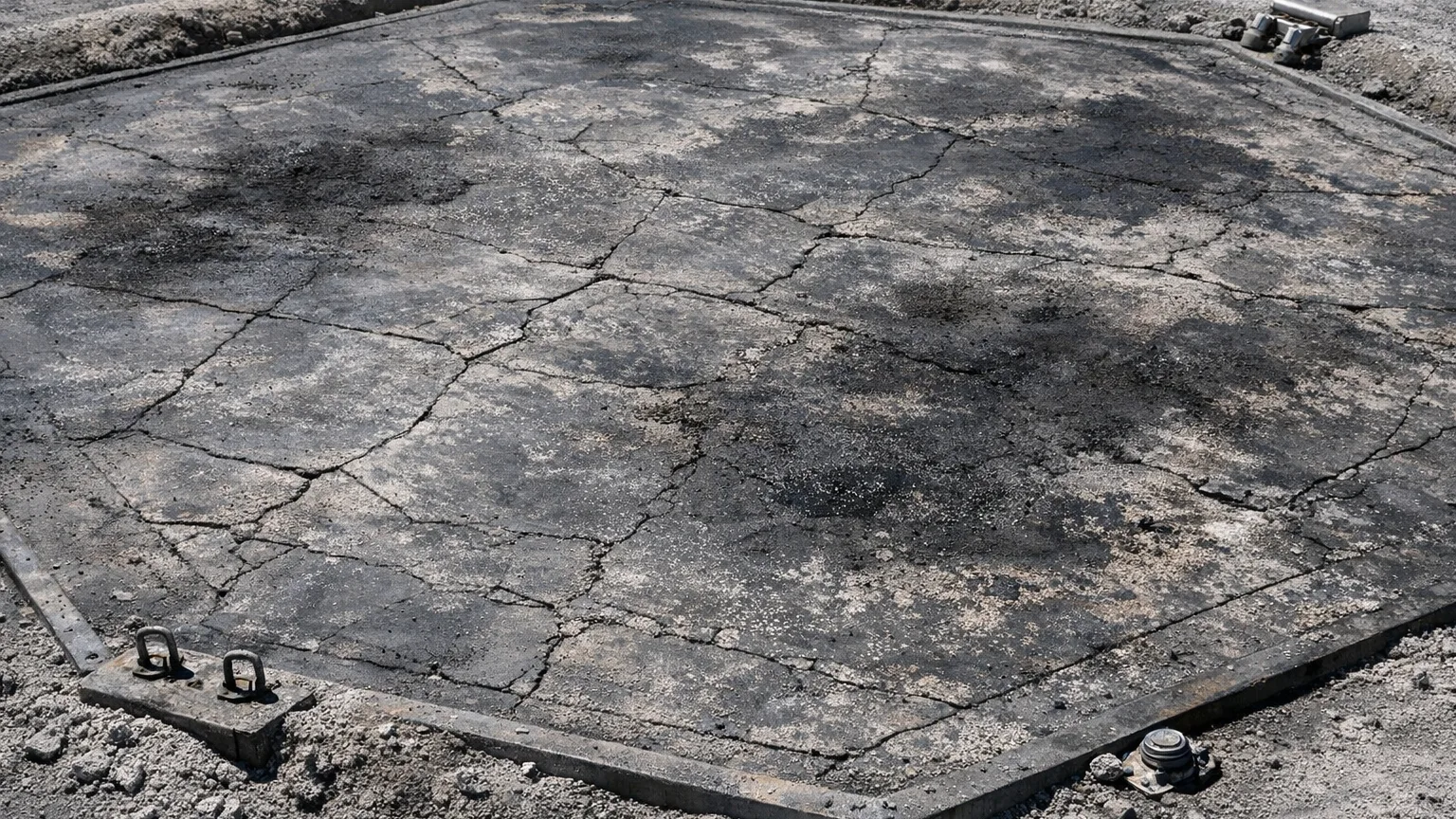
Before the Moon needs houses, it needs boring worksite stuff: landing pads, berms, shielding, roads, and walls made from local dirt.
If you ship a cubic meter of inert construction mass from Earth to the lunar surface, you are not just buying material. You are admitting that your industrial plan still depends on Earth's gravity being cheap.
It is not.
Depending on the launch assumptions, that cubic meter can represent a delivery bill in the millions before it has done anything useful. That is an absurd way to buy something whose main virtue is bulk.
A cubic meter made from local regolith has a different set of problems. It needs power, heat, machinery, process control, abrasion-tolerant parts, and enough operational discipline to keep the system from becoming a maintenance sink. None of that is easy.
But the material is already there.
You are not paying to throw mass out of Earth's gravity well every time you need shielding, a landing slab, a berm, a road tile, a trench cover, or a sacrificial wall.
That is the real correction lunar construction forces on us. This is not, at first, a story about beautiful habitats. It is a cost-gradient story about bulk mass, surface discipline, and keeping expensive equipment alive in a hostile work site.
The Moon does not first need a city. It needs ways to stop importing huge amounts of dumb mass for jobs that local dirt can eventually do.
- Pads
- Berms
- Shielding
- Haul routes
- Blast protection
- Thermal cover
- Crude structural mass
The business begins when local material can take over work that would otherwise consume a launch manifest.
That also means the first real customer is probably not a resident buying square footage with a view of Earth. It is a logistics operator buying uptime. It is a landing provider that wants the pad not to destroy itself. It is an oxygen plant that needs a protective berm. It is a power system that wants cleaner radiators and less abrasive dust in its joints. It is a haul operation that wants one repeatable route across bad terrain instead of six heroic field repairs.
On the Moon, construction shows up first as civil works, not real estate.
That distinction matters because a lot of lunar construction talk still wears the wrong costume. The renderings show domes. The copy talks about settlements. The architecture arrives before the maintenance plan.
Real frontiers do not usually open that way. First, somebody builds the ugly surfaces, barriers, routes, and service areas that make the rest of the site less punishing. Then equipment lasts longer. Then movement gets cheaper. Then the next piece of infrastructure becomes easier to justify.
The Moon is not an exception to that rule.
It is a harsher version of it.
Nobody Pays First for a Moon House
The easiest way to get lost in lunar construction is to start with the habitat.
Habitats matter, but they are late. Houses are late. Pretty interiors are very late.
The first market is much more basic. It is the same kind of market that appears in every rough industrial zone on Earth: making a work site behave like a work site.
That means hardening ground where landing exhaust would otherwise turn the area into a self-inflicted debris field. It means raising berms and blast barriers around equipment, stockpiles, power systems, and propellant lines. It means covering sensitive hardware with local shielding instead of flying every kilogram of protection from Earth. It means cutting trenches, stabilizing paths, shaping service corridors, and creating crude but reliable surface geometry so machines can repeat a route without treating every trip like an expedition.
This is why the usual framing feels backward. People ask what kind of homes or factories we will build on the Moon.
The sharper question is: what site-prep and maintenance work deletes imports fastest?
The answer is almost never luxury pressurized volume. It is usually whatever bulky, local-use material an operator is currently forced to launch because there is no boring local substitute yet.
A landing operator does not need a cathedral. It needs a surface that reduces ejecta damage and dust loading.
A power system does not need a sculptural pavilion. It needs shielding, clean approaches, cable protection, service access, and less abrasive garbage in every exposed interface.
A propellant or oxygen system does not need a grand industrial campus. It needs graded surfaces, protective walls, and enough mass in the right places that expensive imported hardware survives longer.
That is the construction thesis. The Moon becomes more buildable not when someone proves they can make an attractive habitat concept out of regolith bricks, but when local material starts taking over the dumb, bulky jobs that launched mass is bad at doing.
There is a timing problem, though.
The business does not appear the moment one lonely mission lands with a power cart and a shovel. Sparse traffic can tolerate inefficient behavior for longer than dense traffic can. If landings are rare, assets are spread out, and missions are short, imported mats, sacrificial shielding, and a certain amount of accepted damage may win for a while.
Lunar construction becomes a real market when cadence, site reuse, and hardware density rise high enough that recurring damage costs more than moving and shaping local dirt.
Pads, Berms, and Shielding Before Architecture
For the near-term product set, stop thinking like an architect and start thinking like a quarry contractor with a power problem.
Pads come first because rockets are vandals.
A lander does not arrive politely. It arrives as a plume event. If the ground below it is loose, the site gets ejecta, scouring, contamination, damage risk, and all the other problems that turn a landing zone into a recurring self-own.
A hardened surface will not solve everything, but it changes the site from something engines punish every time into something that can survive repeated use.
Berms come close behind. Frontier industry has always liked simple geometry that absorbs punishment.
A berm is not glamorous, which is exactly the point. It is local mass in the right place. It can block line of sight, catch debris, limit plume effects, protect stockpiles, and separate expensive imported systems that should not be exposed to each other across an active work zone.
The Moon is going to need a lot of these dumb piles of dirt. That is one reason the economics are real. The boring, bulky things matter most when every imported kilogram hurts.
Shielding is the next obvious category. Lunar industry cannot treat protective mass as decorative. Radiation, thermal cycling, micrometeoroid exposure, and basic equipment survivability all push toward putting material over, around, or between important assets.
Imported shielding may look tolerable in a small demonstration. It looks worse when you multiply it across every tank, shelter, cable run, work bay, and storage area.
Regolith does not need to be elegant here. It needs to be nearby.
That is why early lunar construction is likely to resemble earthworks more than architecture. The highest-value move is not making the Moon look civilized. It is making the first operating sites less brutal to run.
A pad that keeps a lander from damaging nearby assets does real work. A berm that protects a radiator field or storage yard does real work. A layer of local shielding that reduces imported dead mass does real work.
These are bankable improvements long before anyone has a settlement brochure worth printing.
The categories also overlap. Regolith moved for one purpose can often serve another. Excavation for oxygen production or material processing can feed pad maintenance, berm building, route hardening, shielding, or thermal cover. A site already handling dirt is halfway to becoming a site that can build basic civil works.
That matters because early lunar industry probably will not divide neatly into mining, construction, maintenance, and transport. The first useful operators are more likely to be messy hybrids. They will understand dirt handling, power, wear, shielding, movement, and uptime as one connected problem.
The point is not simply that regolith is useful feedstock. That has been said before, and it is true.
The more specific point is that construction value appears first where local mass replaces imported bulk in the service of operational continuity.
That is a narrower claim, and a stronger one.
The Cheapest Wall Is the Dirt Next to the Hole
One useful thing about frontier construction is that it lowers the bar for what counts as a product.
On Earth, construction material often has to travel a long way, satisfy codes, meet aesthetic expectations, and pretend it belongs in a finished environment.
On the Moon, some of the most valuable material may be the dirt you just moved five meters to the left.
The cheapest wall may be the dirt beside the trench. The cheapest shielding may be the dirt over the machine. The cheapest blast barrier may be the berm shaped by the excavation system you already needed for another job.
That is not just a frontier metaphor. It is the real economy of local mass.
The Moon will reward operators who can accept crude usefulness earlier than Earth-trained instincts might allow. A protective edge around a landing surface, a trench cover, a radiation berm, a thermal layer, a rough retaining wall: none of these needs to be beautiful. The winning material is often the one already under the tracks.
But nearby dirt is not automatically cheap just because it is nearby.
That is the trap.
A regolith wall is not only competing with Earth-made concrete in the abstract. It is competing with prefabricated mats, inflatable shielding bags, sacrificial barriers, and the less noble but very real option of accepting a lower operating tempo.
If excavation throughput is poor, autonomy is weak, power is fragile, or hot processing demands too much radiator area and babysitting, local dirt can still lose to something that arrived finished.
The mass gradient is real.
The conversion stack still has to work.
That pushes early construction toward forms that are compression-friendly, layered, and openly unromantic. Burial is attractive. Berms are attractive. Regolith-filled shells are attractive. Thick protective geometry is attractive.
When bulk mass is locally available and imported mass is expensive, you stop designing as though every structure needs to be a delicate precision object. The site has a quarry attached to it, because in effect it does.
This also changes the sequence of ambition.
It is tempting to go straight from "local building material exists" to "large pressurized habitats are next." That is too fast.
The first major win is not a giant new building. It is deleting recurring imports of shielding, blast protection, and crude structural bulk.
If that works reliably, larger structures become less irrational later. If it does not, the pretty structures are just expensive shells sitting inside a punishing operating environment.
A lot of lunar products also do not need to be finished in the Earth sense.
A road tile does not need charm. A landing slab does not need a high-end surface finish. A shielding berm does not need perfect geometry. A thermal cover does not need to impress a design committee.
It needs to work better than the imported alternative at a much lower mass penalty.
That sounds obvious, but it is exactly the kind of obvious thing people ignore when they imagine the first off-world construction business as a habitat company instead of a site-services contractor with a geology advantage.
Dust Is a Maintenance Problem Before It Is a Materials Problem
Now for the part that ruins the presentation.
Lunar dust is not just a harsh-environment detail. It is a recurring attack on uptime.
The particles are jagged. They cling. They abrade. They get into seals, hinges, joints, optics, connectors, boots, radiators, and all the small mechanical places where good engineering quietly turns into bad field behavior.
A lot of discussion treats this as a cleanliness problem. It is more serious than that.
It is a maintenance and replacement-rate problem, which means it is a business problem.
That is why dust control may become a vendor category earlier than people expect. Once enough expensive hardware is concentrated at one site, dust mitigation stops being a nice feature and starts acting like rent.
Someone will need to provide coating refresh, field cleaning, shield replacement, surface treatment, inspection loops, connector care, seal swaps, and route maintenance that lowers the abrasive tax on everything else.
That reframes the construction thesis.
Construction is not only about putting up structures. It is about building an operating envelope where expensive imported machinery does not get eaten alive by the ground it came to work on.
A hardened route, a cleaner landing surface, a protected radiator corridor, or a disciplined equipment yard counts as construction because it buys equipment life.
On the Moon, equipment life is half the game.
Apollo already gave the warning. Dust does not merely make things dirty. It affects thermal behavior, roughens interfaces, accelerates wear, and increases the amount of labor or robotics needed just to keep the site functioning.
A frontier operator can tolerate ugliness. What it cannot tolerate forever is a surface environment that turns every maintenance cycle into another import bill.
That is why "dust-control market" should be taken literally.
This is not just a future materials-science subplot. It is a surface-economy layer with obvious customers: the people paying for seal life, radiator performance, solar cleanliness, mechanical reliability, and repeated access across a dirty site.
Once framed that way, the lunar construction case stops looking like a speculative real-estate argument and starts looking like a hard-environment service business waiting for enough hardware density to matter.
The market will probably reward operators who think operationally, not heroically.
The cleverest dust shield in a lab matters less than a maintenance loop that reduces shutdowns in the field. The threshold is not technical elegance. It is whether equipment lasts longer, cleaning gets cheaper, and route support becomes predictable enough to schedule.
It is also worth being precise about timing.
The first serious dust-control business will probably be captive before it is specialized. Early lunar sites may be too thin, too bespoke, and too vertically integrated to support independent service providers right away. The same operator may own the pad, the hauling gear, the cleaning procedure, and the seal inventory.
Specialization becomes plausible when enough hardware clusters in one place that someone can sell uptime as a service rather than perform dust control as an internal chore.
Bearings, Seals, and the Cold-Welding Tax
Dust is not the only thing trying to kill the thesis.
The quieter problem is tribology: friction, wear, lubrication, seals, bearings, coatings, and all the unglamorous contact points that decide whether machinery survives.
Lunar construction machines do not work in a friendly atmosphere full of terrestrial conveniences. Vacuum removes a lot of the invisible mercy that Earth equipment gets for free. Exposed metal contacts become more difficult. Protective films can fail. Abrasive fines get everywhere.
Once coatings wear through, adhesion and wear stop being edge cases and become the thing that ends your shift.
That is why the bottleneck should not be framed only as "can we make strong lunar concrete?" That question matters, but it flatters the wrong part of the stack.
The harder question is whether the machines that excavate, convey, compact, sinter, inspect, and repair the site can survive long enough between interventions for the economics to work.
Strong material properties do not help much if the excavator has miserable seal life and bearings that hate vacuum plus abrasive dust.
This has design consequences.
The Moon will reward mechanically simpler approaches sooner than mechanically elaborate ones. Fewer exposed interfaces beat more. Passive beats fussy. Sliding contact is guilty until proven innocent.
Systems that can reduce wheel-regolith abuse, avoid contaminated joints, and simplify field repair will look boring in a rendering and wonderful in the ledger.
There is also a direct connection between route design and machine life.
A smoother or hardened path is not only a transport upgrade. It is a tribology upgrade. A landing pad is not only a landing upgrade. It is a contamination-control upgrade. A buried or shielded equipment zone is not only a radiation or thermal choice. It reduces the number of ways the environment gets a free shot at moving parts.
This is the deeper reason early civil works matter.
Civil works lower the wear tax on everything else. The site improves the machinery. The machinery expands the site. That loop is where the first serious margin lives.
If the loop never closes, lunar construction remains a collection of impressive demonstrations sitting on top of a murderous maintenance schedule.
The Moon Rewards Boring Forms
There is a design lesson hiding here, and it is not glamorous.
The Moon rewards structures and layouts that accept the environment instead of trying to style past it.
Buried systems are attractive. Covered systems are attractive. Compression-dominant forms are attractive. Thick shells, shallow vaults, berm-backed walls, and partially underground service spaces make more sense than delicate exposed elegance.
Thermal cycling is part of the reason. So is dust. So is radiation. So is the simple fact that every exposed moving part becomes a future maintenance argument.
A lot of lunar design rhetoric still imagines the surface organized around machines and buildings that behave like polished cousins of Earth equipment.
That seems backward.
The winning forms are more likely to reduce exposure, shorten unsupported spans, simplify maintenance, and use local bulk where Earth industry would prefer refined precision.
The first great lunar builder may not look like a visionary architect. It may look more like a contractor who understands why a buried cable, a shielded service bay, a ramped berm, and a hardened approach route beat an exposed masterpiece.
Lava tubes fit this logic, but they should not become the main near-term thesis.
The serious point is narrower. If protected natural volume exists and can be made usable, it could let lunar industry skip a large class of expensive surface problems. That would be enormous.
But it is still a sequencing question.
Even if subsurface industrial space becomes real, the surface economy still needs pads, approaches, protective works, access points, power links, and transport routes. The Moon does not teleport from geology to mature underground industry. Someone still has to do sitework.
That is the recurring truth.
Lunar construction is not about expressing confidence. It is about reducing friction.
The forms that win will be the ones that make the site easier to operate, not the ones that make the brochure look historic.
Route Geometry Is Half the Construction Story
A lot of people hear "lunar construction" and imagine static objects.
That misses half the point.
Construction is also movement geometry.
A working lunar economy will need more than protected places to land and store hardware. It will need repeated routes between landing zones, excavation sites, processing lines, power nodes, maintenance yards, and eventually sheltered working volumes.
If those routes remain loose, dusty, slow, and mechanically punishing, the rest of the economic story gets dragged backward.
That is why pads and roads belong in the same conversation.
A route is a form of equipment life support. A hardened path reduces wheel abuse, suppresses some dust generation, stabilizes traffic, and turns each trip into less of an improvisation.
At first, that might mean sintered surfaces, graded tracks, or partially stabilized corridors. Later, it might mean fixed-guideway freight.
But the logic starts early.
Every improvement in movement lowers the tax on uptime.
There is also a middle rung that deserves more attention. Broken polar terrain and crater approaches may not reward a "road first everywhere" mindset. Suspended haulage, cable systems, or other partial-elevation solutions could arrive before full heavy-route infrastructure in places where the terrain is hostile and the main value is simply opening a repeatable line.
That is not a sideshow.
It is exactly the kind of bridge technology frontier operators use when perfect ground preparation would take too long or cost too much.
The transport ladder probably looks something like this.
Rovers and rough hauling win the scouting phase. Repeated work routes then justify hardening, paving, or stabilizing key corridors. Awkward terrain invites suspended or cable-assisted movement where opening the line matters more than elegance. Only after throughput becomes real do more capital-intensive fixed systems begin to make sense on the busiest links.
That sequence keeps the story grounded.
The Moon is unlikely to build a mature surface economy in one leap. It will build it through repeated local improvements to movement. Each route that becomes less punishing makes the next industrial node easier to justify. Each stable corridor improves maintenance planning, dust behavior, and cargo reliability.
That is how a site stops behaving like a field camp and starts behaving like infrastructure.
The customer is obvious: the operator that needs mass, power hardware, feedstock, spares, and shielding material to move on schedule.
The first real lunar transport business may be hard to separate from the first real lunar construction business because both are selling predictability.
The harder problem is that the best lunar locations may not line up neatly.
The terrain that is easiest to work may not have the best power geometry. The best power geometry may not sit next to the most useful volatiles or protected working volume. A promising industrial node may still be attached to a terrible route.
So the first decade may not be about perfecting one coherent lunar site. It may be about stitching together bad locations with enough route discipline that the network does not drown in its own geography.
That is clumsier than the cleanest plans suggest.
It is also probably closer to the truth.
The Near-Term Path Is a Throughput Story
If this works over the next five to fifteen years, it will not look like instant off-world civilization.
It will look like a slow victory for throughput.
First comes pad discipline.
Someone proves they can prepare and maintain landing surfaces well enough that repeated arrivals do not keep turning the work zone into a damage experiment. That sounds modest. It is not. A frontier that can land repeatedly without wrecking itself has crossed a real threshold.
Then earthworks begin to piggyback on everything else already happening.
Excavation for oxygen systems, material handling, shielding, and site prep starts producing useful civil-work mass. Berms, covers, crude barriers, and pad maintenance become ordinary outputs of a dirt-moving industrial site rather than one-off demonstrations.
Then dust control hardens into a service layer.
Not perfect mastery. Just enough operational performance that coatings, shields, cleaning intervals, inspection loops, and replacement schedules become predictable and worth paying for.
That is when the Moon starts to grow a maintenance economy instead of relying on heroic workarounds.
Then route geometry improves.
Some corridors get sintered or stabilized. Some ugly stretches get cable or suspended solutions because the terrain is bad and the cargo still needs to move. Equipment spends less of its life grinding itself against loose abrasive surfaces.
Only after those pieces begin to behave do bigger construction and transport ambitions get their turn: fixed-guideway freight, more protected working zones, heavier local shielding stacks, maybe even serious underground industrial use if the lava-tube story proves out.
The path is cumulative.
The Moon is not waiting for one perfect structural breakthrough. It is waiting for a chain of boring wins that make the next win easier.
That is why the early lunar construction story should not be sold as architecture, manufacturing glamour, or a settlement prequel.
It is a throughput story.
It is about making the site repeatable enough that local bulk beats imported mass often enough to matter.
The Real Counters Are Operational Counters
The strongest objections belong inside the argument, not outside it.
Yes, lunar dust is a real adversary. Yes, vacuum tribology can turn elegant mechanisms into maintenance traps. Yes, thermal cycling and heat rejection punish exposed equipment and sloppy layouts. Yes, many material demonstrations still sit closer to serious research than industrial routine.
The gap between a lab result and a field-maintained lunar system is exactly where a lot of capital can die.
Those are the honest counters, and they should stay on the table.
There is also a sequencing counter.
The best construction terrain, the best power geometry, and the best volatile access may not sit in the same place. Lunar industry may have to open through linked zones rather than one perfect master site. That makes everything slower and messier.
Clumsy frontiers are normal.
But clumsiness still has costs.
The sharpest counter is continuity.
The Moon is not short on dirt. It may still be short on machines that can keep handling, shaping, fusing, protecting, and moving that dirt under real duty cycles without turning the site into a maintenance ceremony.
If the replacement loop stays too heavy, if spare mass stays too expensive, if cleaning and seal life never become boring enough, then the cost-gradient thesis remains physically correct but commercially stranded.
There is also a thermodynamic counter that should not be waved away.
Local construction wins only if the power and heat-rejection stack does not quietly eat the savings. A sintered slab is not competing against an abstract cubic meter of Earth concrete. It is competing against whatever imported workaround gets the job done with less supervision, less process heat, and less radiator burden.
If hot equipment forces too much thermal-control mass into the design, if power continuity remains fragile, or if operators end up flying excessive spare hardware just to keep the local-mass loop alive, the site can be physically buildable and still economically unattractive.
That is a real risk.
But notice what kind of risk it is.
It is not a refutation of lunar construction. It is a claim that the operating envelope may not widen fast enough for the local-mass advantage to cash out.
That is a much more useful argument than dismissing lunar construction as science fiction by default.
The right question is not whether the Moon can ever be built from local dirt. In the physical sense, of course it can.
The right question is how fast a site can become disciplined enough that local bulk beats imported mass in practice, not just in a white paper.
Where the Asymmetric Upside Actually Sits
The asymmetric upside is not in winning an argument about settlements.
It is in winning a series of rude local substitutions.
If an operator can stop importing pad material, shielding mass, route-stabilization mass, sacrificial blast protection, and some of the replacement burden that dust would otherwise impose, the economics change before any glamorous export market appears.
That is the first real wedge.
The Moon starts paying for itself locally by deleting bulky imports from the surface manifest.
This is why operator behavior matters more than grand narrative.
The likely winners are not the loudest people promising cities. They are the ones treating lunar construction as an uptime and site-services business.
They will obsess over wear, cleaning cycles, route geometry, shielding stacks, equipment survival, and how one civil-work improvement lowers costs somewhere else in the stack. They will think like quarry contractors, utility builders, and maintenance maniacs.
Good.
That is the right pathology.
The signals to watch are similarly unromantic.
Repeated pad use without escalating damage. Measurable reductions in dust-driven thermal or optical degradation. Route systems that stay up long enough for throughput to look routine instead of ceremonial. Equipment lifetimes that stop collapsing into emergency replacement drama. Local shielding or berm work that clearly deletes imported mass instead of merely supplementing it.
Those are the signs that the thesis is hardening into an industry.
Better yet, watch for threshold events rather than vibes.
Watch for one landing surface reused several times without a major rebuild between arrivals. Watch for excavation and pad-maintenance hardware becoming part of baseline mission architecture instead of a side demo. Watch for route upkeep, dust cleaning, and seal care turning into explicit service packages. Watch for repeated cargo movement between two fixed surface nodes along a maintained corridor rather than ad hoc rover wandering.
Watch whether imported spare mass per operating hour starts falling instead of rising.
Those are boring data points.
They are also the ones that matter.
If lunar construction has a first product, it is this: a lower-friction operating envelope.
Not beauty. Not even buildings.
Just a site that is less punishing to run than bare regolith plus optimism.
The Dark Horses Are the Rent Collectors
The outer ring of the thesis is not a collection of random futuristic ideas.
It is the next layer of rent once basic siteworks begin to work.
Dust control is the cleanest example.
The first generation of lunar hardware may limp along with ugly procedures and obsessive care. The second generation will want vendors. That means recurring revenue for coating systems, active cleaning hardware, seal and connector service kits, shield replacement, contamination monitoring, and perhaps site-level route treatment that reduces abrasive exposure for everyone else.
Once enough equipment clusters in one place, dust control stops being a technical appendix and becomes a landlord business.
Another hidden tollbooth is motion control.
Whoever masters vacuum-rated bearings, coatings, lubricants, seals, and low-contact mechanisms does not merely build better hardware. They sit at the gate of every excavator, sintering line, rover fleet, cargo handoff system, and maintenance robot on the surface.
Lunar construction can survive mediocre aesthetics. It cannot survive gear trains and sliding interfaces that seize, wear out, or turn abrasive fines into a death sentence.
Tribology vendors are a genuine dark horse because they can collect rent from every operator who learns that beautiful site plans are useless if the machinery keeps destroying itself.
Cable and suspended transport are another dark horse.
Lunar route talk often jumps from rovers to roads to rail. But crater rims, shadow boundaries, and ugly polar approaches may reward systems that open a line before a fully prepared ground corridor exists.
If a suspended system can move useful mass with fewer wheel interfaces, less direct dust abuse, and far less grading, it can win early while looking less grand than full guideway infrastructure.
Frontier history is full of provisional-looking systems that collect the first serious rent.
Then there is hybrid shielding.
Regolith will do the bulk work because it is nearby and locally cheap. But bulk is not the whole story forever. Hydrogen-rich layers, water-rich systems, polymer stacks, and possibly biological or hybrid materials may handle the finer-grained jobs that plain dirt does badly.
That belongs in the outer ring for now, not the center.
But the logic is strong.
The Moon probably wins by using regolith for the dumb heavy part of shielding and more specialized materials for the clever layer, rather than pretending one material has to do everything perfectly.
This extension does not fight the main thesis. It follows from it.
Once local bulk mass is in play, smaller service and materials businesses become more plausible because the heaviest part of the problem is being handled by the ground itself.
Beyond the Cutting Edge
The first beyond-the-cutting-edge idea is that lunar construction may eventually scale by importing precision cores into locally built shells.
That is not full self-replication, and it should not be sold that way.
The point is simpler.
Once local civil works, shielding, bulky enclosures, trench covers, route surfaces, and rough structural shells can be made on site, Earth does not need to keep shipping whole finished systems every time.
It can ship brains, bearings, controls, chips, sensors, and other compact high-value pieces, the parts the Moon will be bad at making early, while local material handles the bulk.
That is a very different expansion curve from launching complete machines and finished structures forever.
The second idea is that protected industrial volume may matter more than surface bravado.
If cave robotics or lava-tube access eventually validates the use of natural underground halls, the capital stack changes. Shielding, thermal control, and micrometeoroid protection stop being huge separate penalties and start looking more like entrance, preparation, access, and service problems.
That should not anchor the near-term thesis.
But it is worth watching because it would make every surface pad, route, berm, and maintenance yard more valuable by connecting them to a more forgiving operating environment below ground.
There is one more branch worth keeping in peripheral vision.
If low-temperature biological or chemical processing ever becomes good enough to handle part of the material burden without demanding ever-larger hot machinery and radiator fields, some of the lunar construction story shifts from exposed thermal violence to sheltered process campuses.
Again, not a near-term anchor.
But it is directionally important. The Moon may become easier to build not only because operators learn to shape dirt better, but because some of the ugliest heat-rejection burdens move into gentler process logic.
Beyond the Poster
The wrong way to sell lunar construction is as a dream of domes.
The better way is less romantic.
A site on the Moon needs local mass because launched bulk is brutally expensive. It needs pads because rockets damage loose ground. It needs berms and shielding because the environment does not care about anyone's import budget. It needs route discipline because movement is part of maintenance. It needs dust control because uptime is a business, not a slogan. It needs simpler mechanical logic because vacuum and abrasive fines will punish every exposed moving part.
That is not the disappointing version of the lunar future.
It is the adult version.
The Moon will become buildable the way most real frontiers become buildable: not when somebody proves it is inspiring, but when somebody proves the ugly surfaces, barriers, covers, routes, and service loops can make the next kilogram of imported precision do more work than the last one did.
At that point, lunar construction stops being a speculative branch of space enthusiasm and becomes what it was always waiting to become:
a cost-gradient business built from dust.
Comments
Reader notes
Reader comments are not connected yet. For now, send notes to @slop_dealer.