Quick version
Asteroid mining is not a race to find space platinum and get rich. It is target selection, assay, sample handling, volatile extraction, orbital logistics, and off-world customers. The headline composition of an asteroid is just a sales lead, not a mine plan. Real operations begin with physical assay: confirming how volatiles and metals are bound inside raw regolith, how materials handle crushing and heat in vacuum, and whether delivered products can beat mission costs. The earliest paying market is propellant and water delivered to orbital buyers, where local mass saves the brutal expense of climbing out of Earth's gravity well.
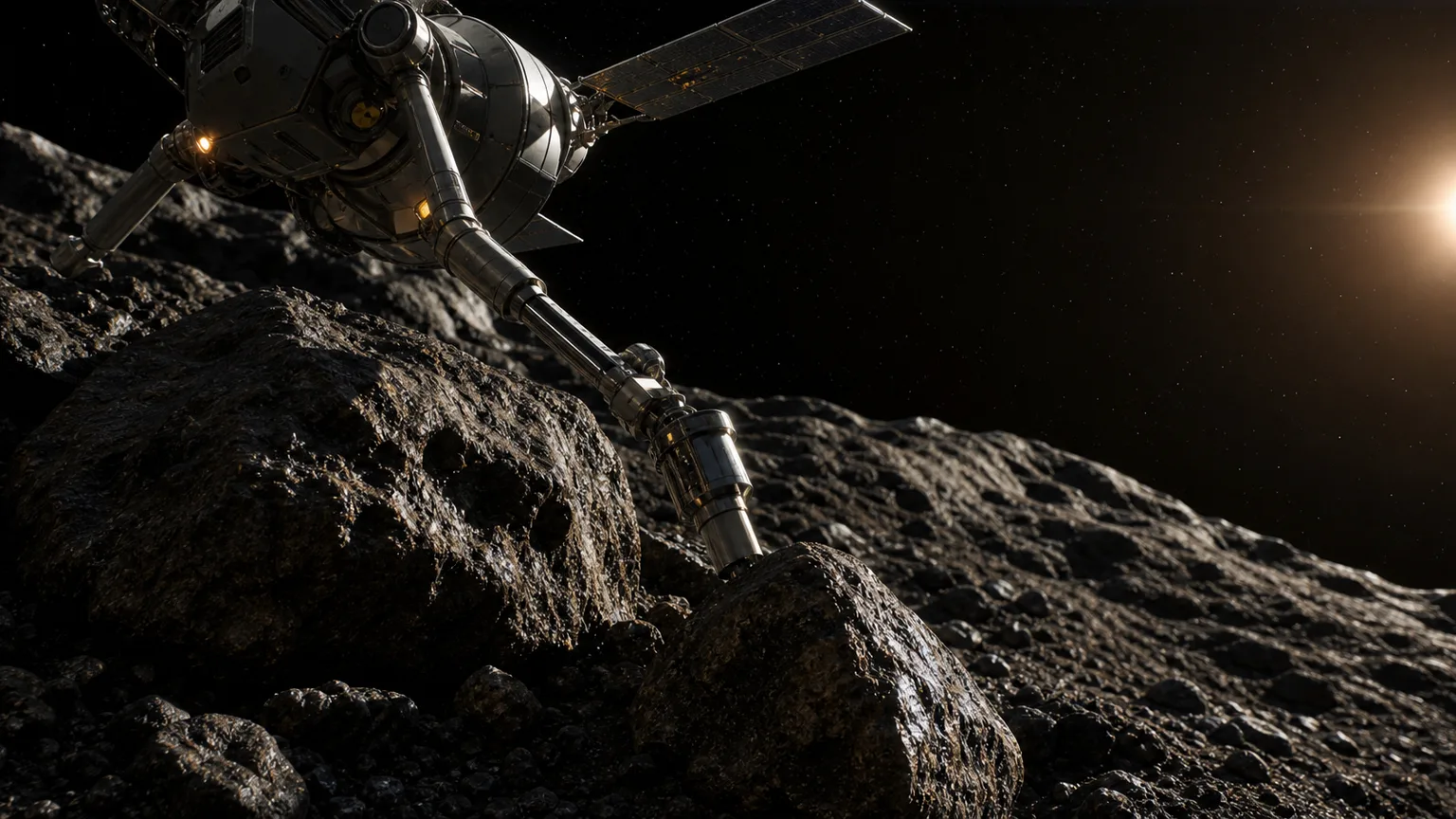
Asteroid mining has a slop problem. The cheap version claims space is packed with platinum, needing only a billionaire and a starry landing page. That's not a business. That's a treasure-chest fantasy with thrusters.
The version that survives contact with raw rock is duller, meaner, and far more useful. It starts with assay. Before selling water, oxygen, nickel-iron, shielding mass, or refined metal, you have to prove what's there, how it's bound, how it handles heat, how it shifts when touched, and whether the delivered product beats mission costs.
Terrestrial mines don't start with headlines about valuable minerals. They start with maps, core samples, assay results, metallurgy, permits, roads, power, water, tailings, buyers, and brutal cost models. Space drops a few of those hurdles and adds nastier ones: no atmosphere, microgravity, floating abrasive dust, spinning rubble piles, and customers who might not exist for a decade.
The Rock Is Not the Resource
A resource isn't just matter floating in space. It has to be found, extracted, processed, moved, sold, and used. Most asteroid-mining pitches skip those middle steps.
NASA's Center for Near Earth Object Studies defines near-Earth objects as comets and asteroids whose orbits enter Earth's neighborhood. That catalog tells you where a rock goes. An accessible orbit does not guarantee an accessible product. You still need a physical inventory.
Take that orbital accessibility at face value and follow it to the deposit. Prospecting demands orbits, launch windows, spin rates, geometry, albedo, thermal inertia, spectral classes, boulder distribution, porosity, cohesion, volatile signatures, and error bars tight enough to keep missions off pure faith.
That prospecting stack has real commercial teeth. A slow, accessible rock of plain gravel beats a famous metal asteroid trapped in a brutal orbit. A volatile-rich body you can't process cleanly is no fuel depot. A high-value metal deposit that demands heroic return logistics is no business. The first assay question isn't how much treasure sits in the rock; it's what job this material does, for whom, and where.
Bennu Is an Assay Lesson
NASA's OSIRIS-REx mission dragged the conversation from poster logic down to sample logic. The probe grabbed material from asteroid Bennu and brought it to Earth on September 24, 2023. That returned sample gives direct laboratory confirmation: early analysis confirmed carbon and water, and follow-up briefings detailed organic molecules and remnants of a wet, salty parent body.
That isn't a payday. For serious operators, it's better: concrete evidence of the messy chemistry behind the label "carbon-rich asteroid." Bennu's minerals show water reacting with rock across eons. NASA briefings also noted salts that degrade when exposed to Earth's air. That's core assay work: tracking composition, mineral hosts, contamination, and process behavior.
For mining, the takeaway is simple: "water-bearing" doesn't mean an ice pond under a crust. That water is locked inside hydrated minerals. To recover that water, extraction equipment must feed raw regolith into a thermal oven, bake the mineral matrices to drive off vapor, capture the gas before it vents into vacuum or fouls seals, and store the purified liquid against wild thermal swings. Salts aren't plumbing. Carbon isn't refined fuel. Organics aren't revenue. They're chemical constraints you solve before cutting flight hardware.
Examining returned regolith under laboratory instruments proves the chemical bonds and identifies the salts. Operating an autonomous assay package on an asteroid requires crushing and heating that same material in microgravity. Supplying an orbital depot means running that extraction loop continuously, processing raw mass without human hands on site. Telescopes spot a target; physical samples change the game. A viable mining venture needs both: survey wide from orbit, then run real dirt through instruments to see how it handles crushing, heating, sorting, and storage.
Psyche Kills the Ingot Cartoon
Asteroid Psyche is another essential reality check. Pop science flattens it into "the solid metal asteroid," which is pure slop. NASA's mission overview indicates a rock-and-metal mix, with metal accounting for 30 to 60 percent of its volume. NASA also highlights contradictory datasets: no one knows Psyche's true makeup until the probe arrives.
Follow what that 30 to 60 percent volume means across development. At the survey stage, it represents an unresolved bracket from conflicting datasets. In an initial prospecting mission, it dictates whether navigation and sampling tools encounter jagged metallic surfaces or loose silicate rock. In a full production facility, that wide spread determines whether processing gear spends most of its power budget separating silicate waste or feeding native metal into a smelter.
That's the entire business dilemma in one rock. Metal-rich doesn't mean mineable. Mineable doesn't mean profitable. Profitable in orbit doesn't mean viable on Earth. A metallic asteroid still brings silicate dilution, jagged surfaces, impact fractures, awkward spins, and unproven smelting requirements.
The Psyche lesson isn't pessimism; it's engineering discipline. Headline composition is just a sales lead. A lead requires characterization; characterization requires sensors, power budgets, comms, navigation, thermal control, fault handling, and a clear reason to deliver data or mass.
The First Customer Is Probably Not a Jewelry Counter
The treasure-chest pitch promises rare metals shipped home to Earth. That might happen someday, but it's a terrible place to start.
Suppose a venture successfully hauls platinum back down to Earth. Earth already has established mines, smelters, recycling loops, material substitution, and volatile pricing. USGS tracks platinum-group metals as industrial commodities with deep supply-chain data. They matter for catalysts, electronics, and chemical processing, but buyers won't pay infinite premiums for space ore. Dump new supply on a thin market and the spot price collapses. Hauling mass down Earth's gravity well adds re-entry, recovery, regulatory, and assay costs that pitch decks routinely ignore.
Water and volatiles offer a less glamorous but far sounder early business case. NASA's in-situ resource utilization research treats local mass as feedstock for water, propellant, breathable oxygen, and shielding. NASA is equally candid that volatile deposits remain poorly characterized and unproven in terms of access.
That's the grounded view. The real product isn't space riches; it's mass delivered to the right orbit. Water runs life support or cracks into hydrogen and oxygen for propellant. Volatiles provide chemical feedstock. Regolith shields against radiation. Over decades of off-world growth, native metal could build hulls once orbital manufacturing catches up. The unit economics work when the buyer is already in orbit, saving the immense cost of climbing out of Earth's gravity well.
Logistics Are the Mine Plan
Asteroid mining is orbital logistics in a hard hat. The ore body moves. The refinery moves. The customer moves. Launch windows dictate opening hours.
To make the logistics loop close, autonomous excavation gear must collect surface regolith in microgravity without blowing away in the reaction, feed the material into volatile capture and thermal processing units, and route the refined product to orbital depots that match trajectories with incoming transport tugs.
- Prospecting decides which targets deserve attention.
- Characterization turns a speck of light into an engineering target.
- Assay turns that target into chemistry, error margins, and bench tests.
- Mission design settles whether the rock can be reached and revisited.
- Extraction gear must operate in microgravity, deep vacuum, sharp dust, and thermal swings.
- Processing has to produce usable feedstock, not just churn up regolith.
- Storage and transport determine whether that feedstock arrives intact.
- The end buyer determines whether the loop was worth running.
That's why asteroid mining will start as unglamorous sub-tiers: sensor packages, spectral databases, radar campaigns, sample handling, autonomous excavation, volatile capture, thermal processing, orbital depots, tug logistics, and off-world bulk supply contracts.
The first winners won't be lone prospectors with pickaxes. They'll look like analytical labs, flight-ops shops, bulk suppliers, and refineries built to operate without gravity.
Processing Is the Wall
People hear mining and picture digging. Digging is useless if the payload is unrefined dust. The bottleneck is processing.
For volatiles, processing means baking water out of mineral matrices and trapping vapor before it vents into vacuum or fouls seals. It means certifying purity, storing cryogens across wild thermal swings, and running hardware with zero hands on site.
For metals, the technical ledger is blunt: whether the metal is trapped in grains, alloys, or sulfides; how much power separation takes; which mechanical parts survive the abrasion; and whether the customer buys powder, ingots, wire, or sheet.
Where do tailings go when there is no downhill pile? In microgravity, discarded rock cannot simply tumble away; material handling gear must actively control and clear stripped silicates so floating abrasive dust does not foul seals or coat working instruments.
None of this kills the sector; it just strips the vaporware. The mine isn't the rock. The mine is the working loop from raw mass to delivered payload.
The Sober Bet
The sober bet is that asteroid mining begins with assay, because assay kills slop. It turns hand-waving about "valuable asteroids" into measured chemistry. It shows investors what's verified versus what's marketing, and tells engineers whether to build a crusher, a thermal oven, a cryogenic tank, or a smelter.
That's less romantic than a trillion-dollar space rock. Good. Romance is dead weight, and space hates dead weight.
When asteroid mining functions as an established trade, the people running it will look like flight-ops controllers, assay technicians certifying chemical purity, and plant operators managing thermal ovens and cryogenic storage in orbit. They will spend their shifts tracking launch windows, signing off-world bulk supply contracts, and billing propellant deliveries by mass to tug operators who need reaction mass on schedule. The glamour drops away, replaced by the steady work of moving useful tons between moving rocks and paying customers.
The real business is prospecting, characterization, volatile handling, logistics, and refining. An asteroid isn't a treasure chest. It's an uncooperative supplier with no loading dock and zero patience for sloppy claims. Start with assay, or watch your story burn up before the rocket leaves the pad.
Source Notes
- NASA OSIRIS-REx mission: Bennu sample-return timeline and mission context.
- NASA Bennu carbon and water release: initial sample findings.
- NASA Bennu discoveries briefing graphics: organics, wet salty environment, and salt minerals in Bennu samples.
- NASA Psyche mission overview: Psyche as mixed rock and metal, with unresolved data contradictions.
- NASA CNEOS NEO Basics: definition and context for near-Earth objects.
- USGS platinum-group metals statistics: grounded commodity context for PGMs.
Comments
Reader notes
Reader comments aren't connected yet. Send notes to @slop_dealer.