Quick version
More than 21,000 desalination plants discharge about 142 million cubic meters of brine a day. That brine carries an estimated 17,400 tonnes of lithium a year.
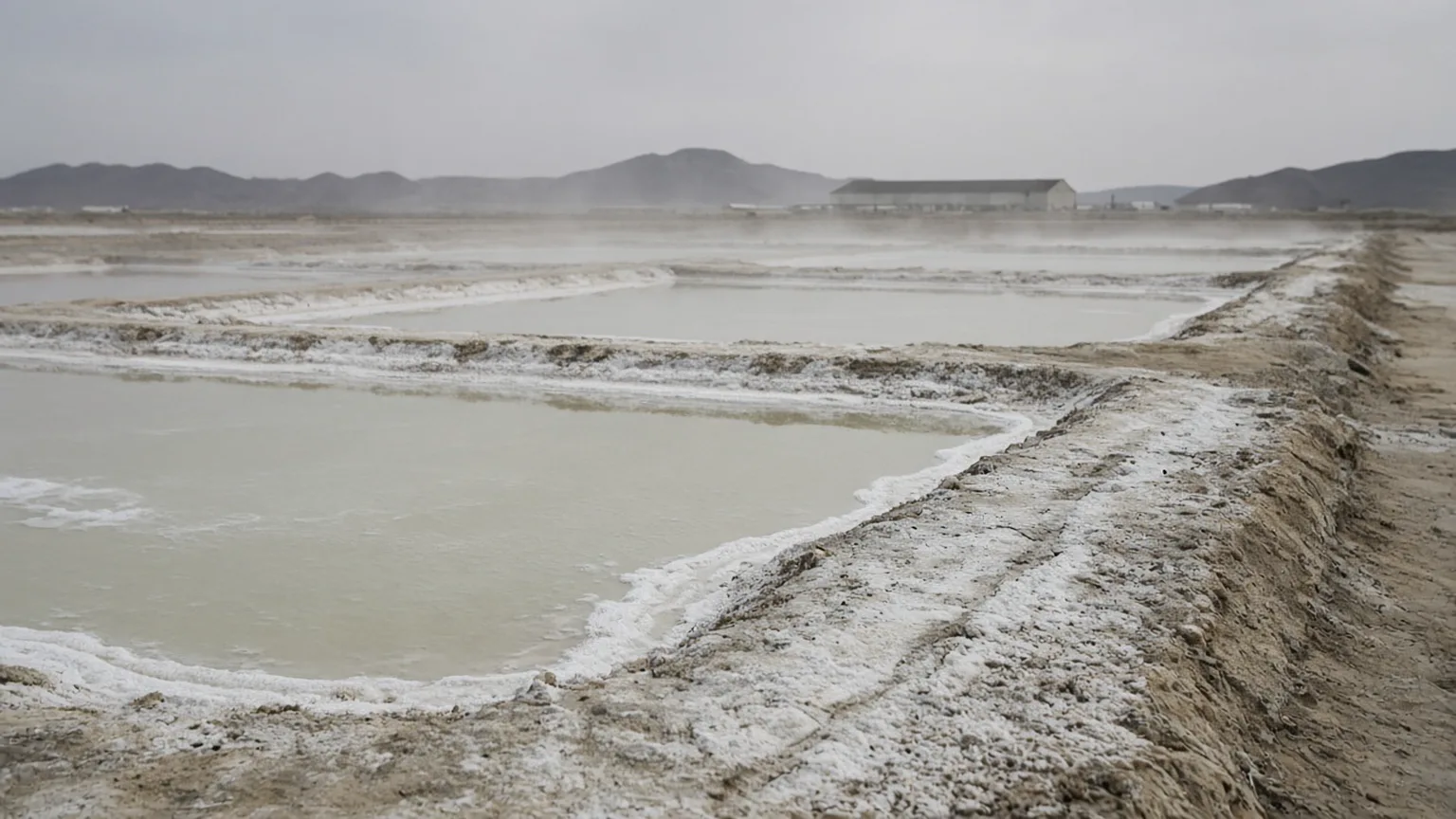
The Deep Harvest, Chapter 5: The Dissolved Fortune
A reverse-osmosis plant pushes seawater hard against a membrane. Fresh water passes through. The salt and everything else dissolved in the sea stay behind, and that leftover goes back out of the plant as brine. On average, for every liter of fresh water a desalination plant makes, about 1.5 liters of brine go back out.
More than 21,000 desalination plants make about 95 million cubic meters of fresh water a day. Together they discharge about 142 million cubic meters of brine a day. A reverse-osmosis plant that turns 40 to 55 percent of the seawater it takes in into fresh water sends out a reject stream 1.8 to 2.5 times as concentrated as the sea. Four countries put out about 55 percent of the world's brine: Saudi Arabia 22 percent, the United Arab Emirates 20.2 percent, Kuwait 6.6 percent, and Qatar 5.8 percent.
That brine carries an estimated 17,400 tonnes of lithium a year. The water has already been pumped in, filtered, and concentrated. Then it goes back to the sea.
Dissolved lithium and uranium in the sea
The oceans hold about 230 billion tonnes of dissolved lithium. Lithium reserves on land come to about 22 million tonnes, and all identified land resources to about 89 million. The research behind this chapter puts the sea-to-land ratio at roughly 2,500 to 1. Seawater also holds about 4.5 billion tonnes of uranium.
It is spread very thin. Lithium sits at 0.17 to 0.2 parts per million of seawater, uranium at 3.3 parts per billion. At that strength, recovering one kilogram of uranium means processing 330 million liters of ocean water. The uranium is also tied up chemically, as uranyl bound to carbonate, and vanadium, at about 1.7 parts per billion, competes for the same binding sites on the materials built to catch it.
So the size of the inventory decides nothing on its own. Concentration comes first, and every extra liter pumped to get around it costs power.
Building beside the plant that already pumps
That is why the brine pipe matters. A mineral plant built next to a desalination plant shares its seawater intake and pretreatment, and it starts on water that is already up to two and a half times saltier than the sea. The research puts the cost saving from that arrangement at 30 to 60 percent, compared with a mineral plant that stands alone. A U.S. Department of Energy analysis found that tying uranium extraction to desalination brine cuts production cost by 31 percent compared with extracting it from open seawater. One of the reports gives that same path as a drop from about $1,000 to about $700 a kilogram.
NEOM, north of Duba, is designed around this. Its plan calls for 1.5 million cubic meters of fresh water a day by 2030. The first project, at 500,000 cubic meters a day, draws seawater through intake tunnels down to 27 meters below sea level, then runs it through nanofiltration, reverse osmosis, ultra-high-pressure reverse osmosis, and a second reverse-osmosis stage. Its projected yearly output includes 1,786 tonnes of gypsum, 511 tonnes of magnesium oxide, 367 tonnes of potassium nitrate, 270 tonnes of potassium chloride, 188 tonnes of magnesium metal, 21 tonnes of bromine, and 0.2 tonnes of lithium carbonate.
At NEOM, lithium is the smallest line on that list. Desalination brine is a hard place to get lithium from. It carries about 7,500 parts magnesium for every part lithium, and in practice selective membranes recover only 2 to 10 percent of the lithium in it. The same kind of membrane recovers 44.5 percent from a brine that is 1 percent lithium.
Labs have also gone after lithium in raw seawater. At Stanford, electrodes made of titanium dioxide and iron phosphate picked lithium over sodium at 18,000 to 1 in real seawater. At KAUST, ceramic membranes made battery-grade lithium phosphate from Red Sea water at about $5 a kilogram in electricity.
Lithium from brine on land
On land, the older way to get lithium from brine is to pump it out of underground aquifers or salt flats and leave it in ponds. Over 12 to 24 months the water evaporates and lithium carbonate settles out. The ponds recover 40 to 60 percent of the lithium and use about 2,000 cubic meters of water for every tonne of lithium. Hard-rock lithium starts with spodumene ore, concentrated to 3 to 6 percent lithium oxide, which is roasted at 1,100 degrees Celsius, leached with acid, and precipitated. Recovery there runs 50 to 90 percent.
Direct lithium extraction pulls the lithium out of the brine with a machine instead of waiting for ponds to dry. At the Lake Resources Kachi project in Argentina, Lilac Solutions' fourth-generation ion-exchange system recovers about 90 percent of the lithium. With that system, the project's power need fell from 82 to 57 megawatts, and the volume of brine fed in and reinjected fell by 30 percent. International Battery Metals reports extraction above 97 percent from a modular plant that recycles 98 percent of its water and fits on three acres, where evaporation ponds take hundreds. A redox-couple electrodialysis method, which uses an electric current to move lithium across a membrane, reaches 80 to 95 percent recovery on under 50 cubic meters of water per tonne of lithium, about one-fiftieth of what the ponds use.
Lilac also has a buyer. In January 2026 it signed a binding 10-year take-or-pay agreement with Traxys for 5,000 tonnes a year of lithium carbonate equivalent from a Great Salt Lake facility. Take-or-pay means the buyer pays for the agreed amount whether it takes delivery or not. Lithium carbonate equivalent is the standard way of counting lithium as if all of it were lithium carbonate.
At $16,000 a tonne of lithium carbonate equivalent, a well-optimized direct-extraction project has a net present value, meaning its worth today after costs, of about $480 million. At $20,000 a tonne, that value is over $1 billion.
What goes wrong in the water
Living growth builds up on the ion-exchange membranes and sorbent materials used to pull minerals from seawater. This biofouling is a bottleneck for seawater extraction, and the research uses the Carlsbad and Long Beach plants as its examples. Fine particles clog membranes too. On a standard particle-fouling test called SDI-5, raw seawater runs 15 to 24 percent per minute, against an ASTM limit of 15. Dual-media filtration brings that number down.
Pumping is the other bill. One industry estimate puts the pumping energy for seawater uranium at 100 to 500 kilowatt-hours for every gram recovered. A reverse-osmosis plant, for comparison, uses about 3 to 5 kilowatt-hours to make a cubic meter of fresh water. Those are different jobs in different units. The desalination plant is already paying to move its water, and a mineral plant next to it starts on water that has already been moved.
Concentration, how long the membranes last, and the water and energy spent along the way decide whether any of this works.
Dissolving it underground
There is another way to get at dissolved metal: dissolve it on purpose. In-situ leaching injects chemical solutions into a permeable ore body underground, then pumps the metal-loaded liquid, called pregnant leach solution, back to the surface. In the research on that method, the lithium evidence is not a new kind of mine. It is direct lithium extraction from brines that already exist, at 90-plus percent recovery.
Recovery, membranes, water, and price
The water side of this is huge and already running: 142 million cubic meters of brine a day, pumped and concentrated, leaving plants in Saudi Arabia, the United Arab Emirates, Kuwait, Qatar, and everywhere else that desalinates. The lithium side is small. NEOM's first plant projects 0.2 tonnes of lithium carbonate a year. Membranes get 2 to 10 percent of the lithium out of desalination brine, while the best direct-extraction systems get 90 percent or more from richer land brines. A dissolved concentration becomes solid lithium only when recovery, membranes, water, and price all hold at the same time. The same research that reports those recovery rates concludes that direct-extraction economics are fragile at current prices and depend on prices rising with demand.
The Deep Harvest takes this up in Chapter 5, The Dissolved Fortune. If the brine pipe is the part that caught you, start there.
Source notes for the claims check:
- 330 million liters per kg, uranyl carbonate complex, vanadium 1.7 ppb: S-046, "Uranium Concentration and Processing Requirements."
- Evaporation ponds: S-031, "Brine Extraction (Evaporation-Based)." Spodumene: S-031, "Hard Rock Mining (Spodumene Ore)." Electrodialysis: S-031, "Emerging Direct Lithium Extraction (DLE)."
- Biofouling, Carlsbad and Long Beach, SDI-5, dual-media filtration: S-046, "Membrane Biofouling in Seawater Extraction Operations" and "Sediment and Particulate Fouling Indices." Pumping 100-500 kWh/g (industry estimate): S-046, "Pumping and Energetics." RO 3-5 kWh/m3: S-046, "Comparison to Desalination Energy Demand."
- Binding constraint (concentration, membrane durability, water-balance parasitics): book-outline-v2.md, "Chapter 5: The Dissolved Fortune."
Comments
Reader notes
Comments aren't live yet. Send notes to @slop_dealer.